
Beauty Unlocked
EmDrive: Does It Really Work? – Inventor Defends Failed Tests
Jun
The EmDrive is one of those science stories that sounds as if it escaped from a movie trailer, ran through a physics department, and knocked over a coffee machine on the way out. A rocket engine with no propellant? A spacecraft drive that pushes without throwing anything backward? A shiny microwave cone promising cheaper satellites, faster missions, and possibly a new chapter in propulsion science? No wonder the internet leaned forward.
But the deeper question is not whether the EmDrive is exciting. It obviously is. The real question is whether the EmDrive actually works. After years of claims, lab measurements, peer-reviewed attention, skeptical analysis, and failed follow-up tests, the best current answer is cautious and rather unromantic: the EmDrive has not been proven to produce real, usable thrust. The most rigorous later experiments found that earlier thrust signals were likely caused by measurement artifacts, including thermal effects and electromagnetic interference.
Still, inventor Roger Shawyer has not accepted the funeral invitation. He has defended the EmDrive concept, arguing that failed tests used incorrect designs or misunderstood the operating principles. That keeps the story alive, at least as a case study in how extraordinary technology claims should be tested. The EmDrive may not be a working space engine, but as a scientific drama, it has excellent thrust.
What Is the EmDrive?
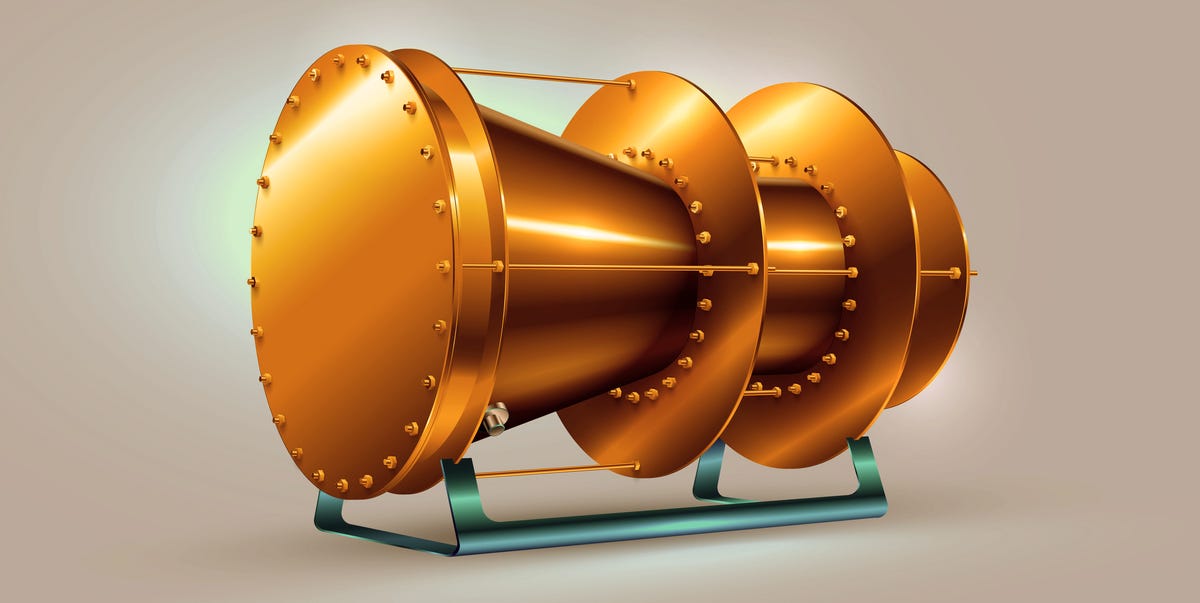
The EmDrive, short for electromagnetic drive, is a proposed propellantless propulsion system. Its basic design is a closed, tapered metal cavity, often described as a cone with the tip cut off. Microwave energy is injected into this cavity, where electromagnetic waves bounce around inside. According to the concept, the shape of the cavity creates an imbalance that results in a tiny net force.
That last sentence is where physicists usually raise one eyebrow high enough to interfere with satellite communications. In conventional propulsion, motion requires momentum exchange. A rocket moves forward because it throws mass backward. An ion engine accelerates charged particles. A solar sail gains momentum from photons arriving from the sun or a laser. In each case, something pushes against something else.
The EmDrive, however, appears to claim thrust from a closed system. Nothing visible leaves the engine. There is no exhaust plume, no propellant tank, no stream of ions, and no tiny space gremlin tossing momentum overboard. That is why critics often call it a “reactionless drive,” even though supporters dispute that label. If it truly produced thrust without interacting with anything external, it would challenge conservation of momentum, one of the most dependable rules in physics.
Why People Wanted the EmDrive to Be Real
The EmDrive became famous because the payoff seemed enormous. Spaceflight is brutally limited by propellant. Rockets must carry fuel to move, and carrying fuel requires more fuel, which then requires more fuel to carry the fuel that carries the fuel. This is the rocket equation, also known as “why space engineers look tired.”
A working EmDrive would have changed that conversation. Satellites could theoretically maintain orbit longer without carrying as much propellant. Deep-space probes might accelerate slowly but continuously using solar or nuclear power. Mission planners could dream about lightweight spacecraft that did not need to haul tons of reaction mass. Even if the thrust were tiny, long-duration operation in space could make small forces matter over months or years.
This is why serious people paid attention. Not because scientists secretly dislike Newton, but because revolutionary claims deserve careful tests. If a strange device produces a repeatable effect, science does not get to ignore it just because it looks weird. It must measure, isolate, repeat, and explain. That is where the EmDrive story moved from science-fiction excitement into the much less glamorous world of torsion balances, vacuum chambers, cable routing, heat drift, and arguments about error bars.
The NASA Eagleworks Moment
The EmDrive received its biggest credibility boost when researchers associated with NASA’s Eagleworks laboratory investigated radio-frequency resonant cavity devices. Earlier NASA-related work reported small force measurements from RF test articles using low-thrust torsion pendulum setups. Later, a peer-reviewed paper in the Journal of Propulsion and Power reported a thrust-to-power ratio of about 1.2 millinewtons per kilowatt for a tapered radio-frequency cavity tested in vacuum.
That number was tiny. A millinewton is not the roar of a Falcon 9; it is more like the universe gently clearing its throat. Still, in propulsion research, tiny forces can be meaningful if they are real, repeatable, scalable, and not caused by the test apparatus itself.
The Eagleworks result made headlines because it passed peer review and reported thrust in a vacuum. To many fans, that sounded like confirmation. To more cautious observers, it sounded like an interesting measurement that still needed independent replication. Peer review does not mean “the laws of physics have been updated.” It means the paper met the journal’s standards for publication. The result still had to survive the next and hardest stage: other teams trying to make the same thing happen under tighter controls.
Why the EmDrive Is So Difficult to Test
Testing tiny thrust is a nightmare in a lab coat. When the claimed force is extremely small, ordinary nuisances become supervillains. Heat can expand metal parts and shift a balance. Power cables can interact with magnetic fields. Vibrations from the building can mimic motion. Electrical currents can tug on wires. Even the orientation of the device can create confusing signals.
This is why a “positive” EmDrive result is not automatically proof of propulsion. A test can measure movement without measuring thrust. The device may be heating unevenly. The support structure may be bending. The power supply may be pulling on the apparatus. A cable may be acting like an invisible hand. In ordinary life, these effects are too small to notice. In micro-newton and nano-newton experiments, they can barge into the room wearing a fake mustache and call themselves a breakthrough.
The scientific challenge was therefore simple to describe but hard to execute: build an experiment sensitive enough to detect tiny forces while also eliminating every boring explanation. If the EmDrive still produced thrust after all those controls, then physics would have a very interesting problem. If not, the story would become a lesson in experimental humility.
The Dresden Tests: A Major Blow
The strongest blow to the EmDrive came from researchers at Technische Universität Dresden, led by Martin Tajmar. The team designed high-sensitivity thrust balances and tested EmDrive-like devices with a focus on eliminating false positives. Their work looked carefully at thermal drift, electromagnetic interactions, power feedthrough effects, and other sources of misleading force readings.
The conclusion was not friendly to EmDrive fans. The Dresden team found no thrust values within the tested frequency bands and modes. Their results limited any anomalous thrust to below the force expected from ordinary radiation pressure for the power involved. In plain English: when the experiment was cleaned up, the extraordinary thrust disappeared.
Earlier intermediate tests had already suggested that signals resembling EmDrive thrust could arise from mundane effects. National Geographic and Space.com reported on tests indicating that apparent thrust might come from electromagnetic interaction, such as power cables coupling with Earth’s magnetic field. Later high-accuracy work strengthened the case that false-positive effects, not new propulsion physics, explained the excitement.
Roger Shawyer’s Defense
Roger Shawyer, the British engineer behind the EmDrive, has defended the invention against failed replication attempts. His argument, broadly summarized, is that some researchers did not test a correct EmDrive configuration. He has said that design details, resonant modes, geometry, and operating conditions matter, and that a flawed device should not be treated as a valid test of the underlying concept.
This defense is not unusual among inventors of controversial technologies. In engineering, small design differences can absolutely matter. A badly tuned antenna does not disprove radio. A leaky pressure vessel does not disprove rockets. A violin made of cheese does not disprove music, though it does raise questions about lunch.
However, the burden of proof remains with the claim. If the EmDrive works only under precise conditions, then those conditions must be described clearly enough for independent laboratories to reproduce the result. That is where the EmDrive has struggled. Extraordinary propulsion claims need more than confidence from the inventor. They need repeatable, independently verified performance with controls strong enough to satisfy skeptics.
Does the EmDrive Violate Physics?
If interpreted as a closed system producing net thrust without external interaction, the EmDrive appears to conflict with conservation of momentum. That is the central problem. Supporters have proposed different explanations, including interactions with the quantum vacuum, unusual electromagnetic behavior, or other theoretical frameworks. Some papers have explored ideas such as quantized inertia or modified field interactions.
But a theory must do more than sound futuristic. It must make precise predictions, survive criticism, and match repeatable measurements. So far, no widely accepted theoretical model has explained the EmDrive in a way that convinces mainstream physics. More importantly, the experimental support has weakened rather than strengthened under improved testing.
Science can revise its laws. It has done so before. Newtonian mechanics gave way to relativity in extreme cases. Classical physics gave way to quantum mechanics at small scales. But those revolutions were not powered by vibes. They were driven by stubborn, repeatable evidence. The EmDrive has not produced that level of evidence.
Was NASA Wrong?
It is tempting to frame the EmDrive saga as “NASA said it worked, then others said it did not.” That is too simple. NASA-related researchers reported small measured forces under specific experimental conditions. They did not deliver a flight-ready engine, launch a propellantless spacecraft, or announce the death of Newton’s laws. NASA also publicly downplayed sensational claims that linked the work to warp drive or near-term miracle propulsion.
The more accurate story is that a small research group measured something unusual, published a result, and invited further scrutiny. Later researchers built better experiments and found that the unusual signal likely came from false positives. That is not scientific failure. That is science functioning as designed. A claim was tested. The test became more refined. The explanation became more ordinary.
In that sense, the EmDrive is less a scandal and more a reminder that measurement is hard. Tiny forces are especially treacherous. The universe often whispers, but sometimes the lab bench creaks.
Current Verdict: Does the EmDrive Really Work?
Based on publicly available evidence, the EmDrive does not currently work as claimed. No independent, high-confidence test has demonstrated anomalous thrust that survives rigorous controls. The strongest later experiments found no effect beyond conventional physics. The inventor’s defense keeps the debate alive rhetorically, but it does not overturn the need for reproducible data.
That does not mean all propellantless propulsion research is foolish. Photon sails, laser sails, magnetic sails, and other concepts can exchange momentum with external fields or emitted radiation. Those ideas obey physics. The problem with the EmDrive is not that it sounds ambitious. The problem is that its central claim seems to require either unknown physics or a measurement mistake. So far, the measurement-mistake explanation is winning by a comfortable margin.
Why the EmDrive Story Still Matters
The EmDrive remains valuable because it teaches several lessons about innovation. First, radical ideas should not be dismissed by laughter alone. They should be tested. Second, positive results are not enough when the signal is tiny and the claim is enormous. Third, independent replication is the difference between a breakthrough and a curiosity. Fourth, skepticism is not the enemy of discovery. It is the quality-control department.
The EmDrive also shows why science communication needs careful language. “NASA tests impossible engine” is clickable. “Small anomalous force observed in a difficult low-thrust measurement setup” is accurate, but it has the marketing energy of a damp sock. The gap between those two sentences is where hype grows.
For readers, the takeaway is simple: be excited, but ask what was actually measured. Was the test done in vacuum? Were cables isolated? Were thermal effects controlled? Was the result replicated by an independent team? Did the device produce thrust in the expected direction when reversed? Did a null device behave differently? These questions are not party poopers. They are how we keep the party from being hosted by nonsense.
Experience-Style Notes: What the EmDrive Teaches Builders, Writers, and Curious Readers
Anyone who has followed strange technology claims for long enough develops a useful instinct: the more revolutionary the claim, the more boring the test should be. That may sound backward. We imagine breakthroughs arriving with lightning, dramatic music, and someone shouting “It works!” across a laboratory. In real life, the decisive moment often looks like a spreadsheet, a calibration routine, and a tired engineer asking whether the cable moved when the chamber warmed up.
The EmDrive is a perfect example. At first glance, it feels like the kind of idea people want to believe. Space travel is difficult, expensive, and slow. A propellantless drive offers an elegant escape from those limits. It is the engineering equivalent of finding a secret elevator in a building where everyone else has been climbing stairs for seventy years. That emotional pull matters. It explains why the story spread so quickly and why each new test attracted attention far beyond the propulsion community.
But the practical experience of evaluating claims like this is less romantic. The first lesson is that tiny measurements deserve suspicion before celebration. In low-thrust experiments, almost everything can become a source of error. Heat is not just heat; it is expansion, bending, shifting mass, and slow drift. A wire is not just a wire; it can carry current, interact with magnetic fields, and pull mechanically on the setup. A vacuum chamber removes air effects, but it does not remove every possible artifact. The test apparatus becomes part of the story.
The second lesson is that inventors and independent testers often see different realities. Inventors know their devices intimately and may believe critics are missing essential design details. Testers, on the other hand, must ask whether the effect survives outside the inventor’s preferred setup. Both perspectives can be useful, but only one standard settles the matter: reproducibility. If a device works, a properly informed outside team should eventually be able to make it work too.
The third lesson is about humility. Failed tests do not necessarily make the people involved foolish. Many serious researchers have explored ideas that did not survive better data. That is not embarrassing; it is the price of checking the edges of knowledge. What matters is whether the community updates its confidence when stronger evidence arrives. In the EmDrive case, confidence should be much lower today than it was during the peak headline years.
For science writers, the EmDrive is also a warning label with blinking lights. A headline can turn a tentative measurement into a public myth. Once readers hear “impossible engine works,” later corrections sound like betrayal rather than refinement. Better coverage explains the uncertainty from the beginning. The right frame is not “genius inventor beats physics” or “skeptics kill dream.” The better story is “a bold claim meets increasingly careful experiments.” That may be less flashy, but it is more honest and more useful.
For hobbyists and curious readers, the EmDrive offers a final practical habit: separate possibility from evidence. Many things are possible in the loose sense that we have not checked every corner of the universe. But technology is not built from possibility alone. It is built from measurements that keep showing up after the easy explanations have been eliminated. Until the EmDrive can do that, it remains a fascinating cautionary tale rather than a working engine.
Conclusion
The EmDrive is not boring. It is bold, strange, controversial, and historically useful. It attracted attention because it promised a way around one of spaceflight’s oldest limits: the need to carry propellant. Early measurements, especially those associated with NASA Eagleworks, made the possibility seem just plausible enough to ignite global curiosity.
But the scientific verdict depends on replication, not excitement. Later high-accuracy tests found no convincing anomalous thrust and identified likely false-positive effects. Roger Shawyer continues to defend the EmDrive, arguing that failed tests did not properly represent his design. Yet without independently repeatable results, that defense remains an argument rather than proof.
So, does the EmDrive really work? Based on the best available evidence, no. Not in the revolutionary, propellantless, physics-rewriting way once imagined. But the story still works beautifully as a lesson in skepticism, measurement, and the importance of letting evidence drive the spacecraft.

