
Makeup
45 Pocket-Sized Masterpieces By This Artist That Paints In Altoid Tins
Aug
Most people open an Altoids tin expecting mints. Artist Remington Robinson opens one and finds room for a mountain range, a glowing city, a stormy coastline, or an entire afternoon compressed into a few square inches. His miniature oil paintings prove that a canvas does not need to dominate a wall to command attention. Sometimes, the most captivating landscape in the room is small enough to disappear into your jacket pocket.
Meet Remington Robinson, the Artist Behind the Tiny Landscapes
Remington Robinson grew up in Chagrin Falls, Ohio, studied painting and drawing at Rocky Mountain College of Art and Design, and now lives in Boulder, Colorado. Alongside larger paintings and murals, he regularly creates miniature plein air paintings inside recycled Altoids tins. His practice combines formal artistic training with the portability of a pocket sketchbook and the improvisational spirit of painting outdoors.
Robinson began experimenting with mint-tin paintings in 2017 after seeing other artists use similar containers. The concept fit naturally with two interests he had already developed: painting on small panels and working directly from landscapes. Instead of hauling a full-size easel, palette, storage box, and several canvases into the field, he could carry nearly everything in his pockets.
The tins are usually recycled rather than emptied by one extremely minty artist. Robinson has explained that many come from donations or bulk purchases of used containers. Only a handful of the tins he has painted were originally his. This is good news for his teeth and even better news for anyone who appreciates imaginative reuse.
How an Altoids Tin Becomes a Portable Art Studio
The Lid Becomes the Easel
Each painting begins with a miniature wooden panel secured inside the lid of the tin. When the container is opened, the lid stands upright like the screen of a very small laptop. The panel becomes the canvas, while the metal base serves as a built-in palette.
Robinson places small amounts of oil paint in the lower half, carries a few fine brushes and a tiny bottle of mineral spirits, and heads toward whatever scene catches his attention. The setup can be used beside a mountain trail, on a city sidewalk, in a garden, at a café, or even inside an airport terminal. It is essentially a pochade box that has been through a shrink ray.
The Painting Is Created on Location
Most of Robinson’s mint-tin works are painted en plein air, a French expression meaning “in the open air.” Rather than relying entirely on a photograph, the artist observes the changing light, colors, atmosphere, and spatial relationships of the actual scene.
This direct approach gives the paintings their freshness, but it also creates a race against time. Shadows move. Clouds reorganize themselves without consulting the painter. Sunlight that was warm and golden at the beginning may turn cool and gray before the final brushstroke. Colorado weather, in particular, has never been famous for respecting creative deadlines.
A typical tiny painting takes Robinson roughly one to three hours. Simpler works may be completed in about 30 minutes, while more complicated scenes can require several hours. The difficulty depends less on the physical size of the panel than on the complexity of the subject, the changing conditions, and the level of precision the artist wants to achieve.
Why These Miniature Altoids Tin Paintings Feel So Large
Scale Forces Every Brushstroke to Work Harder
On a large canvas, an artist has room to describe every roof tile, tree branch, and reflection. A miniature painter must make sharper decisions. One stroke may represent an entire tree. A small patch of pale paint may suggest sunlight on a distant building. A thin horizontal line can turn a blue area into an ocean.
Robinson’s paintings succeed because they do not attempt to squeeze every visible detail into the tin. Instead, they preserve the visual structure of the scene: its dominant shapes, temperature, depth, light, and mood. The viewer’s imagination finishes what the brush merely suggests.
The Original Palette Remains Part of the Artwork
One of the most charming features is the used paint left in the bottom of the tin. Collectors receive not only the finished image but also the colors that helped create it. The lower compartment becomes a miniature archaeological site containing daubs, mixtures, fingerprints, and traces of the artist’s decisions.
This makes each object feel unusually intimate. A conventional framed painting usually hides its production process. Robinson’s tins display the polished result and the colorful evidence of how it happened. It is the artistic equivalent of serving a beautiful cake beside the flour-dusted mixing bowlexcept considerably less likely to attract ants.
The Real Landscape Becomes Part of the Presentation
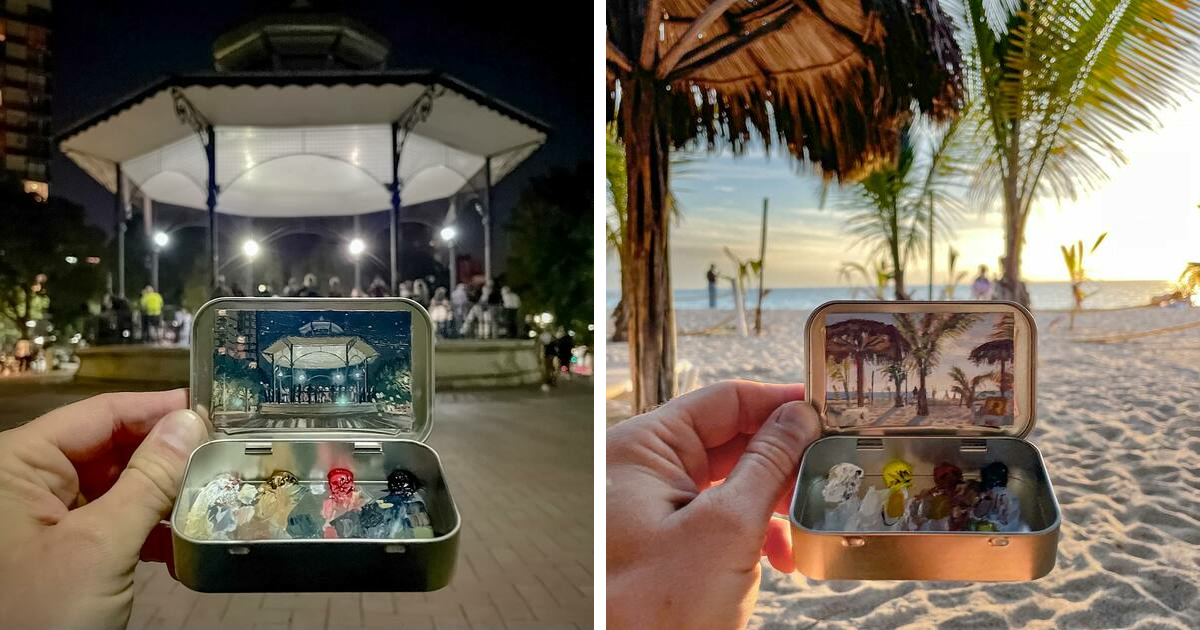
Robinson often photographs an open tin in front of the location depicted in the painting. The tiny image appears to line up with the larger world behind it. A painted mountain meets the real mountain. A miniature horizon continues into the actual sky. The tin becomes both an artwork and a frame through which the environment is reconsidered.
These photographs explain why the series performs so well online. Viewers see the source, the interpretation, the palette, and the artist’s hand in a single image. The comparison is satisfying without becoming a simple test of photographic accuracy. The pleasure comes from seeing how much atmosphere can survive the journey from an enormous landscape to a panel measuring only a few inches.
45 Details to Notice Across These Pocket-Sized Masterpieces
The 45-work collection ranges across landscapes, architecture, plants, water, weather, and ordinary objects. Rather than treating the paintings as tiny photographs, look for the choices that make each scene convincing.
- Mountain silhouettes: Distant peaks are reduced to clean shapes without losing their scale.
- Snow in shadow: Cool blues and violets keep winter scenes from becoming flat white rectangles.
- Sunlit ridges: Thin highlights make rocky edges appear to catch the final light of the day.
- Atmospheric distance: Softer contrast pushes remote hills behind sharper foreground forms.
- Oversized skies: Large areas of changing color make a tiny panel feel surprisingly open.
- Cloud volume: Small shifts between light and shadow turn paint marks into rolling formations.
- Stormy weather: Gray-green skies create drama without requiring a single lightning bolt.
- Golden-hour warmth: Orange light transforms ordinary streets and buildings into cinematic scenes.
- Blue-hour quiet: Cool twilight colors make illuminated windows and streetlights appear brighter.
- Nighttime reflections: Broken vertical strokes suggest neon signs trembling across wet pavement or water.
- Ocean horizons: A carefully placed line separates two blue expanses and creates instant depth.
- Moving waves: Curved highlights imply motion even when the brushstrokes are barely larger than crumbs.
- Turquoise water: Layered greens and blues capture the transparency of coves, pools, and alpine lakes.
- River reflections: Mirrored colors connect architecture, trees, and sky without copying them perfectly.
- Waterfalls: Bright descending marks create energy inside an otherwise still metal container.
- Pine trees: Dark triangular masses become forests without requiring hundreds of individual needles.
- Autumn foliage: Clusters of red, orange, and yellow turn miniature trees into glowing focal points.
- Spring blossoms: Tiny pink and white dabs create branches heavy with flowers.
- Garden paths: Curving walkways guide the eye through scenes that are only inches wide.
- Wildflower fields: Scattered dots of color suggest abundance rather than botanical diagrams.
- Poppies near the Flatirons: Strong red accents stand boldly against Colorado’s cooler mountain colors.
- Single flowers: A bloom can fill the composition and feel monumental despite its miniature format.
- Backlit leaves: Bright edges show sunlight passing through thin plant material.
- Tree shadows: Long directional marks reveal the position and strength of the sun.
- Urban perspective: Converging streets make crowded city scenes feel deeper than the tin itself.
- Architectural landmarks: Famous structures remain recognizable through proportion rather than excessive detail.
- Bridges: Simple horizontal and arched forms connect sections of the composition while emphasizing distance.
- City traffic: A handful of colored marks can become cars, headlights, and a busy avenue.
- Human figures: Small vertical strokes suggest people without turning them into stiff matchsticks.
- Outdoor cafés: Tables, awnings, and warm color create a sense of social life beyond the panel.
- Airport views: Aircraft and runways show that plein air painting does not require wilderness.
- Boats on water: Dark hulls and bright sails establish scale against broad reflective surfaces.
- Coastal buildings: Pale walls become luminous when surrounded by deep sea and sky colors.
- Desert rock: Warm layers of rust, pink, and ocher communicate heat and geological age.
- Road-trip scenes: Highways and distant terrain turn a quick stop into a compact travel diary.
- Snowy streets: Reflected light gives winter neighborhoods a softer, quieter atmosphere.
- Cabins and houses: Familiar structures add warmth and narrative to otherwise expansive landscapes.
- Coffee cups: Everyday objects become worthy subjects when light, color, and composition are carefully observed.
- Food studies: Small meals and desserts demonstrate that the format works beyond traditional scenery.
- Limited palettes: Restricting the number of colors often produces stronger harmony.
- Bold foregrounds: Large nearby shapes create the illusion that the landscape continues beyond the tin.
- Soft edges: Blurred transitions imitate haze, glare, motion, and distance.
- Hard edges: Crisp marks pull important objects forward and establish a visual hierarchy.
- Unpainted evidence: The surrounding metal reminds viewers how astonishingly small the image really is.
- The final comparison: Holding each tin against its subject reveals interpretation rather than mechanical copying.
A Modern Twist on the Plein Air Tradition
Outdoor painting became increasingly practical during the 19th century as portable easels and commercially available paint tubes allowed artists to leave the studio more easily. Painters could respond directly to temporary effects of weather and light instead of reconstructing every scene from sketches and memory.
Robinson’s Altoids-tin setup continues that tradition with an aggressively compact update. The container functions like a tiny pochade box, combining a panel holder, palette, wet-paint carrier, and protective case. The essential goal remains familiar: observe the world closely and record a particular moment before it changes.
The small scale also suits contemporary viewing habits. A dramatic landscape painted on a large canvas may lose some of its force when reduced to a phone screen. Robinson’s paintings were designed at approximately the scale at which many people encounter them online. Close-up photographs enlarge the brushwork, while wider shots reveal the delightful mismatch between the subject’s vastness and the artwork’s size.
What Artists Can Learn From Remington Robinson’s Process
Portability Removes Excuses
A complicated setup can quietly discourage creativity. By the time an artist has packed an easel, tripod, paint box, folding chair, umbrella, water, solvents, panels, and enough snacks to survive a modest expedition, staying home may seem like an excellent artistic decision.
A miniature kit lowers that barrier. The artist can paint during a lunch break, while traveling, or whenever interesting light appears. Robinson has said that the format made plein air painting more accessible and helped him become more prolific. The lesson applies beyond painting: creative tools are most useful when they are easy to reach.
Constraints Can Strengthen Composition
A tiny panel leaves little room for indecision. The artist must identify the central idea of the scene immediately. Is the painting about the glowing cloud, the red flower, the distant tower, or the reflection on the water? Everything that does not support that idea can be simplified.
This discipline is useful for artists working at any scale. A limited surface, short time window, or reduced palette can interrupt overthinking and encourage stronger choices. Freedom is wonderful, but sometimes it wanders around the studio for three hours wondering which brush to use.
Ordinary Places Deserve Attention
Robinson paints recognizable landmarks, but he also depicts sidewalks, plants, neighborhood views, meals, pools, and quiet corners. The recurring message is that beauty is not restricted to famous destinations. It may appear in a shadow crossing a wall, a flower leaning toward the sun, or headlights beginning to glow at dusk.
Painting such moments requires observation rather than spectacle. The tin does not merely preserve a location; it records the decision to stop and notice it.
Experiencing the Altoids Tin Painting Process for Yourself
Trying a mint-tin painting project offers a new appreciation for Robinson’s work. The first surprise is how quickly the available space disappears. After placing a horizon, a tree, and one enthusiastic cloud, the panel may already feel crowded. Details that seem essential in the landscape suddenly become negotiable. The mailbox can go. The seventh window can definitely go. That complicated fence has received an unexpected pardon from existence.
The experience begins before paint touches the panel. Choosing a subject becomes an exercise in editing. Wide panoramic scenes may look impressive in person but collapse into visual confusion at miniature scale. Stronger options often contain one clear silhouette, a distinct light pattern, or a simple division between foreground, middle distance, and sky.
A recycled mint tin should be cleaned thoroughly, and a small primed panel can be secured inside the lid. The bottom compartment can hold a restrained selection of colors. Using fewer paints makes the kit easier to carry and reduces the temptation to mix every color ever discovered by humanity.
Once outdoors, the changing light becomes immediately obvious. A cloud shadow may move across a hill before its color has been mixed. A bright building may become dull when the sun disappears. The painter must decide whether to follow current conditions or remain faithful to the original impression. This is one reason plein air works often feel energetic: they contain evidence of real-time decisions.
Working small also changes how the hands behave. Brushes must be loaded carefully, but timid strokes can make the image fussy. The most effective marks are often confident and economical. A single angled stroke may describe a roof. Two pale dots can become distant people. A dark line followed by a bright accent may produce an entire row of parked cars.
Unexpected interruptions are part of the experience. Wind may shake the lid. Dust may land in the paint. A curious stranger may ask what you are doing precisely when you are attempting to place the world’s smallest tree trunk. Outdoor painting rewards patience, but it also encourages flexibility and a sense of humor.
The most satisfying moment arrives when the finished tin is held against the original scene. The painting will not contain everything. It may not even match every color exactly. Yet a successful miniature preserves something more valuable than exhaustive detail: the identity of the moment. The temperature of the light, the weight of the clouds, or the calm of the location remains recognizable.
Closing the lid adds another emotional layer. An open tin contains a landscape; a closed tin looks like an ordinary object. The artwork becomes private, portable, and slightly secretive. Reopening it feels like returning to the place where it was painted. In that sense, a miniature plein air painting works as both art and memory storagean analog travel file with no password, no battery, and a faint possibility that it still smells like peppermint.
Even an imperfect attempt can change the way a person looks at Robinson’s 45 pocket-sized masterpieces. Their realism is impressive, but the deeper achievement is selection. Each painting demonstrates how to remove information without removing experience. That is a difficult skill at any size, and the Altoids tin offers nowhere for weak decisions to hide.
Why These Tiny Masterpieces Matter
Remington Robinson’s Altoids tin paintings are memorable because the concept is clever, but they endure because the paintings are genuinely accomplished. The recycled container attracts attention; the observation, composition, color, and brushwork reward it.
The series also challenges the assumption that important art must be physically imposing. A work can be small without being slight. These miniature oil paintings contain weather, geography, travel, humor, concentration, and evidence of the artist’s hand. They invite viewers to lean closer rather than step back.
Across 45 pocket-sized masterpieces, mountains rise, gardens bloom, streets glow, and oceans stretch toward horizons that technically end at a metal hinge. The format should feel restrictive. In Robinson’s hands, it feels like a doorway.

