
Body Care
Which of the Seven Deadly Sins Are You? (Personality Quiz)
Aug
Everyone has a less-than-saintly side. Maybe you secretly enjoy winning arguments, guard your snacks like a dragon protects treasure, or postpone folding laundry until the pile develops its own political system. The interesting question is not whether you have flaws. It is which temptation most often grabs the steering wheel.
This seven deadly sins personality quiz explores seven recognizable patterns: pride, greed, lust, envy, gluttony, wrath, and sloth. It is designed for entertainment and honest self-reflectionnot for assigning you a permanent label or reserving you a suspiciously warm seat in the afterlife.
What Are the Seven Deadly Sins?
The seven deadly sins are a traditional classification of human vices in Christian moral teaching. The familiar list did not appear in its final form all at once. Early Christian monk Evagrius Ponticus described eight troubling thoughts, and later thinkers reorganized the ideas. Pope Gregory I helped establish the seven-part list commonly recognized today.
Despite the dramatic name, these sins can also be understood as exaggerated versions of ordinary drives. Confidence may swell into pride. Ambition can harden into greed. Attraction can become obsession. Rest may slide into avoidance. Even a perfectly innocent plate of nachos can become gluttony when “one more” turns into “who ate the entire tray?”
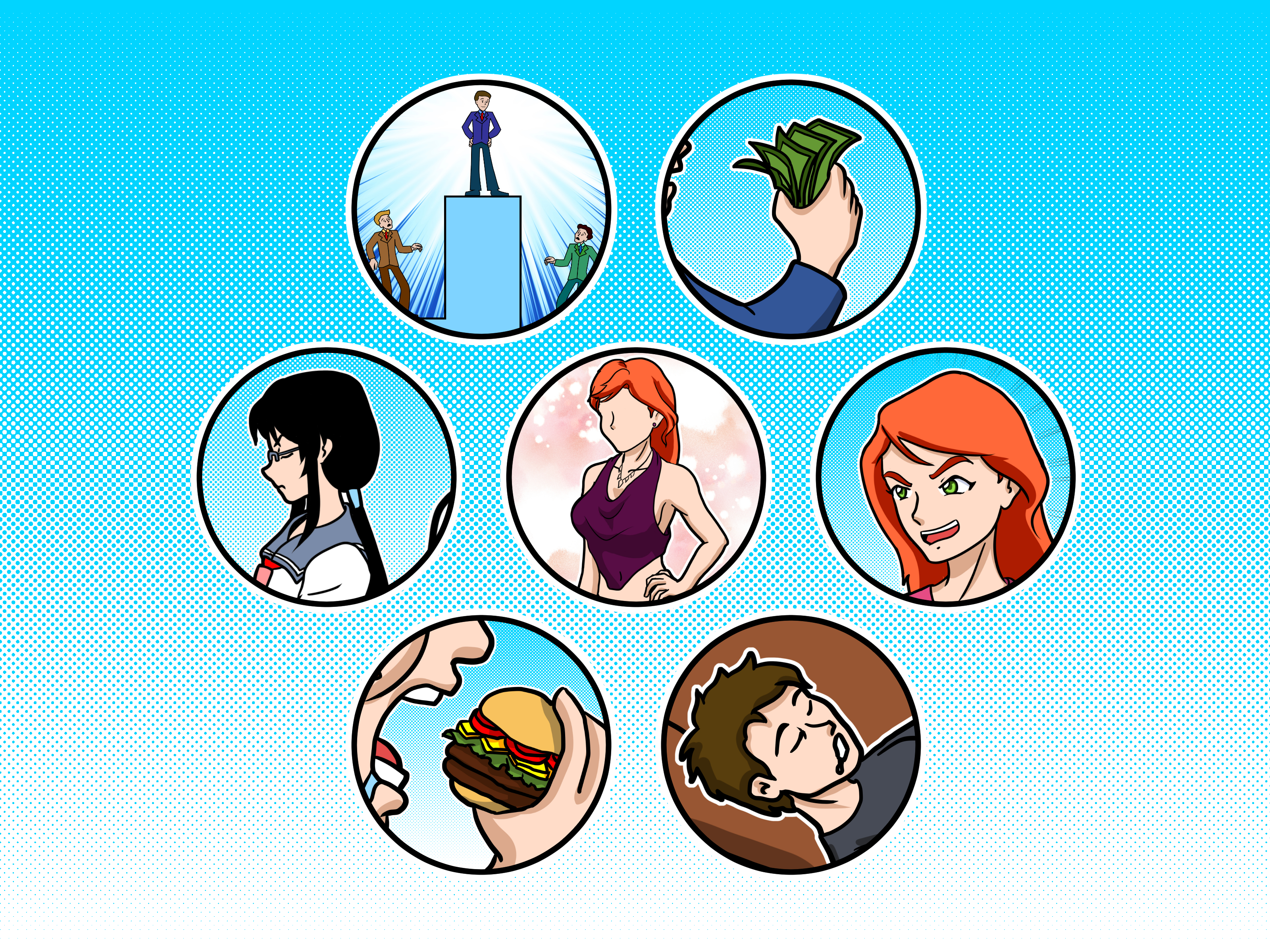
The Seven Categories in This Quiz
- Pride: An excessive need to feel important, superior, admired, or unquestionably correct.
- Greed: A powerful desire to acquire or protect money, possessions, influence, or status.
- Lust: An intense pursuit of attraction, excitement, fantasy, or physical gratification.
- Envy: Discomfort with another person’s advantages, recognition, possessions, or success.
- Gluttony: Overconsumption of food, entertainment, shopping, attention, or other pleasures.
- Wrath: Anger that becomes aggressive, vengeful, explosive, or difficult to release.
- Sloth: Avoidance of effort, responsibility, discomfort, growth, or meaningful action.
Take the Seven Deadly Sins Personality Quiz
Rate each statement from 1 to 5 according to how accurately it describes your usual behavior. Answer based on what you actually do, especially when stressednot what the heroic version of you plans to do next Monday.
Rating scale: 1 = Never, 2 = Rarely, 3 = Sometimes, 4 = Often, 5 = Very often.
Seven Deadly Sins Quiz Results Explained
Pride: The Crowned Competitor
If pride is your strongest result, you want your ability, intelligence, taste, or accomplishments to be recognized. You may naturally take charge and hold yourself to demanding standards. The trouble begins when confidence turns into superiority or when protecting your image becomes more important than learning.
Your hidden strength: Leadership, ambition, confidence, and high expectations.
Your growth challenge: Practice saying, “I was wrong,” without adding a 20-minute documentary explaining why you were technically almost right.
Greed: The Strategic Collector
A greed result does not necessarily mean you sleep on a mountain of gold coins. Your preferred currency might be money, professional influence, property, social connections, information, or control. You feel safer when resources accumulate, but “enough” can become a finish line that moves every time you approach it.
Your hidden strength: Planning, resourcefulness, persistence, and financial awareness.
Your growth challenge: Define what enough means before your ambitions define it for you.
Lust: The Passionate Adventurer
If lust leads your scores, you are responsive to chemistry, beauty, fantasy, novelty, and emotional intensity. You may bring enthusiasm into relationships and refuse to live like a beige office carpet. However, excitement can become a substitute for intimacy, commitment, or good judgment.
Your hidden strength: Passion, charisma, spontaneity, and emotional vitality.
Your growth challenge: Ask whether you genuinely value the person or experienceor simply enjoy the rush it produces.
Envy: The Reluctant Comparer
An envy result suggests that social comparison has a strong influence on your mood. You notice who is succeeding, who is admired, and who appears to have received the deluxe life package while yours arrived with missing instructions.
Psychological research distinguishes between forms of envy that motivate self-improvement and forms that encourage hostility or a desire to pull others down. In other words, envy can become information or poison depending on what you do next.
Your hidden strength: Awareness, competitiveness, sensitivity to opportunity, and motivation.
Your growth challenge: Convert “Why do they have that?” into “What does their success reveal about what I want?”
Gluttony: The More-Is-More Enthusiast
Gluttony is not limited to food. You may overconsume television, online content, shopping, work, praise, alcohol, games, or even self-improvement advice. Your brain has difficulty accepting that a satisfying experience can end without immediately receiving a sequel.
Your hidden strength: Enthusiasm, curiosity, appreciation, and the ability to enjoy life.
Your growth challenge: Pause while pleasure is still pleasurable. The goal is enjoyment, not defeating the buffet in single combat.
Wrath: The Human Thunderstorm
If wrath is your top sin, injustice, disrespect, incompetence, or blocked goals may activate you quickly. Anger itself is a normal emotion, but it becomes destructive when it controls your speech, decisions, relationships, or blood pressure. Mayo Clinic guidance recommends calming down before responding, communicating assertively rather than aggressively, and using physical activity to reduce stress.
Your hidden strength: Courage, directness, protectiveness, and a powerful sense of justice.
Your growth challenge: Create a delay between feeling anger and delivering it to another human being with express shipping.
Sloth: The Comfortable Avoider
A sloth result may involve procrastination, low motivation, fear of failure, decision fatigue, or resistance to uncomfortable effort. It is not always about being physically lazy. A person can remain extremely busy while avoiding the one task that actually matters.
Your hidden strength: Calmness, patience, energy conservation, and resistance to unnecessary urgency.
Your growth challenge: Shrink important tasks until beginning feels almost embarrassingly easy.
What Your Result Really Means
Your result identifies the pattern that received the highest score today. It does not reveal your permanent essence. Personality research generally treats major traits as dimensions rather than rigid boxes. The widely used Big Five model, for example, describes openness, conscientiousness, extraversion, agreeableness, and neuroticism as broad continuums on which people vary.
Your behavior also changes across situations. You might show pride at work, gluttony on vacation, envy while using social media, and sloth whenever the bathroom needs cleaning. Human beings are wonderfully complicated and annoyingly resistant to neat labels.
Why You May Get a Different Result Later
Self-report quizzes depend on memory, honesty, interpretation, and current mood. People may answer according to their ideal self, underestimate habits they dislike, or judge themselves using standards different from those used by other people. Researchers have repeatedly documented both the usefulness and limitations of self-reported personality information.
That does not make a personality quiz worthless. It simply means the result should begin a conversation rather than end one. Popular quizzes can encourage reflection, but they are not equivalent to validated clinical assessments and should not be used to diagnose mental health conditions.
How to Use Your Seven Deadly Sins Result
Identify the Trigger
Notice when your dominant pattern appears. Wrath may arrive when you feel ignored. Envy may grow after an hour of viewing carefully edited social media lives. Gluttony may emerge when you are bored, while sloth may appear when a task feels confusing rather than difficult.
Find the Legitimate Need Beneath It
Every temptation may be trying to satisfy a real need. Pride may seek respect. Greed may seek security. Lust may seek connection. Envy may seek direction. Gluttony may seek comfort. Wrath may seek justice. Sloth may seek rest or protection from failure.
Choose a Healthier Expression
Instead of trying to erase the underlying drive, redirect it. Turn pride into mastery, greed into responsible planning, lust into genuine intimacy, envy into goal-setting, gluttony into mindful enjoyment, wrath into assertive action, and sloth into deliberate recovery followed by one manageable step.
Skip the Self-Condemnation
Harsh self-criticism can make honest reflection more difficult. Self-compassion involves acknowledging mistakes or limitations without treating yourself as a hopeless case. Research summarized by Harvard Health connects self-compassion with psychological and physical well-being.
A Seven-Day Sin Diary: An Illustrative Personal Experience
The following first-person account is an illustrative reflection showing how someone might use the quiz in everyday life.
When I first took the quiz, I expected sloth to win. My laundry chair had recently expanded into a laundry district, and I had postponed one email so long that replying felt like reopening an archaeological site. Instead, envy finished first, with pride only one point behind.
My immediate reaction was to question the scoring system, which was an impressively efficient demonstration of pride.
I decided to keep a seven-day diary. The goal was not to catch myself being terrible. I simply recorded moments when one of the seven patterns appeared, along with the situation that triggered it.
On Monday, a colleague announced a successful project. I congratulated her sincerely, but a small voice immediately asked why my own work was not receiving similar attention. That was envynot dramatic, green-faced villainy, but the uncomfortable sense that someone else’s win had changed my position. When I examined it, I realized her achievement represented something I wanted: greater creative control. The envy became useful once I stopped pretending it was not there.
Tuesday belonged to wrath. A customer-service problem consumed nearly an hour, and I began composing a message with the emotional temperature of molten steel. I waited ten minutes before sending it. The revised version solved the problem without forcing an innocent support employee to reconsider every life choice that had led to their desk.
On Wednesday, gluttony appeared through scrolling rather than food. I opened my phone to check one message and resurfaced 45 minutes later knowing far too much about a stranger’s kitchen renovation. The experience was not even enjoyable after the first few minutes. I had continued because stopping required a conscious decision.
Thursday exposed greed in a quieter form. I hesitated to share a useful professional contact because I feared losing an advantage. No money was involved; I was hoarding access. Sharing the contact felt risky for approximately three minutes and completely reasonable afterward.
Friday produced lust as novelty-seeking. I abandoned a nearly finished project because a shiny new idea felt more exciting. The temptation was not romantic, but the pattern was similar: intensity looked more attractive than commitment. I wrote the new idea down and returned to the existing project before it joined my museum of unfinished brilliance.
Saturday was pride’s main event. During a disagreement, I noticed that I had stopped trying to understand the other person. I was collecting evidence for my own victory. Asking one sincere question changed the conversation. It also revealed that I had misunderstood part of the issue, an outcome my ego received with all the grace of a cat being placed in a bathtub.
Sunday finally brought sloth. I wanted to postpone planning the upcoming week because the task felt tedious. Instead of promising myself a complete productivity transformation, I set a five-minute timer. Starting was unpleasant; continuing was easy.
By the end of the experiment, I no longer thought of myself as one sin. The quiz had identified a recurring tendency, but the diary showed an entire committee. Different members took control under different conditions. More importantly, each pattern carried information. Envy pointed toward neglected goals. Wrath revealed boundaries. Sloth exposed tasks that needed to be simplified. Pride showed where my identity felt threatened.
The experience did not turn me into a flawless person. I still procrastinated, compared myself with others, and occasionally ate snacks with the commitment of a competitive athlete. What changed was the speed with which I noticed the pattern. Recognition created a tiny space between impulse and actionand that tiny space was often enough to choose something better.
Final Thoughts: Which Deadly Sin Are You?
Your dominant sin is not a verdict. It is a playful name for a habit that may become exaggerated when you feel stressed, insecure, bored, threatened, or tempted. Pride can become healthy confidence. Greed can become careful stewardship. Lust can mature into passion and intimacy. Envy can clarify ambition. Gluttony can soften into appreciation. Wrath can defend important values. Sloth can remind you that genuine rest matters.
The most useful result is not the one that flatters you. It is the one that makes you laugh, wince, and quietly admit, “Fine, that does sound like me.” Take the insight, leave the shame, and try one small experiment the next time your favorite vice reaches for the controls.
document.addEventListener(“DOMContentLoaded”, function () {
const button = document.getElementById(“calculate-result”);
const output = document.getElementById(“quiz-result”);
const resultDescriptions = {
pride: {
title: “Pride The Crowned Competitor”,
text: “Recognition, competence, and respect matter deeply to you. Your confidence can inspire others, but growth begins when curiosity becomes more important than protecting your image.”
},
greed: {
title: “Greed The Strategic Collector”,
text: “You value security, resources, influence, and control. Your planning ability is powerful, but remember to define what “enough” means before accumulation becomes the goal.”
},
lust: {
title: “Lust The Passionate Adventurer”,
text: “You are drawn to attraction, novelty, fantasy, and intensity. Your passion brings energy to life, provided excitement does not replace judgment, intimacy, or commitment.”
},
envy: {
title: “Envy The Reluctant Comparer”,
text: “You quickly notice what other people possess or achieve. Comparison can drain your joy, but it can also reveal goals and desires that deserve your attention.”
},
gluttony: {
title: “Gluttony The More-Is-More Enthusiast”,
text: “You love enjoyable experiences and may have difficulty stopping once pleasure begins. Your challenge is learning that satisfaction often depends on limits.”
},
wrath: {
title: “Wrath The Human Thunderstorm”,
text: “You react strongly to disrespect, frustration, or unfairness. Your courage and sense of justice are valuable, but your message becomes stronger when anger is directed rather than detonated.”
},
sloth: {
title: “Sloth The Comfortable Avoider”,
text: “You may postpone effort, difficult decisions, or uncomfortable responsibilities. Your calm nature is useful, but meaningful progress usually begins with one deliberately small action.”
}
};
button.addEventListener(“click”, function () {
const answers = document.querySelectorAll(“#deadly-sins-quiz select”);
const scores = {
pride: 0,
greed: 0,
lust: 0,
envy: 0,
gluttony: 0,
wrath: 0,
sloth: 0
};
let completed = true;
answers.forEach(function (answer) {
if (!answer.value) {
completed = false;
} else {
scores[answer.dataset.sin] += Number(answer.value);
}
});
if (!completed) {
output.innerHTML = “
Please answer every question before revealing your result.
“;
return;
}
const highestScore = Math.max(…Object.values(scores));
const winners = Object.keys(scores).filter(function (sin) {
return scores[sin] === highestScore;
});
if (winners.length === 1) {
const result = resultDescriptions[winners[0]];
output.innerHTML =
“
Your Result: ” + result.title + “
” +
“
” + result.text + “
” +
“
Your score: ” + highestScore + ” out of 10.
“;
} else {
const titles = winners.map(function (sin) {
return resultDescriptions[sin].title;
});
output.innerHTML =
“
Your Result Is a Tie
” +
“
Your strongest patterns are ” + titles.join(“ and “) + “.
” +
“
This suggests that your behavior changes significantly with the situation. Read both result descriptions and consider which pattern creates more trouble in your daily life.
“;
}
output.scrollIntoView({
behavior: “smooth”,
block: “center”
});
});
});

