
Body Care
The Best Kitchen Timers for Holidays, Baking, and Everyday
Jun
A kitchen timer may be small enough to hide behind a flour canister, but it has the power to prevent a burned pie crust, a forgotten pot of pasta, and that awkward moment when someone asks, “Wasn’t the turkey supposed to come out an hour ago?” A dependable timer is one of the least glamorous tools in the kitchenand one of the most useful.
Whether you are baking cookies on a Tuesday night, managing a Thanksgiving feast, proofing sourdough, or simply trying not to turn tea into a bitter science experiment, the best kitchen timers make cooking calmer, more accurate, and far less dependent on memory. Your brain already has enough tabs open. Let the timer handle one of them.
Why a Dedicated Kitchen Timer Still Matters
Yes, your oven has a timer. Your microwave has a timer. Your phone has enough timers to schedule a lunar landing. Still, a dedicated kitchen timer earns its drawer space because it is built for one job: keeping track of time while you cook.
A phone can disappear under a recipe video, run out of battery, become slippery with olive oil, or distract you with a message that somehow leads to twenty minutes of scrolling. An oven timer can be useful, but it is not always portable, easy to hear from another room, or capable of managing several dishes at once.
A good digital kitchen timer gives you a visible countdown, an alarm you can actually hear, and controls that work even when your fingers are dusty with flour. During holiday cooking, that kind of simplicity feels less like a gadget and more like a tiny sous-chef who never asks to sample the stuffing.
The Best Kitchen Timers for Different Cooking Styles
The best kitchen timer is not necessarily the one with the longest feature list. It is the one that fits the way you cook. Some people need one loud countdown for cookies. Others need four timers running at once because they have decided that Thanksgiving is the right day to become a restaurant line cook.
Best Overall for Easy Visibility: ThermoWorks Extra Big & Loud Timer
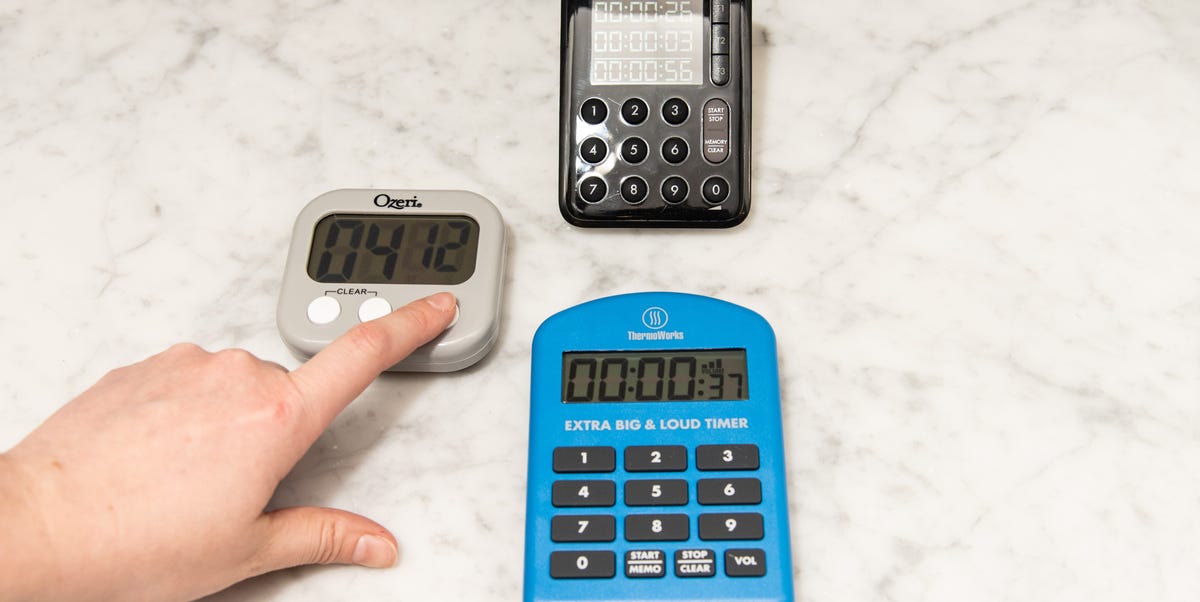
For cooks who want a timer that is difficult to ignore, the ThermoWorks Extra Big & Loud Timer is a standout choice. Its oversized screen, generously sized buttons, magnetic back, and countertop stand make it especially useful in busy kitchens. The adjustable alarm is a major advantage when your kitchen is filled with conversation, sizzling pans, running water, and a playlist that has somehow reached its third holiday song remix.
This style of timer is ideal for baking, roasting, boiling eggs, steeping tea, and any task where you need clear information at a glance. It is also a smart pick for cooks who prefer physical buttons over tiny touch controls.
Best for Holiday Multitasking: OXO Good Grips Triple Kitchen Timer
Holiday meals rarely involve one timer. More often, they involve a roast in the oven, vegetables on the stovetop, rolls warming near the finish line, and a dessert that politely refuses to wait its turn. The OXO Good Grips Triple Kitchen Timer is designed for this kind of controlled chaos.
It can run three separate timers at once, with each timer offering its own alert. That means you can set one for mashed potatoes, one for a pie, and one for the moment you need to rotate the casserole. Its angled display sits comfortably on a countertop, and the backlit screen helps in kitchens where the lighting is more “cozy dinner party” than “operating room.”
This is a strong choice for home cooks who regularly prepare several dishes at once but do not want three separate timers scattered around the kitchen like tiny electronic breadcrumbs.
Best Compact Kitchen Timer: CDN TM8 Digital Timer
The CDN TM8 is a practical option for cooks who want a compact, no-fuss timer that can travel around the kitchen. It is known for an easy-to-read display, count-up and count-down functions, a magnetic back, and a kickstand for countertop use. Its small footprint makes it especially handy for apartment kitchens, crowded counters, and bakers who already have a mixing bowl, cooling rack, scale, cookbook, and suspicious amount of butter competing for space.
A compact kitchen timer is also useful for meal prep, coffee brewing, hard-boiled eggs, quick pasta dinners, and batch baking. If you like to repeat favorite recipes, a memory feature can save a little time and remove one more step from your routine.
Best for Serious Holiday Cooking: ThermoWorks TimeStack
When one timer is not enough and three still feels optimistic, a multi-channel model such as the ThermoWorks TimeStack becomes appealing. It can manage four separate countdowns, making it well suited to large holiday meals, ambitious baking days, barbecue sessions, or anyone preparing dinner while also trying to finish dessert before guests arrive.
Its biggest advantage is organization. Rather than hearing one mysterious beep and wondering whether it belongs to potatoes, pie, or the sauce you forgot was simmering, you can assign separate timer channels to each job. Some advanced versions even allow labels or voice reminders, which can be surprisingly helpful when the kitchen starts feeling like an airport control tower.
This kind of timer is more than most people need for a quick weeknight dinner. For big gatherings, though, it can be the difference between serving a coordinated meal and presenting “a selection of dishes that were ready at different emotional moments.”
Best Analog Option: Time Timer MOD Home Edition
Not everyone wants another digital screen in the kitchen. An analog visual timer, such as the Time Timer MOD Home Edition, offers a calmer approach. Instead of reading small numbers, you can see a colored section slowly disappear as the countdown progresses.
This is especially useful for people who think visually, for families cooking with children, or for anyone who wants a screen-free kitchen routine. A visual timer works beautifully for short tasks such as resting dough, cooling cookies, steeping tea, simmering rice, or keeping track of a quick cleaning sprint while dinner cooks.
Analog timers are not always the best choice for precise multi-step baking, but they bring a satisfying simplicity. Twist the dial, watch time pass, and enjoy the gentle reminder that not every kitchen tool needs Bluetooth.
What to Look for in the Best Kitchen Timer
A Display You Can Read Without Leaning In
A timer should be readable from across the kitchen. Large digits are especially helpful during holiday cooking, when countertops are crowded and you may be carrying a hot pan rather than standing directly in front of the display. A backlit screen is useful in dim kitchens, though a high-contrast display can also work well.
Loud, Adjustable Alerts
A timer that quietly chirps once and gives up is not much help when the dishwasher is running or your family is debating whether marshmallows belong on sweet potatoes. Look for a loud alarm, ideally with adjustable volume. Different alert sounds are even better for a multi-channel kitchen timer because they help you identify what needs attention without staring at the screen.
Multiple Timers for Multiple Tasks
A single countdown timer works for simple cooking. A triple or four-channel timer is better for baking days, dinner parties, and holiday menus. Multi-timer models are also helpful for meal prep: you can track roasted vegetables, rice, eggs, and a cooling period without relying on sticky notes or pure optimism.
Count-Up and Count-Down Functions
Countdown mode is the obvious feature, but count-up mode is equally useful. It lets you measure how long bread dough has been proofing, how long a roast has rested, how long water takes to boil on your stove, or how long your toddler has been “helping” with cookie dough.
Magnet, Stand, Clip, or Lanyard
Think about where your timer will live. A magnetic kitchen timer is great for refrigerators and range hoods. A sturdy stand works for countertops. A clip or lanyard is useful for cooks who bounce between the kitchen, grill, laundry room, and backyard. The best timer is the one that stays visible instead of vanishing into a drawer with the mystery takeout menus.
Easy-to-Press Buttons
Buttons should be large enough to use without accidental settings changes. This matters more than it sounds. Tiny buttons may look sleek in product photos, but they become less charming when you are trying to set 12 minutes with one hand while holding a butter-smeared spatula in the other.
How to Use Kitchen Timers for Holiday Cooking
Holiday meals become easier when you treat time as part of your plan rather than an emergency announcement. Start by writing down your serving time, then work backward. Include cooking time, resting time, reheating time, oven temperature changes, and the inevitable ten-minute delay caused by someone asking where the serving spoons are.
Use One Timer for the Main Dish
Set a timer for your roast, turkey, ham, or other centerpiece, but remember that time is only one clue. Large cuts of meat should also be checked with a reliable food thermometer. A timer tells you when to start paying attention; a thermometer helps confirm when the food is actually ready.
Set Midpoint Reminders
Do not only set a timer for the end of cooking. Set another one for halfway through baking, basting, rotating pans, stirring sauces, or checking a casserole. A midpoint timer is one of the easiest ways to avoid uneven cookies, scorched nuts, or a roasting pan that needed attention twenty minutes ago.
Build in Resting and Cooling Time
Many cooks remember the oven timer but forget the rest period. Use a countdown timer for resting meat, cooling cakes, setting custards, chilling cookie dough, and allowing bread to cool before slicing. These quiet stages often affect the final texture just as much as the active cooking time.
Why Bakers Need More Than One Timer
Baking rewards patience, precision, and an ability to avoid opening the oven every thirty seconds “just to check.” A baking timer helps with obvious tasks, such as cookie and cake bake times, but it is also valuable for mixing, chilling, proofing, cooling, and decorating.
For example, a recipe may call for butter and sugar to be creamed for several minutes. That can feel like forever when you are holding a mixer, but a timer helps you follow the technique instead of stopping early because the bowl looks vaguely fluffy. The same applies to kneading dough, blooming yeast, resting pie dough, or letting ganache cool to the right consistency.
Still, the timer should not become your only source of truth. Ovens vary, pan materials affect baking speed, and humidity can change how dough behaves. Set your baking timer a few minutes early, then use visual cues. Cookies should look appropriately set at the edges. Cakes should respond to the doneness test recommended by the recipe. Bread dough should look and feel properly proofed rather than merely having completed its scheduled appointment with the clock.
Kitchen Timer Experiences: Small Beeps, Big Saves
One of the first lessons many home cooks learn is that the kitchen timer does not make you less skilled. It makes you more available. You can stir a sauce, answer the door, set the table, help with homework, or take a breath without constantly trying to remember whether the potatoes have been simmering for eight minutes or eighteen. Memory is a wonderful thing, but it has a poor track record around browned butter.
Holiday cooking is where this becomes especially obvious. Imagine Thanksgiving morning: the oven is warming, pie dough is chilling, a casserole is waiting for its second bake, and someone has asked whether the rolls can go in “whenever.” That is not a moment for heroic mental math. It is a moment for multiple timers, a written plan, and the confidence that you do not have to keep every minute inside your head.
Multi-channel timers can feel almost silly on an ordinary weekday, but they become useful surprisingly fast. One channel can track pasta. Another can remind you to add vegetables to a sheet pan. A third can mark the time to check chicken, tofu, or fish. Suddenly, dinner has a rhythm. You are not rushing back and forth because you are nervous; you are moving through the kitchen because you have a system.
Bakers often develop a special relationship with timers because baking contains so many invisible stages. Cookie dough needs chilling. Yeast needs time to wake up. Cake layers need to cool before frosting. Butter needs to soften, but not turn into a shiny puddle that looks ready to apply for a job as salad dressing. A timer turns these vague waiting periods into manageable steps.
There is also something satisfying about using a dedicated timer instead of a phone. A phone brings messages, alerts, news, and the endless temptation to check one more thing. A kitchen timer brings one simple promise: when it beeps, something deserves your attention. That is refreshingly direct. It does not ask you to like, subscribe, update, or enable notifications. It just wants you to rescue the cookies.
Analog timers have their own charm. The ticking can make a kitchen feel calmer, especially during slow tasks such as proofing dough or simmering soup. A visual timer is helpful for children learning to cook, too. They can see time shrinking rather than trying to interpret a changing digital display. This can make kitchen tasks feel more approachable and turn waiting into part of the activity instead of a mysterious adult rule.
Over time, you may notice that a timer teaches you how your kitchen behaves. You learn how long your oven truly takes to preheat, how quickly your stovetop brings water to a boil, and whether your favorite cookie recipe needs the full bake time or just a few minutes less. The timer does not replace instinct. It helps build it.
That is the real beauty of a kitchen timer. It is not there to make cooking rigid or joyless. It gives you enough structure to relax. Once the important minutes are covered, you can enjoy the smell of bread baking, the sound of onions sizzling, and the feeling that dinner is under controleven when the kitchen looks like a flour-covered weather event.
Final Thoughts
The best kitchen timers are simple, readable, and loud enough to cut through real life. For everyday cooking, a compact magnetic timer may be all you need. For baking, choose one with clear controls and count-up capability. For holidays, a multi-channel timer can keep several dishes moving without turning you into a stressed-out human stopwatch.
Choose a timer based on how you cook, not how impressive it looks in a product photo. A reliable kitchen timer with big buttons and a dependable alarm will help more than a complicated gadget you never want to program. In the end, the best kitchen timer is the one that saves dinner, preserves dessert, and lets you enjoy the people gathered around the table.
Note: Product features, colors, and availability may change over time, so review current manufacturer details before purchasing.

