
Beauty Unlocked
Silent Speak And Spell Gets Its Voice Back
Sep
Note: This article is an independent historical and repair-focused overview. Vintage Speak & Spell models vary by production run, so anyone restoring one should confirm the exact board layout, power requirements, and component specifications before making changes.
There are few sounds more instantly recognizable than an old Texas Instruments Speak & Spell clearing its electronic throat and delivering a word with the confidence of a tiny robot substitute teacher. The voice was scratchy, cheerful, and just strange enough to make “rhythm” sound like an intergalactic command.
So when a vintage Speak & Spell goes silent, it feels less like a broken toy and more like a tiny piece of technological history has lost its personality. The buttons may still click. The display may still glow. But without that unmistakable synthetic voice, the orange-and-yellow learning machine becomes a very stylish plastic brick with spelling anxiety.
The story behind a recently restored silent Speak & Spell is a reminder that old electronics are often more resilient than they first appear. A machine that seemed to have lost its speech was not necessarily suffering from a dead speech chip. Instead, the real trouble was hiding in the power system, where damaged components and voltage behavior kept the device from operating properly on batteries. Once the power circuitry was repaired and adjusted, the classic learning toy spoke again.
That repair matters because the Speak & Spell was never “just a toy.” Introduced by Texas Instruments in 1978, it became one of the most important consumer electronics products of its era. Its talking voice helped make speech synthesis feel normal long before smartphones, GPS directions, voice assistants, and cars that politely tell you the door is open.
Why the Speak & Spell Was a Big Deal
Today, speech technology is everywhere. A phone can read a message aloud, a navigation app can tell you to turn left, and a smart speaker can mishear a request for “jazz music” as “play whale noises.” In 1978, however, getting a compact consumer product to produce understandable speech was a major engineering achievement.
The original Speak & Spell used Texas Instruments speech technology based on linear predictive coding, commonly called LPC. Instead of storing full audio recordings in the bulky, expensive way we might imagine today, LPC used a mathematical model of the human vocal tract to recreate speech from a much smaller amount of stored information. That clever compression approach made synthetic speech practical in a portable, battery-powered educational device.
The machine combined several technologies that were impressive for the late 1970s: a microcontroller, speech synthesizer circuitry, ROM-based vocabulary data, a membrane keyboard, a vacuum fluorescent display, and interchangeable learning cartridges. It was essentially a tiny computer built to help children spell difficult words without rolling its eyes at them.
The Speak & Spell became a milestone in the history of digital signal processing. IEEE recognizes the product for its role in introducing an early single-chip speech-generation system using LPC technology. The same broad ideas behind digital signal processing eventually helped shape modern communication, audio, imaging, and embedded-device technology.
When a Talking Toy Goes Silent
A silent Speak & Spell can create immediate panic for collectors. The obvious suspect is the speech synthesizer chip, because that is the component most closely associated with the toy’s famous voice. But vintage electronics are rarely that simple. A failed voice output can begin much earlier in the chain.
Before synthetic speech reaches the speaker, the device needs stable power. It also needs its control circuitry, memory, display system, audio path, and switch contacts to behave themselves. Any one of those sections can interrupt the performance. In other words, blaming the speech chip first is a bit like blaming the singer when the concert hall has no electricity.
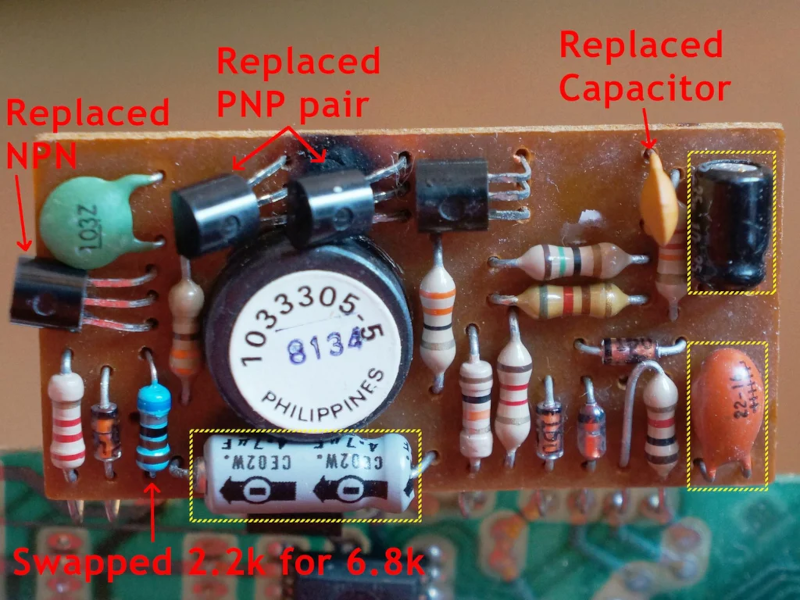
In the restoration that inspired this story, the Speak & Spell showed evidence that it may have been connected to an unsuitable power adapter in the past. There were signs of previous repair attempts, and the power board had a burn mark along with a cracked small transistor. The device also used a more complicated power arrangement than its friendly toy-like exterior suggested because it had to support the vacuum fluorescent display as well as the rest of the electronics.
That detail is important. The bright display on a classic Speak & Spell is not powered in the same casual way as a pocket flashlight. The VFD system requires a dedicated power section, which means a fault in that area can create symptoms that seem unrelated to speech. Old electronics are masters of disguise. A damaged transistor can masquerade as a dead voice chip. A weak voltage rail can pretend the speaker is broken. A corroded battery contact can act like the entire machine has given up on life.
The Repair That Brought the Voice Back
The restoration began with inspection rather than guesswork. The case was opened, the boards were examined, and damaged components were identified. The cracked transistor was part of a pair, so both transistors were replaced rather than trusting the surviving part to carry on after its electronic partner had clearly had a rough day.
After the initial repair, the Speak & Spell worked when powered by an AC adapter but still refused to operate correctly from batteries. That clue narrowed the problem. Batteries deliver a lower voltage than a suitable wall adapter, so a circuit that barely works with external power may fail when battery voltage sags under load.
Rather than declaring victory too early, the restorer investigated the startup behavior and adjusted the circuit so it could work with the lower battery voltage. The result was not merely a machine that powered up on a bench. It became a portable Speak & Spell again, which is the whole point. A vintage educational toy restored only for a wall outlet is a little like restoring a bicycle and then insisting it be stored on a treadmill.
Once the power system behaved correctly, the Speak & Spell regained its voice. The repair showed that its speech hardware had survived. The iconic digital voice had been waiting there all along, apparently ready to resume spelling lessons after a long and entirely justified vacation.
What Makes the Original Voice So Memorable?
The Speak & Spell voice was not a simple recording played back from a tape. It was synthesized speech created from processed speech data. A real human voice was recorded and analyzed, then transformed into compact digital information that the machine could use to recreate recognizable words. The result was mechanical but understandable, which gave the device its distinct personality.
That slightly robotic sound is part of the magic. Modern voice technology often aims to sound as natural as possible. It adds pauses, emotional tone, breathiness, and conversational rhythm. The Speak & Spell did the opposite. It sounded like a polite robot who had read every dictionary in the building but had never attended a birthday party.
Yet the voice worked. Children could hear a word, repeat it, spell it, and receive feedback. The machine created a memorable learning loop: listen, think, type, try again. That direct interaction helped make the device feel less like a worksheet and more like a game.
Texas Instruments packed this experience into a portable unit that ran from C-cell batteries and supported cartridge-based learning modules. It was a compact, purpose-built computer long before “edtech” became a favorite word in conference presentations and pitch decks.
Lessons for Vintage Electronics Repair
Start With the Power Path
The biggest lesson from this silent Speak & Spell repair is simple: verify power before blaming rare chips. Check the battery compartment, battery contacts, polarity, power jack, switches, and power rails. Leaking batteries, incorrect adapters, cracked solder joints, and stressed transistors can all create failures that look much more dramatic than they really are.
Look for Evidence, Not Just Symptoms
Burn marks, damaged components, corrosion, lifted traces, and suspicious soldering are clues. They tell a story about what may have happened years ago. A vintage device is not only an object; it is a mystery novel written in dust, oxidation, and questionable repair work.
Understand Voltage Differences
A machine that works with a wall adapter but fails on batteries is not fully repaired. Battery-powered electronics need to tolerate lower voltage and changing load conditions. Testing both power methods can reveal problems that a quick bench test misses.
Preserve What You Can
Original speech chips, ROMs, displays, keyboards, and circuit boards are increasingly difficult to replace. The best restoration is usually one that keeps as much original hardware as possible while replacing only components that are genuinely failed or unsafe. This approach protects both the device’s historical value and its strange little electronic soul.
Why Restoring Old Educational Toys Matters
Vintage technology restoration is often dismissed as nostalgia, but it is also hands-on history. A restored Speak & Spell helps people understand how far consumer electronics have come. It reveals the limitations engineers faced when memory was expensive, chips were slower, batteries were heavier, and getting a device to speak clearly was enough to make people stop and stare.
The product also captures a moment when educational technology was becoming interactive. Instead of passively watching a screen, a child could press buttons, hear words, answer questions, and receive immediate feedback. The device was not perfect, and nobody would confuse its voice with a modern audiobook narrator, but it created a personal relationship between a learner and a machine.
That relationship still matters. Modern learning apps may offer animation, cloud syncing, artificial intelligence, progress dashboards, and enough notifications to make a refrigerator feel insecure. But the basic learning principle remains familiar: give people a clear prompt, let them respond, provide feedback, and make the process engaging enough that they want to keep going.
Experiences Related to Restoring a Silent Speak & Spell
Anyone who has brought an old electronic toy back to life understands the strange emotional swing that comes with the job. At first, the device is just an object from a thrift store, attic, flea market, or online auction. It may be dusty, yellowed, scratched, and missing a battery cover. Then you install fresh batteries, press a button, and nothing happens. Suddenly, it becomes personal.
A silent Speak & Spell creates a very particular kind of disappointment because its entire identity depends on sound. A broken calculator can still look like a calculator. A dead clock can still be decorative. But a Speak & Spell that cannot speak feels like a piano with no strings. It has the keys, the case, the screen, and the history, but the character is missing.
The first experience most restorers have is detective work. You start by checking the obvious things: fresh batteries, clean terminals, a working speaker, and intact wires. Sometimes the answer is wonderfully boring. A battery contact is corroded. A switch is dirty. A wire has snapped. The repair takes ten minutes, and suddenly the machine is talking again as if it had merely been pretending to nap.
Other times, the repair becomes more involved. Opening a vintage Speak & Spell can feel like entering a tiny museum exhibit. The plastic case, circuit boards, old solder joints, strange chip markings, and glowing display all belong to a different era of electronics. You can almost imagine the engineers trying to squeeze a talking computer into a child-friendly package without turning it into a lunchbox-sized power plant.
There is also a special satisfaction in tracing a problem instead of replacing parts randomly. When a damaged transistor, weak power rail, cracked connection, or failed capacitor is identified, the repair stops being luck and becomes understanding. That moment is addictive. It is the electronic equivalent of finding the missing puzzle piece under the couch after everyone has already accused the dog.
For many people, the most memorable moment comes at the end. The device powers up. The display lights. A button is pressed. Then the familiar robotic voice returns. It may say a simple word. It may ask for a spelling response. It may sound slightly eerie, as all vintage speech synthesizers do after sitting silently for decades. But it speaks.
That first successful sound is bigger than it seems. It proves the device is not obsolete in the emotional sense. Its parts may be old, its voice may be grainy, and its vocabulary may be tiny compared with a modern phone. Still, it works. It teaches. It communicates.
Restoring a Speak & Spell also changes the way people look at modern technology. Today, a voice assistant can answer trivia questions, control lights, create reminders, and occasionally misunderstand a request so badly that it feels like a comedy sketch. The Speak & Spell had none of that complexity. It had a few buttons, limited memory, a simple display, and a voice generated through clever engineering. Yet it made people feel that computers could listen, respond, and participate in learning.
That is why the revival of a silent Speak & Spell matters. It is not just a repair story. It is a reminder that good technology does not always need to be newest, fastest, or connected to the internet. Sometimes it just needs to turn on, say one word clearly, and make someone smile because a small electronic voice from the past has found its way back.
Conclusion
The restored Speak & Spell proves that a silent vintage device is not necessarily beyond saving. By following the evidence, investigating the power system, and respecting the original hardware, a broken educational toy can regain its signature voice and its place in technology history.
Its revival is also a tribute to the engineers who made synthetic speech practical for ordinary families in the late 1970s. The Speak & Spell may sound primitive beside a modern voice assistant, but its influence is enormous. It helped show the world that a computer could speak, teach, and become part of everyday life.
And now, thanks to careful restoration, one more tiny robotic teacher is back on dutyready to ask for a spelling word, judge your answer with mechanical calm, and remind everyone in the room that “because” still has more letters than it looks like it should.

