
Hair Care
Physicists Found a New Way to Search the Universe for Wormholes
Jun
Wormholes have always sounded like the universe’s most dramatic shortcut: fold space, step through a cosmic tunnel, skip the boring commute across a few billion light-years, and arrive just in time for lunch in another galaxy. Unfortunately, physics is not a science-fiction travel agency. Nobody has found a wormhole, nobody has booked a ticket through one, and the customer-service desk for faster-than-light tourism remains closed.
Still, physicists have not given up. In fact, a recent line of research suggests a surprisingly practical way to search the universe for wormholes: look for how they bend and magnify light. The idea is rooted in gravitational lensing, the same Einstein-approved phenomenon that allows galaxies, black holes, and galaxy clusters to act like cosmic magnifying glasses. If wormholes exist, they may leave behind a distinctive lensing signatureone that could help astronomers tell them apart from black holes.
The new method does not require anyone to fly into a tunnel in spacetime, which is excellent news for insurance companies. Instead, it asks a cleaner question: if a wormhole passed between Earth and a distant light source, what would we see? The answer may be a strange, amplified pattern of imagespossibly including a bright central image and dimmer companionsthat differs from the way black holes distort background light.
What Is a Wormhole, Really?
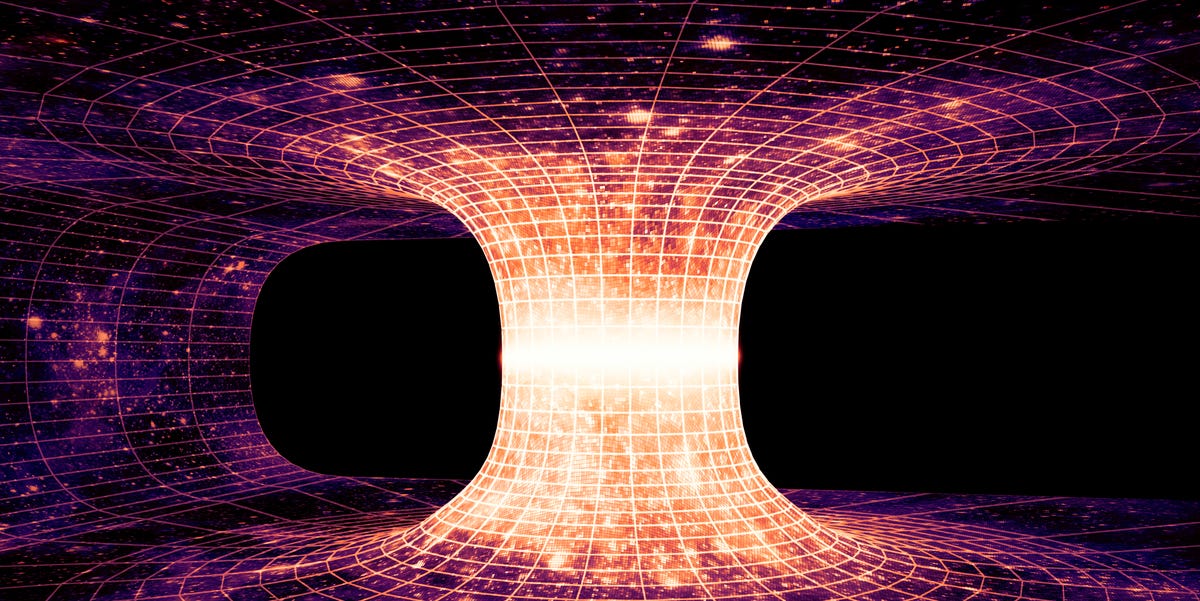
A wormhole, also called an Einstein-Rosen bridge, is a hypothetical structure in spacetime that could connect two distant regions of the universe. The concept comes from the mathematics of general relativity, Albert Einstein’s theory that describes gravity not as an invisible pulling force, but as the curvature of spacetime caused by mass and energy.
The classic analogy is the folded sheet of paper. Draw two dots on opposite corners of a page. Normally, traveling from one dot to the other means crossing the page. But if you fold the paper so the dots touch, the trip becomes much shorter. A wormhole is the cosmic version of that shortcutexcept the “paper” is spacetime, the folding is done by extreme gravity, and the whole thing comes with enough theoretical complications to make your GPS quietly resign.
The problem is that most traversable wormhole models require exotic matter, a strange form of matter with negative energy density. Ordinary matterstars, planets, coffee, your laptop, your cat judging you from across the roomhas positive energy. Exotic matter, if it exists in the needed form, would behave in ways that are not known to occur naturally on large scales. That is one reason wormholes remain hypothetical.
Why Black Holes Are the Main Cosmic Look-Alikes
If wormholes exist, they may resemble black holes from far away. Both are predicted by solutions to Einstein’s equations. Both involve extreme spacetime curvature. Both could bend light dramatically. And both make physicists use sentences that sound like they were written during a caffeine emergency.
A black hole is a region where matter has been packed so densely that gravity creates an event horizona boundary beyond which nothing, not even light, can escape. Astronomers now have strong evidence for black holes through stellar orbits, X-ray emissions, gravitational waves, and direct imaging of black hole shadows such as M87* and Sagittarius A*, the compact object at the center of the Milky Way.
Wormholes, however, have no confirmed observation. That means researchers must search for indirect signals. The challenge is not merely finding something strange; the universe is already full of strange things. The real challenge is finding something strange in a way that points specifically to a wormhole rather than a black hole, neutron star, galaxy cluster, dark matter clump, or a telescope artifact having a bad day.
The New Search Strategy: Watch the Light Bend
The promising new approach focuses on microlensing, a small-scale version of gravitational lensing. In gravitational lensing, a massive object between Earth and a distant light source bends the path of that light. Sometimes the source appears brighter. Sometimes it appears distorted. Sometimes it appears as multiple images, rings, arcs, or weird little smears that make astronomers very excited and everyone else ask, “Is the telescope okay?”
Microlensing happens when a compact objectsuch as a star, planet, black hole, or possibly a wormholepasses in front of a more distant star or galaxy. The foreground object acts as a lens, temporarily boosting the brightness of the background source. Because microlensing depends on alignment, it is rare, but modern sky surveys watch huge numbers of stars, making rare events easier to catch.
In the wormhole model studied by physicists, an electrically charged, spherically symmetric wormhole could magnify light in a way that differs from a black hole. The calculations suggest that, depending on the wormhole’s properties and alignment, the magnification could be enormousup to 100,000 times in some theoretical cases. That does not prove wormholes exist, but it gives astronomers a pattern to hunt for.
How Wormhole Lensing Could Differ From Black Hole Lensing
Black holes can split light and create multiple images of a background object. Their gravity can bend light into arcs, rings, and repeated images. Wormholes could do something similar, which is exactly why they are hard to identify. If every weird lens looks like a black hole, the wormhole stays hidden in the cosmic crowd wearing sunglasses and a fake mustache.
The key difference in the new research is the predicted image pattern. A charged wormhole may generate at most three images of a background source: two dim images and one bright image. The presence, arrangement, and brightness of these images could provide a possible fingerprint. In particular, the extreme magnification and the distinctive structure of the images might separate wormholes from ordinary black holes under the right observational conditions.
This is not a simple “spot one bright flash and declare victory” method. Astronomers would need to compare real microlensing light curves with detailed theoretical templates. They would ask whether the brightening rises and falls in a way consistent with known objects or whether it follows the stranger curve predicted for a wormhole. In other words, the search is less like finding a glowing tunnel in space and more like solving a cosmic accounting problem in photons.
Why This Matters Even If Wormholes Are Never Found
At first glance, wormhole hunting may sound like an expensive way to chase science fiction. But that is unfair. The history of physics is full of ideas that once sounded absurd and later became essential. Black holes were once mathematical curiosities. Gravitational waves were once so difficult to detect that even Einstein doubted whether they would ever be observed. Today, black holes are imaged, gravitational waves are detected, and the universe keeps reminding us that “too weird” is not the same as “impossible.”
Searching for wormholes also sharpens the tools of astrophysics. The same methods used to test wormhole models can improve our understanding of black holes, dark compact objects, gravitational lensing, and the structure of spacetime. Even a non-detection is useful because it narrows the range of possible wormhole properties. Science often advances by learning where something is not hiding.
Think of it like looking for your keys. You may not find them in the couch, but now you know the couch is innocent. Eventually, after enough searching, you either find the keys or accept that the washing machine has developed a secret civilization.
Where Astronomers Might Look First
The center of the Milky Way is one obvious place to search for exotic spacetime behavior. Sagittarius A* is the supermassive black hole at our galaxy’s core, with millions of times the mass of the Sun packed into a compact region. Extreme gravity makes it a natural laboratory for testing general relativity, black hole physics, and speculative alternatives such as wormhole-like objects.
Some researchers have proposed that if a wormhole existed near Sagittarius A*, stars on one side of the wormhole could gravitationally influence stars on the other side. That influence might produce tiny deviations in stellar orbits. These deviations would be incredibly difficult to measure, but astronomers are already tracking stars near the galactic center with remarkable precision.
Another hunting ground is the sky-wide microlensing data collected by current and future observatories. Surveys that repeatedly image billions of stars can catch temporary brightenings caused by foreground lenses. If a wormhole lensing event has a recognizable shape, large datasets may eventually provide the best chance of spotting one.
Future Telescopes Could Make the Search Stronger
The next generation of astronomical surveys will be especially important. The Vera C. Rubin Observatory is expected to discover huge numbers of transient events and gravitational lenses during its Legacy Survey of Space and Time. Its wide, repeated imaging of the sky will create an enormous time-domain database, exactly the kind of resource needed to search for rare microlensing patterns.
NASA’s Nancy Grace Roman Space Telescope will also use microlensing to study objects in the Milky Way, especially exoplanets and compact lenses. While Roman was not designed specifically to find wormholes, its precision and large survey capability could make it valuable for testing unusual microlensing models.
Meanwhile, gravitational-wave astronomy offers another possible path. If wormholes can mimic black holes in collisions, they might produce gravitational-wave signals with differences after the main “ringdown.” Some models suggest that wormholes could create late-time echoesfaint repeated signals caused by waves bouncing around near the object rather than disappearing across an event horizon. Current detectors may not be sensitive enough to confirm such signals reliably, but future instruments, including space-based observatories like LISA, could expand the search.
Could Wormholes Become Cosmic Telescopes?
One of the more delightful implications of wormhole lensing is that wormholes, if real, might not only be objects to studythey might also become tools. A wormhole that magnifies light by extreme amounts could act like a natural telescope, amplifying distant objects too faint to observe otherwise.
That idea comes with a giant “if.” First, wormholes must exist. Second, they must exist in forms that survive long enough to lens light. Third, they must align with distant sources in ways we can observe. Fourth, astronomers must distinguish them from the many other objects that bend light. So yes, the universe has paperwork.
Still, natural cosmic lenses are already useful. Galaxy clusters help astronomers see very distant galaxies. Black holes and stars produce microlensing events that reveal hidden planets and compact objects. If wormholes are part of nature, their lensing effects could add a strange new instrument to the astronomical toolbox.
Why Scientists Remain Cautious
It is important to say this clearly: physicists have not found a wormhole. The new method is a theoretical search strategy, not a discovery. The calculations show what a certain type of wormhole might do to light if such a wormhole exists. That is a big difference from pointing to a spot in the sky and saying, “There it is. Please keep your hands inside the spacetime tunnel.”
The caution is not pessimism. It is how science protects itself from wishful thinking. Wormholes are exciting because they touch some of the deepest questions in physics: the nature of spacetime, the limits of general relativity, the relationship between gravity and quantum mechanics, and whether the universe contains structures far stranger than anything we have confirmed.
But excitement is not evidence. Evidence will require repeated observations, careful modeling, elimination of ordinary explanations, and agreement across multiple instruments or datasets. A single odd lensing event would be interesting. A population of events matching wormhole predictions would be revolutionary.
The Big Picture: Wormholes as Tests of Reality
The most valuable part of wormhole research may not be the dream of cosmic shortcuts. It may be the pressure it puts on our theories. General relativity works beautifully on large scales, from planetary orbits to gravitational waves. Quantum mechanics works stunningly well on tiny scales. But the two theories do not yet fit together completely. Wormholes sit at the intersection of that problem.
Some wormhole ideas appear in studies of quantum gravity, black hole information, and spacetime geometry. Others emerge from modified gravity theories or exotic matter models. By asking how wormholes would behave observationally, physicists transform speculation into testable predictions. That is the difference between science and late-night dorm-room philosophy, although both may involve snacks.
If future surveys find no wormhole signatures, that result will still matter. It will restrict possible models and help scientists understand which versions of exotic spacetime are unlikely. If future surveys do find something that survives every ordinary explanation, the discovery would be one of the most profound in modern physics.
Experience-Based Reflection: How to Think About Wormholes Without Falling Into the Hype Hole
For readers, the best way to approach wormhole news is with two feelings at once: wonder and discipline. Wonder keeps the topic alive. Discipline keeps it honest. Wormholes are thrilling because they invite us to imagine a universe where distance is not the final boss. A trip across cosmic space could, in theory, become a shortcut through geometry. That is the kind of idea that makes science feel huge again.
But the experience of following real physics teaches a humbler lesson. The universe does not owe us convenience. It does not care that humans would enjoy a shortcut to Alpha Centauri, or that science-fiction writers have already designed the spaceship interiors. Nature has its own rules, and physics is the slow art of discovering them without accidentally fooling ourselves.
A useful way to understand the new wormhole search is to compare it to detective work. Astronomers are not looking for a glowing portal. They are looking for fingerprints: a brightness curve here, a distorted image there, a delay in a gravitational-wave signal, a tiny orbital deviation near a supermassive black hole. None of these clues is glamorous by itself. But together, they can test whether the universe contains objects that behave unlike anything we already know.
This is also a good reminder that modern astronomy often works indirectly. We do not “see” black holes in the ordinary sense; we infer them from their effects on light, gas, stars, and spacetime. We did not confirm gravitational waves by watching space ripple like a pond; we measured unbelievably tiny changes in laser interferometers. In that tradition, searching for wormholes through microlensing is not bizarre. It is classic astronomy: look for the shadow, the wobble, the echo, the bend.
There is also a practical lesson for science communication. Headlines about wormholes can easily sprint ahead of the evidence wearing roller skates. A responsible reading is this: physicists developed a possible observational signature for a theoretical class of wormholes. That is exciting. It is not proof. It is a map of where to look, not a postcard from the destination.
The emotional experience of this topic is part of its charm. Wormholes make people curious. They pull readers into general relativity, gravitational lensing, black holes, quantum theory, and the future of telescopes. Even if wormholes never become real travel routes, they already function as intellectual tunnelsconnecting pop culture to deep physics, imagination to mathematics, and big questions to measurable predictions.
So when physicists propose a new way to search the universe for wormholes, the right response is not blind belief or automatic dismissal. The right response is: wonderful, now test it. Let the telescopes stare. Let the surveys collect. Let the models compete. If the universe has hidden doors, patient science is how we learn where they are. And if it does not, the search will still teach us how gravity shapes the cosmos we actually inhabit.
Conclusion
Physicists have found a new way to search for wormholes by studying how these hypothetical spacetime tunnels might magnify and split light through microlensing. The method is powerful because it turns a science-fiction favorite into a testable astronomical question. Instead of asking whether wormholes sound coolobviously yes, they are the leather jackets of theoretical physicsresearchers are asking what observable signal they would produce.
The latest models suggest that some wormholes could create unusual lensing patterns, including extreme magnification and a distinctive arrangement of images. Future sky surveys, precision observations of the Milky Way’s center, and improved gravitational-wave detectors may help scientists test these predictions. No wormhole has been discovered yet, but the search itself is valuable. It pushes physics toward sharper questions about gravity, spacetime, black holes, and the hidden architecture of the universe.
If wormholes exist, they may someday become one of the most astonishing discoveries in science. If they do not, the hunt will still deepen our understanding of cosmic lenses, compact objects, and the boundaries of Einstein’s theory. Either way, the universe remains wonderfully weirdand physicists now have another clever way to interrogate it.
Note: This article is written for web publication in standard American English and is based on real astrophysics research, including theoretical wormhole microlensing, gravitational lensing, black hole observations, and future survey astronomy.

