
Beauty Unlocked
I Make Pencils, Notebooks And Journals For Wizards, And Here’s Some Of My Best Work (23 New Pics)
Jun
Some people buy a notebook because they need to remember groceries. Others buy one because it looks like it was stolen from a dragon’s private library during a moonlit heist. This article is for the second group.
Handmade fantasy stationery has a special kind of charm. It is practical, yes, but only in the way a tiny brass telescope, a suspiciously glowing bottle, or a velvet cloak is practical. It turns an ordinary actwriting a list, sketching a creature, planning a novel, tracking moods, or doodling during a meetinginto a small ritual. That is exactly why wizard-inspired pencils, notebooks, and journals feel so irresistible. They are not just supplies. They are invitations.
The work behind these magical-looking pieces often combines several crafts at once: sculpting, painting, book decoration, prop design, packaging, and an excellent tolerance for tiny details that refuse to behave. In the case of Les Nadises, the creative universe includes handmade grimoires, dragon journals, wand pencils, witchy notebooks, and fantasy accessories designed for people who want their desk to look less like an office and more like a spellcasting station with Wi-Fi.
Why Wizard Stationery Feels So Magical
A plain notebook can be useful. A wizard journal, however, feels like it already knows three secrets and is waiting patiently for you to add a fourth. That emotional difference matters. The objects we write with can influence how we approach the page. When a notebook looks precious, strange, or story-rich, it can lower the barrier between “I should write something” and “I must record this prophecy immediately.”
Fantasy stationery works because it borrows from old visual languages: leather-like textures, raised symbols, celestial colors, dragon scales, feathers, metallic finishes, wax-seal aesthetics, and mysterious labels. These details suggest history. They make a brand-new journal feel as if it has survived a castle fire, two apprenticeships, and one unfortunate potion incident.
That is the fun of wizard notebooks and journals: they are functional art. They can hold recipes, sketches, poems, role-playing notes, garden plans, novel outlines, tarot spreads, dream logs, or the name of that one coworker who keeps microwaving fish. Magic has many forms.
The Artist Behind The Spellbook Desk
Les Nadises is the shop and creative identity of Nadège, also known as Nad, a French artist living in Canada. Before focusing on handmade fantasy stationery, she spent years working in animation in Paris, a background that makes sense the moment you see her work. Animation trains the eye to think in character, silhouette, texture, mood, and story. A journal cover is not just a surface; it becomes a little stage.
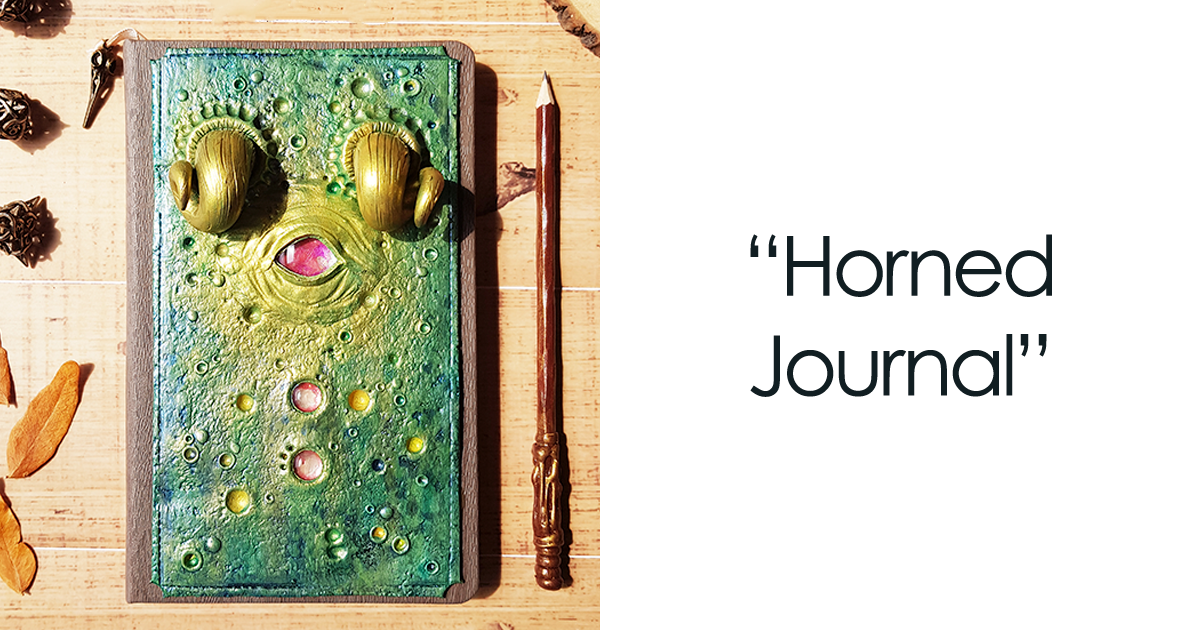
Her pieces often feel like props from a fantasy film that wandered into real life and decided to become useful. Many of the notebooks feature sculpted three-dimensional covers, often built with polymer clay and painted in rich colors. The result is tactile, dramatic, and delightfully odd in the best possible way. A dragon journal may have scales that seem to curl around the cover. A feather-themed notebook may look like it belongs to a scholar who writes beside candlelight. A Milky Way-inspired journal may feel cosmic enough to make your grocery list seem like a map to another dimension.
Best Work: Dragon Journals, Wand Pencils, And Pocket-Sized Grimoires
The best pieces in this fantasy stationery collection succeed because they do not merely place a dragon image on a cover. They build the object as if it belongs to a world. That is a different level of design.
Milky Way Journal
The Milky Way Journal captures the appeal of celestial stationery: deep color, night-sky mystery, and the feeling that every page could contain star charts, poems, or notes on how to politely negotiate with comets. Cosmic designs work especially well for journals because writing is often a private act. A galaxy cover makes personal thoughts feel large, strange, and meaningful.
Copper Green Dragon Journal
A copper green dragon journal is exactly the kind of object that makes people whisper, “I don’t need it,” while already clearing shelf space. Dragon motifs are powerful in fantasy craft because they communicate protection, danger, age, treasure, and wisdom all at once. Add copper tones and green scales, and the journal starts looking like it was approved by a very stylish reptilian librarian.
Feather Journal
The feather journal leans into a softer kind of magic. Feathers suggest messages, flight, transformation, and old-fashioned writing tools. Unlike the bolder dragon pieces, a feather design can feel elegant and poetic. It is perfect for writers, artists, daydreamers, and anyone whose notes contain more feelings than bullet points.
Night Dragon Journal
The Night Dragon Journal brings mood to the front. Darker fantasy stationery often has the strongest “ancient artifact” energy. A night-themed dragon design can feel protective, watchful, and slightly dramaticbasically the journal equivalent of standing on a tower during a storm while your cape behaves beautifully.
Frosted Green Dragon Journal
The Frosted Green Dragon Journal shows how color changes character. Frosted details can make a dragon feel less fiery and more enchanted, like a creature from a snowy forest or a mountain cave. That contrastcool finish, fierce texturegives the piece depth.
Why Wand Pencils Are Such A Clever Idea
Among the most charming parts of the collection are the wand pencils. The concept is simple and brilliant: take a regular pencil, then transform it into a wizard’s wand through sculpted detail, paint, and finish. The pencil still writes. It just now looks like it might also open a secret door if you tap the right brick.
This is where fantasy design becomes especially satisfying. A wand pencil is not only decorative; it changes the physical experience of writing. Holding it feels theatrical. It makes sketching more playful and journaling less routine. It is the difference between “I wrote a reminder” and “I inscribed a matter of grave importance.” The reminder may still be “buy oat milk,” but presentation counts.
Pencils also have a long creative history. Their graphite cores are traditionally made by combining graphite with clay in different proportions, which helps determine hardness and darkness. That technical heritage makes the pencil a perfect candidate for magical reinvention. It is already a humble tool of artists, students, designers, writers, and list-makers. Dress it like a wand, and suddenly the humble tool has a backstory.
The Craft: Polymer Clay, Paint, Texture, And Patience
Fantasy stationery depends heavily on texture. A flat printed dragon can be beautiful, but a raised dragon scale that catches light feels alive. Polymer clay is useful here because it can be shaped, cured, painted, and layered into dimensional forms. It allows the maker to create covers that feel sculptural rather than simply decorative.
But polymer clay is not a “just squish it and become a master” material. It requires conditioning, shaping, baking or curing according to the product instructions, finishing, and sometimes starting over when the tiny horn, claw, or ornamental corner decides to betray the entire kingdom. Painting adds another layer of difficulty. Metallic finishes, antique effects, shadows, and highlights all help create depth.
That is why handmade wizard journals often look impressive even before you open them. The cover tells a story through relief, color, and surface. You can see the hand of the maker in the small imperfections, and those imperfections are part of the charm. A mass-produced notebook can be perfectly uniform. A handmade grimoire looks like it has opinions.
Why People Love Handmade Fantasy Journals
The appeal is not only visual. Handmade fantasy journals satisfy several desires at once. They appeal to collectors who love unique objects. They appeal to writers who want tools that spark imagination. They appeal to role-playing fans who enjoy props that enrich a character or campaign. They appeal to gift shoppers who want something more memorable than another mug that says “But First, Coffee.”
They also fit perfectly into the current love of slow, tactile hobbies. In a world full of screens, a handmade notebook feels refreshingly physical. It has weight. It has texture. It asks you to pause. Journaling, sketching, and planning by hand can become grounding rituals, especially when the object itself feels special.
There is also an identity factor. A fantasy journal quietly announces, “Yes, I am the kind of person who enjoys dragons, mystery, and possibly buying too many pens.” That is not a problem. That is a brand statement.
What Makes A Wizard Journal Actually Work?
A good fantasy journal needs more than a cool cover. It must balance beauty with usability. If the object is too fragile, the owner may never write in it. If it is too bulky, it becomes more sculpture than stationery. The best designs live in the sweet spot: dramatic enough to feel magical, sturdy enough to use, and comfortable enough to keep nearby.
Paper choice matters too. Writers and artists care about whether pages handle pencil, gel pen, fountain pen, markers, or light watercolor. Binding matters because a journal should open comfortably. Size matters because some people want a desk grimoire while others want a travel-sized spellbook they can tuck into a bag and dramatically remove at a café.
Packaging also adds to the experience. When handmade stationery arrives wrapped thoughtfully, it feels like receiving an artifact, not just a product. For magical stationery, that unboxing moment can be part of the story.
Gift Ideas For Wizards, Writers, And Fantasy Fans
Wizard pencils, notebooks, and journals make excellent gifts because they are personal without requiring dangerous levels of guessing. You do not need to know someone’s sweater size, skincare routine, or stance on scented candles. If they like fantasy, writing, art, journaling, tabletop role-playing, witchy decor, or unusual handmade goods, a magical notebook is probably safe territory.
For writers
Choose a journal with a moody or literary design: feathers, moons, stars, antique textures, or subtle metallic details. Writers often enjoy objects that make the act of drafting feel ceremonial.
For artists
Look for notebooks that pair well with sketching tools. A wand pencil set can be especially fun for artists who enjoy fantasy illustration or character design.
For role-playing fans
A dragon grimoire or mini spellbook can become a campaign journal, character diary, prop, or place to record maps, spells, inventory, and suspicious NPC behavior.
For witchy decor lovers
Choose pieces with botanical, celestial, potion-label, or grimoire-inspired details. These objects look good on a desk, altar, shelf, or reading nook.
SEO-Friendly Takeaway: Why This Craft Niche Works
From a content and search perspective, handmade wizard stationery sits at the intersection of several strong interests: handmade journals, fantasy gifts, witchy stationery, dragon notebooks, wand pencils, journaling supplies, and unique gifts for writers. That overlap gives the topic broad appeal while still feeling specific.
It also photographs beautifully, which matters for online discovery. Sculpted covers, metallic paints, dragon scales, and wand-shaped pencils are naturally shareable. They stop the scroll because they look like everyday objects that wandered through a portal and came back with better accessories.
Most importantly, the work has a clear emotional hook. People are not only buying paper. They are buying atmosphere. They are buying the feeling of opening a book that could contain a secret. They are buying a reason to write.
Experience Section: What It Feels Like To Use Wizard Pencils, Notebooks, And Journals
The first thing you notice about wizard stationery is that it changes your posture. A regular notebook lets you slouch. A grimoire-looking journal makes you sit up like you are about to document a rare lunar event or accuse someone of forbidden herb storage. Even when the page is blank, the object has a presence. It makes the desk feel intentional.
Using a wand pencil is even more ridiculous and wonderful. It turns ordinary handwriting into a small performance. You may begin with a simple to-do list, but after three lines, you start naming tasks like quests. “Email the client” becomes “Send correspondence to the Council.” “Clean kitchen” becomes “Restore the alchemical chamber.” This may not make chores easier, but it does make them funnier, and sometimes funny is enough to get the dishes done.
A handmade fantasy journal also encourages slower writing. Because the object feels crafted, you tend to treat the page with more attention. You choose words more carefully. You pause before scribbling. You may even use your best handwriting, the one you save for birthday cards and pretending you are more organized than you are. That sense of ceremony can be useful for journaling, planning, or creative brainstorming.
There is also a sensory pleasure to textured covers. Raised clay details invite touch. Dragon scales, feathers, stones, vines, moons, and sculpted corners make the journal feel like an object with history. This tactile quality is something digital notes cannot replicate. A phone note is efficient, but it will never feel like it was recovered from a forgotten tower.
For creative people, these tools can help break through hesitation. A blank page can feel intimidating, but a magical-looking notebook reframes the experience. You are not “starting a project.” You are “opening the archive.” You are not “messing around with ideas.” You are “testing spells.” That playful shift gives permission to write badly, sketch freely, and experiment. Ironically, the more dramatic the notebook looks, the easier it can become to treat creativity as play.
As gifts, wizard journals have another advantage: they create instant reaction. The recipient does not have to be an expert in bookbinding or polymer clay to understand the care involved. They can see the hours in the texture. They can feel the personality in the details. And because every handmade piece varies slightly, the gift feels chosen rather than grabbed from a generic shelf five minutes before the party.
The only real danger is becoming the person who owns too many notebooks and still hesitates to write in the prettiest one. The cure is simple: use it. A magical journal becomes more magical when it contains your messy life. Fill it with drafts, lists, maps, recipes, dreams, bad poems, good ideas, and sketches of dragons with questionable anatomy. The spell is not in keeping the book perfect. The spell is in making it yours.
Conclusion
Wizard pencils, handmade notebooks, and fantasy journals prove that stationery does not have to be boring to be useful. The best pieces combine craft, imagination, texture, and function. They make writing feel like an event and turn a desk into a tiny creative laboratory. Whether decorated with dragon scales, cosmic colors, feather motifs, or wand-like details, these objects remind us that everyday tools can still feel enchanted.
In a world where many notes disappear into apps and cloud folders, a handmade grimoire offers something wonderfully stubborn: paper, texture, personality, and a little theatrical flair. It says, “Write it down. Make it real. Also, maybe add a dragon.”

