
Beauty Tools & Accessories
French Artist Creates Surreal Fantasy Universes Inspired By Hayao Miyazaki And Tim Burton
May
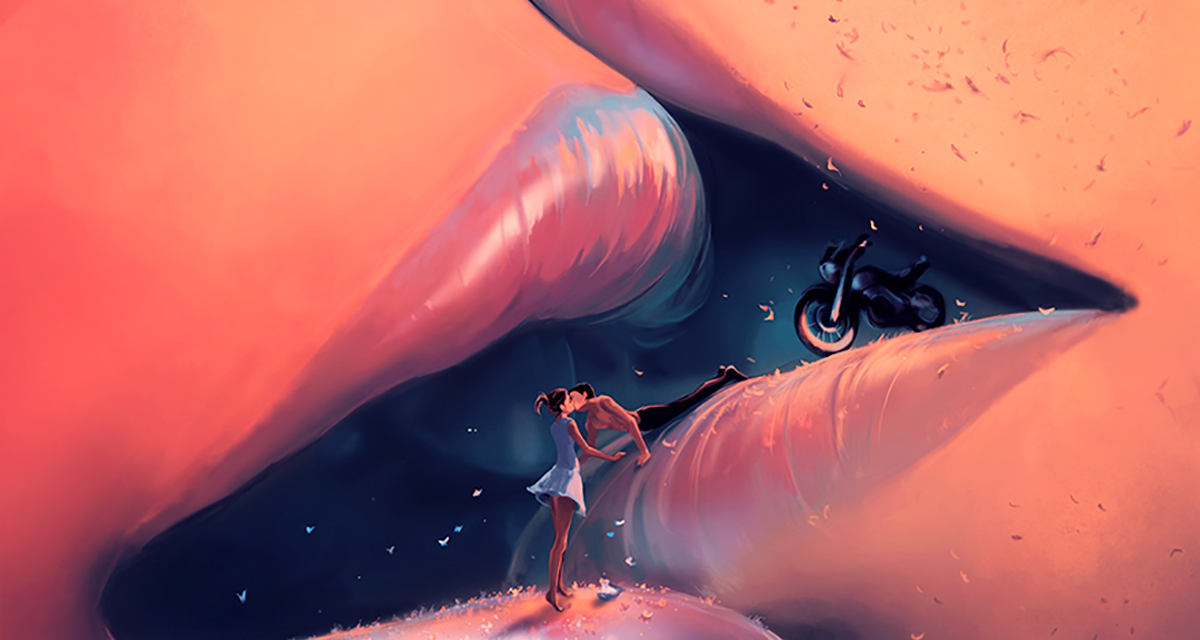
Some artists paint what they see. French digital artist Cyril Rolando, better known online as AquaSixio, paints what feelings might look like if they escaped the human chest, borrowed a moonlit coat, and wandered into a dream with excellent lighting. His surreal fantasy universes feel familiar and impossible at the same time: tiny figures face enormous creatures, sadness turns into weather, oceans behave like memories, and the human psyche gets its own theatrical stage.
Rolando’s work has often been linked to the imaginative worlds of Hayao Miyazaki and Tim Burton, two creators who understand that fantasy is not an escape from emotion. It is often the most direct road into it. Miyazaki gives us wonder, nature, flight, mystery, and quiet courage. Burton gives us oddball tenderness, gothic humor, lonely outsiders, crooked architecture, and shadows with personality. Rolando seems to meet both influences in the middle, then adds his own psychological lens. The result is not imitation. It is a deeply personal form of surreal digital art that feels like a bedtime story told by someone who has read a lot of therapy notes and still believes in magic.
Who Is Cyril Rolando, the Artist Behind AquaSixio?
Cyril Rolando is a French psychologist and hobbyist digital painter who has built a devoted following under the name AquaSixio. What makes his story especially interesting is that he did not come from the classic art-school pipeline. He has described himself as self-taught, working intuitively with digital tools rather than traditional paper drawing. His creative setup has included Photoshop and a Wacom tablet, a humble pair of tools that he uses to build worlds large enough to make your everyday worries feel like they accidentally walked onto an opera stage.
That background matters. Rolando’s profession as a psychologist is not a fun biographical footnote; it is one of the keys to understanding his art. His images often feel less like fantasy landscapes and more like emotional case studies painted in color, scale, and atmosphere. Instead of explaining anxiety, loneliness, grief, love, or hope in plain language, he turns those feelings into visual metaphors. A person may appear tiny before a gigantic animal. A body may float through water. A room may stretch into a strange dreamscape. The image says, “Yes, this is what the feeling feels like,” without handing you a textbook and ruining the mood.
A Surreal Fantasy Style Rooted in Emotion
The phrase “surreal fantasy universes” fits Rolando’s work because his paintings rarely behave like ordinary scenes. They obey emotional logic. In real life, a problem might be invisible; in an AquaSixio painting, it becomes a towering creature, a broken ship, a flooded room, or a moon too close to ignore. That is the charm. His digital paintings take private inner weather and make it visible.
Many of his compositions use exaggerated scale. Small human figures appear beside massive animals, oversized natural elements, or impossible structures. This approach immediately communicates vulnerability. The viewer understands the feeling before analyzing the picture. Being small in a vast world is not merely a visual trick; it is a psychological truth. Anyone who has faced grief, change, heartbreak, or a Monday morning email inbox knows the sensation.
Color is another major part of Rolando’s storytelling. His palettes can be glowing, aquatic, stormy, or dreamlike, but they rarely feel random. Blues and violets create melancholy and mystery. Warm lights suggest tenderness or fragile hope. Bright contrasts give the images an enchanted quality, as if the scene has just been discovered by a child with a flashlight and a highly advanced emotional vocabulary.
How Hayao Miyazaki’s Influence Appears in Rolando’s Worlds
Hayao Miyazaki’s influence can be felt in the way Rolando treats wonder as something serious. Miyazaki’s films are famous for their imaginative depth, strong emotional atmosphere, concern for nature, and ability to make the impossible feel lived-in. In movies such as My Neighbor Totoro, Spirited Away, Princess Mononoke, and Howl’s Moving Castle, fantasy is not just decorative. It reveals character, morality, memory, and the complicated relationship between humans and the natural world.
Rolando’s work echoes that sense of enchantment. His creatures are often strange but not simply monstrous. His environments feel magical without becoming sugary. Like Miyazaki, he seems interested in the emotional life of fantasy: the hush before discovery, the loneliness of transformation, the comfort of a creature too large to fit into common sense. The influence is not about copying a Studio Ghibli forest or borrowing a flying machine. It is about believing that an imaginary universe can carry real human weight.
There is also a Miyazaki-like tenderness in Rolando’s treatment of scale. A childlike figure beside a massive animal can feel frightening, but it can also feel protective. A strange creature may be a threat, a companion, or a symbol of something the character must learn to understand. The best fantasy does this beautifully: it refuses to flatten the world into good and bad, cute and scary, light and dark. It leaves room for mystery, which is where the best art usually keeps its snacks.
How Tim Burton’s Influence Shapes the Darker Side
If Miyazaki brings wonder and emotional spaciousness, Tim Burton brings the crooked doorway. Burton’s work is associated with gothic fantasy, oddball characters, macabre humor, theatrical design, and a lasting affection for outsiders. Films like Edward Scissorhands, Beetlejuice, Corpse Bride, and The Nightmare Before Christmas helped define a visual language where the strange can be lovable, the dark can be funny, and the misfit can be the moral center of the story.
Rolando’s art shares that sympathy for fragile, unusual figures. His images often suggest characters who are emotionally exposed, isolated, or caught inside strange symbolic situations. The darkness in his paintings is not horror for shock value. It is closer to melancholy with a lantern. There may be sadness, but it is rarely empty. Something glows. Something waits. Something has feathers, antlers, a boat, or a suspiciously poetic moon.
That is where the Burton comparison becomes useful. Burton’s worlds often look spooky, but their emotional engine is tenderness. Rolando’s paintings work in a similar emotional neighborhood. They may include surreal darkness, but they invite empathy rather than fear. The viewer is not asked to scream; the viewer is asked to feel.
Why Rolando’s Art Connects With So Many Viewers
One reason AquaSixio’s surreal fantasy art resonates online is that it gives shape to emotions people often struggle to explain. A viewer does not need a degree in art history to understand a tiny person standing in front of a gigantic symbolic force. The message lands quickly because the image speaks in metaphor. And metaphor, when it works, is basically emotional Wi-Fi.
His pieces often explore imagination, insecurity, dreams, sadness, memory, and hope. These are universal themes, but Rolando avoids making them bland. Instead of painting “sadness” as a person crying in a corner, he may create a whole universe where sadness has weather, architecture, scale, and atmosphere. That extra imaginative step gives the viewer room to project their own story into the image.
This is especially powerful in digital culture. People scroll past thousands of images every week. A piece that stops them usually does more than look pretty. It creates recognition. Rolando’s art often produces the feeling of, “I do not know exactly what is happening here, but somehow it is about me.” That is a strong reaction, and it explains why surreal digital paintings like his travel so well across social media, art blogs, and visual platforms.
The Digital Craft Behind the Dream
Although the emotional effect of Rolando’s work feels spontaneous, the craft behind it is carefully built. Digital painting allows him to develop atmosphere through layers, lighting, texture, and composition. Photoshop gives him control over color and mood, while the tablet lets his hand remain connected to the image. The result is not the cold, mechanical look some people wrongly associate with digital art. His paintings feel handmade, painterly, and personal.
Digital art has sometimes had to defend itself against the old “but is it real art?” question, which should probably be retired and sent to live on a quiet farm with other tired debates. Rolando’s work is a useful answer. The tool is digital, but the imagination is deeply human. A brush does not create meaning by itself. Neither does software. The artist does.
His images also show how digital painting can expand the language of fantasy illustration. Lighting can become cinematic. Scale can become extreme. Color can be adjusted until a scene feels like a dream remembered at 3 a.m. The medium gives artists freedom to chase visual ideas that might be difficult, expensive, or impossible in traditional formats.
Specific Visual Motifs in AquaSixio’s Fantasy Universes
Water and Emotional Depth
Water appears frequently in discussions of Rolando’s visual world, and it is easy to see why the motif suits him. Water can symbolize memory, grief, calm, danger, or transformation. It can hold a body, hide a secret, reflect a sky, or swallow a room. In surreal fantasy art, water is practically an emotional Swiss Army knife.
Small Figures in Enormous Worlds
Rolando often places human figures in scenes that dwarf them. This creates instant drama but also intimacy. The viewer understands that the character is facing something larger than ordinary life. It may be fear. It may be love. It may be the future. It may be a giant creature with excellent posture.
Creatures as Symbols
Animals and fantastic beings in Rolando’s work often feel symbolic rather than merely decorative. They can represent instinct, protection, burden, mystery, or emotional conflict. This is where the Miyazaki and Burton influences blend beautifully: the creature can be magical, unsettling, and sympathetic all at once.
Light as Hope
Even when the subject matter is dark, Rolando frequently uses light to create emotional balance. A glow in the distance, a luminous sky, or a soft highlight can change the entire mood of a piece. The darkness becomes a setting, not a verdict.
Why the Miyazaki-Burton Comparison Works Without Reducing the Artist
Comparing a contemporary artist to Hayao Miyazaki and Tim Burton can be tricky. Those names are so culturally powerful that they can swallow the artist being described. But in Rolando’s case, the comparison works best as a map of influence, not a label that explains everything. He is not simply “Miyazaki plus Burton.” He is a psychologist-painter using fantasy to process human emotion.
Miyazaki helps explain the wonder, the emotional sincerity, the dreamlike relationship between people and strange beings. Burton helps explain the gothic tenderness, the outsider mood, the comfort with darkness and oddity. Rolando’s own contribution is the psychological framing. His images feel like visual therapy sessions conducted in a magical forest where the chairs are probably mushrooms and the receptionist is a moon.
That blend gives his art its identity. It is whimsical but not shallow. Sad but not hopeless. Strange but not alienating. Beautiful but not merely pretty. It invites viewers to feel complicated things without forcing them into a neat explanation.
The Role of Psychology in His Surreal Digital Art
Rolando’s psychology background gives his work a rare kind of emotional precision. He seems interested in the inner life of people: insecurity, longing, resilience, imagination, and the private battles that rarely look dramatic from the outside. A person sitting quietly may be carrying an entire storm. Rolando paints the storm.
This makes his fantasy universes feel less like escapism and more like translation. Emotions become landscapes. Thoughts become creatures. Vulnerability becomes scale. The invisible becomes visible enough that viewers can finally point and say, “That. That is the thing.”
In an online art world crowded with polished fantasy images, Rolando’s work stands out because it does not chase spectacle alone. The spectacle serves the feeling. The glowing creature, strange building, or impossible sky is not just there to impress. It is there to communicate something about being human.
What Artists Can Learn From AquaSixio
Artists, illustrators, and content creators can learn several important lessons from Rolando’s career. First, personal perspective matters more than perfect credentials. He did not need a traditional art-school path to create memorable work. He developed a recognizable voice by following curiosity, emotion, and consistent practice.
Second, influences are most powerful when transformed. Rolando openly admires the worlds of Miyazaki and Burton, but his art does not feel like a copy-and-paste tribute. He absorbs the emotional grammar of those creators and uses it to speak in his own accent.
Third, technical tools are only as interesting as the story behind them. Photoshop and a tablet can make clean images, but Rolando uses them to build emotional scenes. That is the difference between decoration and art that lingers.
Experiences Inspired by the Topic: Entering a Surreal Fantasy Universe
Looking at Cyril Rolando’s work can feel like stepping into a dream you almost remember. The experience is not passive. You do not simply observe one of his fantasy universes; you wander through it emotionally. A painting may begin as a striking image, but after a few seconds, it turns into a question. Who is that small figure? Why is the creature so large? Is the scene sad, hopeful, dangerous, or comforting? Why do I suddenly feel like texting an old friend and apologizing for something from 2014?
That is the power of surreal fantasy art. It gives the viewer permission to interpret. Unlike straightforward illustration, which often tells you exactly what is happening, Rolando’s work leaves open doors. The meaning is not locked in a single explanation. One viewer may see grief. Another may see courage. Someone else may see childhood imagination trying to survive adulthood. All of them may be right.
For many people, the experience of discovering AquaSixio’s art online is similar to finding a secret room inside the internet. You arrive expecting another pretty digital painting, and suddenly you are standing in front of an image that feels like a tiny emotional earthquake. The colors pull you in first. Then the composition takes over. Then the metaphor quietly taps you on the shoulder and says, “Hello, we need to discuss your feelings.” Rude? Maybe. Effective? Absolutely.
The connection to Miyazaki and Burton makes the experience even richer. If you grew up with Studio Ghibli films, you may recognize the sense that fantasy can be gentle, strange, and morally complex. If Burton’s films shaped your imagination, you may recognize the comfort of oddness, the beauty of misfits, and the idea that darkness can have a sense of humor. Rolando’s work sits near both emotional territories while remaining distinctly his own.
There is also a personal lesson in the way his art handles sadness. Many images influenced by fantasy try to defeat darkness by covering it with sparkle. Rolando does something more interesting. He lets darkness exist, then places light inside it. That feels honest. Life is rarely a clean victory over every fear and wound. More often, it is a strange walk through a surreal landscape while carrying a small lamp and hoping the giant symbolic animal nearby is friendly.
For artists, spending time with Rolando’s work can be motivating because it proves that imagination does not have to be loud to be powerful. A strong concept, emotional honesty, and a clear visual mood can do more than a hundred overstuffed details. His paintings remind creators to ask better questions: What feeling am I painting? What symbol expresses it? What scale makes it visible? What color does this emotion wear when nobody is watching?
For viewers, the experience is simpler and deeper: his art makes room for complicated feelings. It says that sadness can be beautiful without being romanticized, that fantasy can be meaningful without being heavy-handed, and that the imagination is not childish just because it contains moons, creatures, and impossible skies. Sometimes, imagination is the grown-up mind’s most elegant survival tool.
Conclusion
Cyril Rolando, known as AquaSixio, creates surreal fantasy universes that feel emotionally alive. Inspired by the imaginative wonder of Hayao Miyazaki and the gothic tenderness of Tim Burton, his digital paintings transform human feelings into symbolic dreamscapes. His background as a psychologist gives the work unusual depth, while his self-taught digital craft proves that powerful art does not need to follow a conventional path.
What makes Rolando’s art memorable is not only its beauty, but its emotional accuracy. His worlds are strange because feelings are strange. His characters are small because life can feel enormous. His darkness glows because hope often arrives quietly, carrying a lantern and wearing very impractical shoes. In a crowded digital art landscape, AquaSixio’s work stands apart as a reminder that fantasy is not the opposite of reality. Sometimes, it is the most honest way to show it.
Note: This article is an original, fully rewritten SEO article prepared for web publication. It does not include source links in the body copy and removes unnecessary citation placeholders or publishing artifacts.

