
Body Care
Failed 3D Printed Part Brings Down Small Plane
Aug
A tiny aircraft component, a big engineering lesson, and one very uncomfortable reminder: in aviation, “looks good enough” is not a certification standard.
When a Small Plastic Elbow Became a Big Safety Story
A small plane crash can begin with dramatic ingredients: bad weather, pilot error, fuel starvation, or a mechanical failure that announces itself with a bang. This one began with something quieter and sneakier: a plastic air induction elbow that softened, collapsed, and starved an engine of the air it needed to keep making power.
The aircraft was a Cozy Mk IV, a kit-built canard airplane powered by a Lycoming O-360 piston engine. During a final approach to Gloucestershire Airport in March 2025, the pilot advanced the throttle and discovered the engine was no longer responding. At low altitude, with little time and fewer options, the aircraft landed short of the runway and struck an instrument landing system localizer antenna array. The pilot suffered minor injuries, but the aircraft was destroyed.
The headline writes itself: Failed 3D Printed Part Brings Down Small Plane. But the real story is more useful than the headline. This was not a simple case of “3D printing is dangerous.” It was a case of an unverified part, made from an unsuitable or misidentified polymer, installed in a hot engine environment without the design features and approval scrutiny the application required. In other words, the printer was not the villain. The villain was assumption, wearing safety goggles and a confident smile.
What Actually Failed?
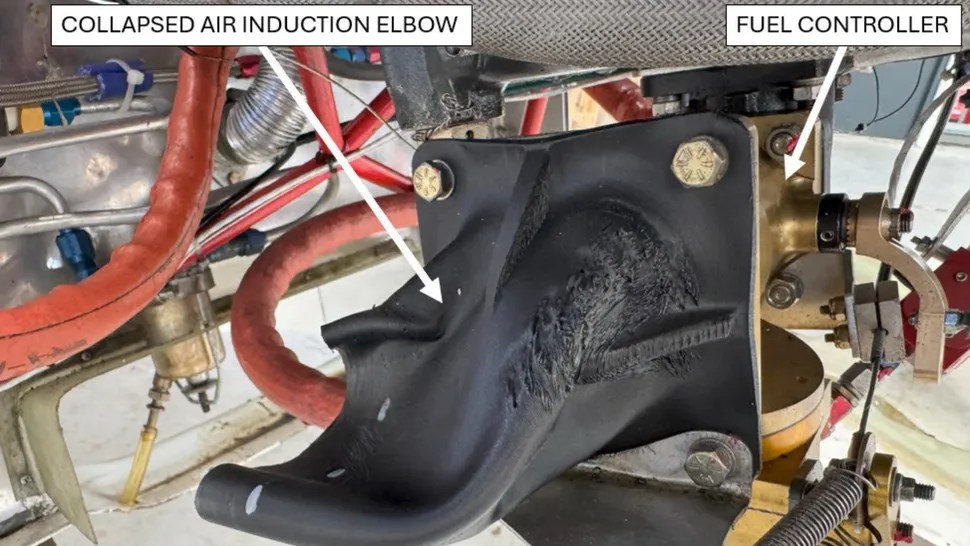
The failed component was a 3D printed plastic air induction elbow attached to the fuel controller. Its job was not glamorous. It was not a wing spar, landing gear leg, or turbine blade. It was a duct-like part that helped route induction air into the engine system. Still, in aircraft engineering, “not glamorous” does not mean “not important.” Airflow is not optional. Engines are famously picky about needing air, fuel, and spark in the right amounts.
Investigators found that the elbow had collapsed, severely restricting airflow. The attached air filter had detached and was found loose in the lower engine cowling. Once the intake path was compromised, the engine could not produce power when the pilot needed it most.
The previous aircraft owner had reportedly purchased the printed elbow at a U.S. airshow and understood it to be made from CF-ABS, a carbon-fiber-filled ABS filament. The material was believed to have a glass transition temperature of 105°C. On paper, that may have sounded comfortably better than the 84°C glass transition temperature of the epoxy resin specified for a laminated version of the part in the aircraft plans.
That comparison looked tidy, but reality brought a red pen. Testing after the accident found the failed samples had glass transition temperatures of about 52.8°C and 54.0°C. That is not a small paperwork mismatch. That is the difference between “should stay rigid near engine heat” and “may become a sad rubbery noodle while you are trying to land.”
Why Glass Transition Temperature Matters
Glass transition temperature, often shortened to Tg, is the temperature range where a polymer changes from hard and glassy to softer and more flexible. It does not have to melt into a puddle to become dangerous. A plastic aircraft part can fail simply by losing stiffness, deforming under clamp pressure, sagging under load, or collapsing under airflow and heat.
This distinction matters because many people casually talk about plastics by melting temperature. That is like judging a tire only by the temperature where it bursts into flames. Long before catastrophe, performance can degrade. In an engine compartment, radiant heat, conducted heat, airflow patterns, vibration, fuel and oil exposure, clamp loads, and aging all team up like a tiny committee of troublemakers.
For desktop 3D printing enthusiasts, the part may have looked strong. Carbon-filled filament often feels stiff. A fresh print can seem professional. Layer lines can even look charming, in a “tiny engineering lasagna” sort of way. But stiffness on a workbench is not the same as verified performance in a hot aircraft cowling. A component that survives your garage test may not survive heat soak, vibration, repeated flights, or a low-pressure airflow condition near exhaust piping.
The Missing Aluminum Support
One of the most important details in the accident report was not just the plastic itself. The original laminated design in the Cozy Mk IV plans included a thin-walled aluminum tube at the inlet end, where the air filter attached. That metal tube provided structural support in a location exposed to heat and clamping forces.
The 3D printed replacement did not include an equivalent aluminum support. That matters because engineering is rarely about one number. A material’s advertised temperature rating does not replace geometry, reinforcement, installation method, load path, or inspection history. The laminated part and the printed part may have shared a general shape, but they were not the same design.
This is a classic trap in replacement parts: copying the outline while missing the function. A part can have the right silhouette and still be wrong. The invisible details often do the heavy lifting. Wall thickness, fiber orientation, cure schedule, metal inserts, fastener loads, and local airflow all matter. Aircraft do not care whether a part “looks close.” Aircraft care whether it behaves correctly at the worst reasonable moment.
Why the Modification Process Matters
The modified fuel system had been treated as a prototype modification by the Light Aircraft Association in the United Kingdom. The fuel system modification itself was approved after the required process and flight testing. However, the 3D printed induction elbow was omitted from the parts list submitted for evaluation. Because it was not listed, the airworthiness of that component was not independently assessed during the approval process.
This detail turns a material failure into a process failure. Aviation safety depends on boring paperwork for a reason. Forms, parts lists, conformity checks, inspections, and test plans are not just bureaucratic confetti. They are how hidden assumptions become visible before the airplane is in the air.
In experimental and amateur-built aviation, builders enjoy creative freedom that makes innovation possible. That freedom is valuable. Many brilliant aircraft, modifications, and problem-solving ideas come from the builder community. But freedom does not suspend physics. A part installed near an engine needs proper design review, material verification, installation documentation, and testing. The more critical the function, the less room there is for “the vendor said it was fine.”
Is 3D Printing Safe for Aircraft?
Yes, 3D printing can be safe for aircraft. Also yes, the wrong 3D printed part can be wildly unsafe. Both statements are true, and pretending otherwise helps no one.
Additive manufacturing is already used in aerospace, including certified applications. Major companies have used 3D printed metal parts in aircraft engines and structural applications after extensive qualification, testing, process control, documentation, and regulatory approval. These parts are not printed casually on a Saturday night between a phone stand and a novelty dragon. They are made under controlled processes where machine settings, feedstock, material properties, post-processing, inspection, and traceability are managed with obsessive seriousness.
That is the key difference. Industrial aerospace additive manufacturing is not merely “printing a part.” It is a validated manufacturing system. The printer is only one piece of the chain. The chain includes design allowables, material batch control, test coupons, nondestructive inspection, process qualification, environmental testing, fatigue analysis, and documentation. It is less “click print” and more “welcome to the paperwork gym.”
By contrast, a one-off polymer part bought at an airshow, installed in an engine compartment, and omitted from an approval package sits in a very different risk category. The question is not whether 3D printing belongs in aviation. It does. The question is whether a specific part, made by a specific process, from a verified material, for a specific environment, has been proven fit for that aircraft and that function.
The Real Lesson: Application Beats Hype
The phrase “3D printed” can make people react in opposite ways. Some hear it and imagine futuristic precision. Others hear it and picture brittle plastic toys. Both reactions are too simple. Additive manufacturing is a tool, and like any tool, it can produce excellent work or excellent trouble.
A titanium bracket printed under aerospace controls is not comparable to a hobby-grade thermoplastic duct used near an engine. A cabin trim cover is not comparable to an induction component. A prototype used for fit checking is not comparable to a flight-critical part. A part printed in nylon, ULTEM, PEKK, ABS, PLA, or carbon-filled material may behave very differently depending on printer settings, moisture, layer orientation, annealing, infill, wall count, and post-processing.
That is why the phrase “3D printed aircraft part” is almost meaningless without context. The useful questions are: What material? What process? What load? What temperature? What failure mode? What inspection? What traceability? What approval basis? What happens if it fails?
In the Cozy Mk IV accident, the answer to that last question was severe: loss of engine power on final approach. That is exactly the kind of failure consequence that demands conservative design and independent review.
How Builders and Owners Can Think About 3D Printed Parts
For aircraft owners, builders, and maintainers, the lesson is not to throw every printer into the nearest lake. Please do not; the fish have suffered enough. The lesson is to classify parts by risk and environment before deciding how they should be made.
Low-Risk Uses
3D printing can be extremely useful for noncritical shop aids, drill guides, templates, organizers, fairing mockups, cable routing prototypes, inspection tools, and ergonomic cockpit accessories that do not affect flight safety. Even then, builders should consider flammability, sharp edges, attachment security, and whether a loose object could jam controls.
Medium-Risk Uses
Parts that live inside the aircraft, support minor systems, or experience modest heat and vibration deserve more caution. Material choice, fastening method, inspection intervals, and failure consequences should be documented. A printed bracket that fails and drops a wire bundle onto a hot surface is no longer a cute bracket. It is a plot twist.
High-Risk Uses
Anything related to engine induction, fuel, controls, structure, landing gear, fire protection, exhaust areas, or flight instruments belongs in the high-scrutiny category. These parts should not rely on hope, vendor claims, or a beautiful surface finish. They need engineering review, known material properties, environmental testing, and approval through the appropriate authority or inspection process.
Specific Technical Takeaways from the Crash
First, advertised material properties are not enough. A filament data sheet may describe ideal test conditions, not your printer, your slicer settings, your part geometry, your humidity, your annealing process, or your engine bay. Printed specimens can perform differently from molded specimens, and different print orientations can produce different strength and heat behavior.
Second, engine compartments are hostile places. Temperatures are uneven. Hot spots form. Air moves in surprising directions. A belly airbrake, cowling geometry, exhaust pipe location, or pressure change can alter heat exposure. A part that seems fine in cruise may fail during approach, idle, climb, or after heat soak on the ground.
Third, design substitutions require function-level thinking. Replacing a fiberglass-and-epoxy component with a printed polymer part is not a simple material swap. If the original design includes a metal insert, reinforcement, post-cure requirement, or specific laminate schedule, those features likely exist for a reason.
Fourth, modification documentation matters. If a part is not disclosed, it cannot be evaluated. In aviation, hidden changes are dangerous because they bypass the people and processes designed to catch exactly this kind of mismatch.
Finally, failure consequence should drive conservatism. If a part can cause engine power loss, flight control restriction, fire, structural failure, or loss of situational awareness, treat it as safety-critical even if it is small enough to fit in your hand.
What This Means for the Future of 3D Printing in Aviation
This accident should not slow the responsible use of additive manufacturing. It should sharpen it. Aerospace has already proven that 3D printed parts can be certified, reliable, and valuable when produced under disciplined controls. Additive manufacturing can reduce weight, simplify assemblies, shorten supply chains, and make complex geometries possible.
But the technology’s accessibility creates a cultural challenge. A desktop printer can make a part that looks finished long before the engineering is finished. That is exciting for innovation and dangerous for safety. The gap between “printable” and “airworthy” is wide enough to park a hangar in.
The aviation community needs practical education, not fear. Builders should understand heat deflection, glass transition temperature, creep, layer adhesion, anisotropy, fatigue, chemical exposure, and flammability. Inspectors should know which questions to ask when they see a printed component. Vendors should avoid vague claims and provide traceable material data. Owners should resist the temptation to treat a clever replacement as harmless simply because it is inexpensive.
Experience-Based Notes: Lessons from the Shop, the Hangar, and the Workbench
The most useful experience around 3D printed aircraft parts often begins far away from the runway. It begins at the workbench, where a printed prototype solves a problem so neatly that the builder starts wondering whether the prototype could become the final part. That is the moment to slow down. Many makers have had the same experience: the first print fits, the second print looks better, and the third print feels strong enough to trust. But “feels strong” is not a test method. Your hand is not an environmental chamber, and your garage is not a vibration lab.
A good habit is to separate printing for shape from printing for service. Printing for shape is wonderful. You can make mockups, check clearances, route hoses, test ergonomics, and identify interference before committing to expensive materials. Printing for service is different. That means the part will live with heat, load, vibration, chemicals, UV exposure, and time. Once a printed object crosses that line, the builder should start asking harder questions: What is the worst temperature it will see? Will it be loaded continuously? Could it creep? Could it crack along layer lines? Could a clamp crush it? What happens if it breaks loose?
Another experience many builders learn the hard way is that plastics age differently than they appear to. A part can look unchanged while its strength, stiffness, or heat resistance has degraded. Some filaments absorb moisture. Some soften earlier than expected. Some become brittle. Some behave well in one print orientation and poorly in another. A black carbon-filled part may look like miniature aerospace magic, but color and texture do not certify anything. The fanciest-looking print in the hangar may still be the weakest link if the material is wrong for the job.
Engine areas deserve special respect. The cowling of a piston aircraft is not a friendly place for experimental plastic unless the material and design have been proven. Heat does not distribute politely. It collects near exhaust components, changes during low-speed flight, and can spike after shutdown. A printed duct, spacer, clip, or bracket may survive several flights and then fail on the one day when ambient temperature, engine load, and airflow line up badly. That is why inspection after early flights is important, but it is not a substitute for qualification.
The safest builders treat 3D printing as a powerful assistant, not a shortcut around engineering. They document the material, save the slicer settings, label the part, photograph the installation, and ask a qualified inspector or engineer to review anything with safety implications. They also keep humility in the toolbox. In aviation, humility is cheaper than repairs, lighter than armor, and far more reliable than optimism.
Conclusion: A Small Part With a Loud Message
The failed 3D printed part that brought down a small plane is not a reason to reject additive manufacturing. It is a reason to respect it. The technology is capable of producing excellent aircraft components when design, material, process, testing, and approval all work together. The danger appears when a printed part is treated as equivalent simply because it looks equivalent.
In this accident, a small induction elbow softened and collapsed in a hot engine environment, restricting airflow and causing loss of power during final approach. The part lacked a support feature found in the original design, its actual thermal behavior did not match the believed material capability, and it was not included in the modification evaluation. Those details form the real lesson: aviation safety is built from verified facts, not assumptions.
3D printing belongs in the future of aviation, but every printed aircraft part must earn its place. The printer can create the shape. Only engineering can create confidence.

