
Body Care
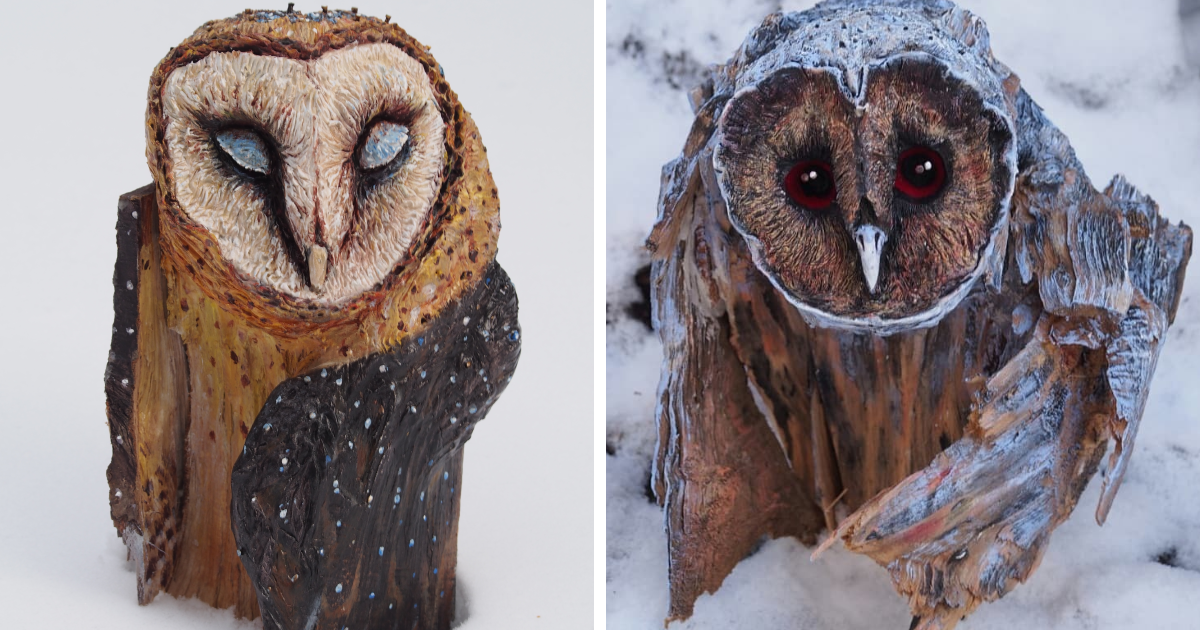
I Use Wood And Clay To Create Realistic Owl Sculptures
Jun
Note: This article is an original, publish-ready HTML draft synthesized from reputable references on owl biology, sculpture methods, ceramic materials, woodcarving, and the artist’s publicly shared process.
Some people look at a wooden log and see firewood. I look at it and think, “There is probably an owl trapped in there, judging me silently.” That is the strange, wonderful starting point behind realistic owl sculptures made from wood and clay: ordinary natural materials transformed into lifelike birds with watchful eyes, soft-looking feathers, and the dignified expression of a tiny forest professor.
The idea is simple in theory and wildly demanding in practice. A piece of wood provides the organic base, weight, and natural character. Clay adds the details that wood alone may not easily express: curved eyelids, layered facial feathers, subtle beaks, talons, and all those tiny textures that make an owl feel alive. The original artist behind the title described choosing interesting pieces of wood, sculpting and painting them, and using ordinary wooden logs with a special type of clay to create owls that feel both handmade and startlingly real.
Why owls? Because owls already look like nature’s own sculptures. They have rounded bodies, dramatic eyes, mysterious faces, and a posture that says, “I know what you did, but I am too elegant to comment.” Their anatomy gives an artist plenty to study: facial discs, silent wings, feather patterns, powerful feet, and a personality that can shift from adorable to ancient woodland wizard with one tiny change in the brow line.
Why Wood And Clay Work So Well Together
Wood and clay are very different materials, which is exactly why they make such a strong team. Wood is solid, warm, grainy, and unpredictable. It carries knots, cracks, rings, and natural scars. Those imperfections can become part of the sculpture’s story. A knot may turn into a shoulder. A curved branch may suggest a perch. A dark grain line may become part of a wing.
Clay, on the other hand, is patient. It can be pushed, pinched, smoothed, scratched, carved, and reworked. The National Gallery of Art explains that modeling with soft materials such as clay or wax lets artists build forms by hand, often with tools and sometimes with a supporting framework called an armature. Fired clay becomes durable terracotta, which shows why clay has long been useful for sculpture.
In realistic owl sculpture, the wood often gives the piece its natural soul, while the clay provides anatomical control. The two materials create a conversation: the wood says, “I grew in a forest,” and the clay replies, “Great, now let’s add 437 tiny feather marks.”
The Secret Ingredient Is Observation
Realism does not begin with tools. It begins with looking. A realistic owl sculpture depends on understanding the bird before touching the material. The artist has to study the shape of the head, the position of the eyes, the curve of the beak, the thickness of the body, and the way feathers flow around the face and chest.
Owl faces are especially important. Many owls have a facial disc, a circular arrangement of feathers that helps shape their unmistakable face. Research on owl flight and sensory biology describes the facial disc as a structure that interacts with sound and helps direct it toward the ear canal. In sculpture, this feature matters visually because it creates the owl’s iconic “mask.” Get the facial disc wrong and the owl may look less like a bird of prey and more like a startled pancake.
The eyes are another challenge. Owls do not merely “have eyes.” They have presence. Cornell’s All About Birds describes the American Barn Owl as pale overall with dark eyes, buff and gray upperparts, and a white face and body. Those color contrasts are extremely useful for artists because they show how facial markings can make an owl recognizable even before the body is fully detailed.
Building The Form: From Log To Owl
Choosing The Right Wood
The process often begins with the wood itself. Not every log wants to become an owl. Some want to become a table leg. Some want to become mulch. The artist looks for pieces with interesting proportions, curves, bark texture, and natural character. A good owl base may already suggest a perched body, a tilted head, or a compact silhouette.
Woodcarving depends heavily on grain direction. Woodcarving Illustrated notes that grain affects every cut, and that cutting in the wrong direction can cause splitting or loss of control. That matters because owl sculptures often include small, delicate areas: beaks, feather edges, raised brows, and talons. If the grain fights the artist, the sculpture can go from “majestic owl” to “abstract splinter tragedy” very quickly.
Adding Clay For Detail
Once the wooden base is prepared, clay can be added to refine the owl’s anatomy. The artist may build up the face, eyes, beak, feather layers, and feet. This is where patience becomes the main tool. Clay allows gradual adjustment, which is perfect for realism. A millimeter can change an expression. A slightly lowered brow can make the owl look wise. Raise it too much and suddenly the owl looks like it just read your browser history.
For larger clay elements, artists often need to think about structure. Ceramic Arts Network explains that sculptural clay work may require careful support and drying, especially for animal forms. In one described technique, nichrome wire and paper-covered supports help maintain structure while allowing for shrinkage during drying and firing. Even if a mixed-media owl is not fired like a traditional ceramic sculpture, the lesson is the same: clay has weight, moisture, and movement, and the sculpture must be planned accordingly.
Making Feathers Look Real Without Carving Every Feather
Here is the funny truth about sculpting feathers: if you carve every single feather literally, the sculpture may look stiff. Real feathers overlap, soften, bend, hide, fluff, and blur together. The artist must suggest detail without turning the owl into a wooden spreadsheet.
On the body, broad feather masses usually come first. The chest may be rounded and soft. The wings may be carved or modeled as larger panels. Then smaller lines, cuts, and painted markings create the illusion of layered plumage. A Woodcarving Illustrated owl project recommends small, systematic sweeping cuts for belly feathers, arranged at consistent angles to keep the cuts clean and avoid tearing the grain. That is a practical reminder that realism is not just about adding more detail; it is about placing detail where it helps the eye believe.
Painting finishes the illusion. Owls often have mottled patterns, soft gradients, speckles, and subtle color transitions. A realistic owl sculpture may use acrylics, washes, dry-brushing, or layered paint to imitate the softness of feathers. The best paint job does not scream, “Look, I painted 900 spots!” It whispers, “This bird has been sitting quietly in a tree since before you were born.”
Why Owl Anatomy Inspires Artists
Owls are visually dramatic because their bodies are built for specialized hunting. Audubon explains that owls are known for silent flight, and that features of their wings and feathers help reduce sound while flying. For a sculptor, that scientific fact becomes an artistic opportunity. The wings should not look like generic bird wings. They should feel broad, soft, and quiet.
Scientific studies have also described several owl wing adaptations associated with silent flight, including large wings, low wing loading, and special feather structures. This helps explain why owl sculptures often look best when the feather texture is soft rather than sharp. Even a carved owl should not feel like it was assembled from metal shingles. It should feel velvety, layered, and almost soundless.
The feet matter too. Talons give the sculpture tension. Even a peaceful perched owl has the equipment of a professional nighttime hunter. The contrast between soft feathers and powerful claws is one reason owls are so compelling. They are fluffy, yes, but not harmless. They are basically woodland ninjas wearing feather pajamas.
The Role Of Expression In Realistic Owl Sculptures
Realistic animal sculpture is not only about anatomy. It is also about expression. Owls are perfect for this because small changes in their face can create huge emotional differences. A forward tilt can make the owl curious. Deep-set eyes can make it intense. A slightly asymmetrical pose can make it feel alive rather than decorative.
The artist must decide what kind of owl is emerging from the material. Is it calm? Alert? Sleepy? Fierce? Mildly disappointed in humanity? Each sculpture begins to develop a personality through the angle of the head, the spacing of the eyes, the depth of the facial disc, and the posture of the body.
This is where wood and clay become more than materials. The wood may suggest age, wilderness, and strength. The clay allows emotional precision. Together they create a piece that feels less like a manufactured object and more like a small creature paused in thought.
Why Handmade Owl Sculptures Feel Different From Factory Decor
Factory-made owl decor can be cute. There is nothing wrong with a cheerful ceramic owl on a bookshelf, especially if it is guarding your unpaid bills. But handmade realistic owl sculptures offer something different: evidence of time. Every tool mark, brushstroke, and shaped feather carries the maker’s decisions.
The Smithsonian American Art Museum’s collection includes Louis Schanker’s 1937 carved wood piece titled Owl, made from applewood. That example shows how long artists have been drawn to the owl as a sculptural subject. The bird’s compact form, symbolic power, and strong silhouette make it ideal for wood.
Handmade sculptures also preserve the personality of the material. A natural crack may remain visible. The grain may curve through the body like hidden movement. The clay may carry fingerprints beneath the paint. Those marks are not flaws; they are proof that the owl was not born from a mold in a warehouse full of identical cousins.
The Challenge Of Mixing Natural And Modeled Surfaces
One of the hardest parts of combining wood and clay is making the transition feel intentional. If the materials do not blend visually, the sculpture can look like a log wearing a clay mask. The artist has to balance texture, color, and form so the wood supports the owl rather than competing with it.
This may involve sanding parts of the wood, leaving bark in selected areas, sealing surfaces, or painting both materials in a way that unifies the piece. Getty Conservation Institute publications on painted wood show how complex painted wooden objects can be, especially when surface layers, materials, and long-term care are considered. For contemporary artists, that reinforces the importance of surface preparation and finishing choices.
A realistic owl sculpture should still reveal its handmade origin. The goal is not to erase the wood or disguise the clay completely. The goal is harmony. The viewer should sense both nature and craft: the tree that once grew, the hands that shaped it, and the owl that somehow appeared between them.
What Makes A Realistic Owl Sculpture Successful?
A successful realistic owl sculpture usually has five qualities: believable anatomy, strong expression, thoughtful texture, balanced materials, and a convincing finish. It does not need to be photographically perfect. In fact, too much perfection can make handmade art feel cold. The best sculptures leave room for imagination.
The viewer should feel that the owl could blink. That is the magic point. Not fly away, necessarilywe do not want the sculpture escaping during dinnerbut blink. When the eyes, posture, and feather texture come together, the object crosses from craft into character.
Realistic owl sculptures also work because they appeal to many kinds of people. Bird lovers appreciate the species details. Art collectors appreciate the material combination. Nature lovers enjoy the organic feel. People who simply like owls enjoy having a silent, judgmental roommate who does not eat snacks from the pantry.
Experiences From Creating Realistic Owl Sculptures
The most important experience I have learned from making realistic owl sculptures is that the material always has an opinion. Wood is not passive. It has grain, density, knots, hidden cracks, and stubborn areas that seem personally offended by tools. Clay is not passive either. It dries when you need more time, stays soft when you want firmness, and records every accidental thumbprint with the enthusiasm of a crime scene investigator.
At the beginning of a sculpture, I try not to force the design too quickly. I turn the wood in my hands and look for the owl that already exists inside the shape. Sometimes the log suggests a tall, narrow owl with a serious face. Sometimes it suggests a round, sleepy owl that looks like it has just had a large lunch. The best pieces usually begin when I stop demanding a plan and start listening to the material.
One memorable challenge is the face. The face decides everything. I can spend hours shaping the body, adding wings, and preparing the perch, but if the eyes are wrong, the whole sculpture feels wrong. Owl eyes need depth and focus. They cannot simply sit on the surface like buttons on a coat. I usually build the surrounding facial disc first, then slowly adjust the eyelids and brow until the expression appears. When it finally happens, it feels less like sculpting and more like being stared at by something I accidentally summoned.
Feathers are another lesson in restraint. Beginners often want to carve or model every feather separately. I understand the temptation. Detail feels productive. But realism often comes from rhythm, not quantity. I have learned to create large feather groups first, then add selective texture where the eye expects it: around the face, chest, wing edges, and tail. Too much detail everywhere can flatten the sculpture. The viewer needs quiet areas so the detailed areas can speak.
Painting is where the sculpture either becomes alive or becomes a decorative potato. I prefer building color slowly. A base tone gives unity. Thin darker layers settle into grooves and feather lines. Dry highlights catch raised areas. Speckles and markings come last. The danger is overpainting. Owls have complex patterns, but they are not circus posters. Their beauty is muted, camouflaged, and soft. When the paint looks too clean, I add subtle irregularity. Nature rarely uses copy-and-paste.
Another experience is learning when to stop. This may be the hardest skill. There is always one more feather to refine, one more shadow to deepen, one more tiny mark to add. But every sculpture has a point where more work begins to reduce life rather than add it. I try to step back often, view the owl from across the room, and ask a simple question: does it feel present? If the answer is yes, I put the tool down before my enthusiasm commits vandalism.
Creating these owl sculptures has taught me patience, humility, and respect for both birds and materials. Owls look simple from far away, but the closer you study them, the more complex they become. Wood looks solid, but it has movement inside it. Clay looks obedient, but it has rules. The finished sculpture is a negotiation between all three: the animal, the material, and the maker. When that negotiation works, a plain piece of wood and a handful of clay become something quietly alive.
Conclusion
Using wood and clay to create realistic owl sculptures is a slow, thoughtful art form that combines observation, patience, and a deep respect for natural materials. Wood provides warmth, character, and organic structure. Clay adds detail, expression, and sculptural flexibility. Together, they allow the artist to capture what makes owls so fascinating: the silent wings, the intense eyes, the soft feather patterns, and that mysterious expression that seems to know more than it is willing to say.
These sculptures are not just decorative objects. They are studies of nature, experiments in texture, and small acts of transformation. A log becomes a body. Clay becomes feathers. Paint becomes life. And somewhere along the way, the artist discovers that the owl was never just an owl. It was a conversation between the forest, the hand, and the imagination.

