
Skincare
6 Absurd Pirate Myths Everyone Believes (Thanks to Movies)
Jun
Hollywood has done many wonderful things for pirates. It gave them dramatic entrances, fabulous cheekbones, suspiciously clean shirts, and the ability to swing from ropes with the confidence of a gymnast who has never paid for boat insurance. Unfortunately, movies also filled our heads with pirate myths so sticky that even a gallon of rum could not wash them out.
When most people imagine pirates, they picture a swaggering captain with an eye patch, a parrot, a peg leg, a treasure map, a skull-and-crossbones flag, and a habit of saying “Arrr!” every seven seconds like a sea-sick lawn mower. The real history of piratesespecially during the Golden Age of Piracy from the late 1600s to early 1700sis messier, darker, stranger, and often more interesting than the movie version.
Real pirates were not floating cartoon villains, nor were they romantic superheroes with cutlasses and moral clarity. They were criminals, sailors, opportunists, mutineers, privateers-gone-rogue, and sometimes desperate men looking for profit in a violent maritime world. They had rules, but they were not saints. They used fear, but not always sword fights. They wanted money, but usually did not bury it under a palm tree marked with a giant X.
So grab your historically questionable tricorn hat. We are sailing straight into six absurd pirate myths everyone believes thanks to moviesand tossing them overboard.
Myth 1: Pirates Buried Treasure Everywhere
The movie version
A pirate captain steals gold, draws a mysterious map, marks the location with an X, buries the treasure on a tropical island, and then somehow expects to remember which identical palm tree was “the special palm tree.” A hundred years later, a child, a professor, or Nicolas Cage finds the map and adventure happens.
The reality
Buried treasure is the granddaddy of pirate myths. It is dramatic, simple, and extremely marketable. It also makes very little practical sense.
Most pirates did not bury treasure because their loot was not always treasure in the movie sense. They stole cargo: sugar, tobacco, cloth, food, medicine, weapons, wine, rum, and anything else that could be sold, traded, eaten, worn, or immediately regretted the next morning. Even when pirates captured coins, jewels, or precious metals, they usually spent or divided the loot quickly.
Imagine telling a crew of armed criminals, “Great work risking death and hanging, everyone. Now instead of paying you, I will bury your share in a hole and make a treasure map only I can read.” That captain would not need a plank. The crew would invent one.
There were exceptions. Captain William Kidd is often linked to buried treasure, and some of his valuables were reportedly hidden before his arrest. But Kidd is famous partly because he was unusual. The average pirate was not running a long-term retirement fund called “Sand Bank of the Caribbean.” He wanted cash, booze, repairs, supplies, and a good time in port before the navy or another pirate found him.
The buried treasure myth owes a huge debt to adventure fiction, especially Treasure Island. Robert Louis Stevenson did not invent every pirate stereotype, but his novel helped weld treasure maps, parrots, one-legged seamen, and buried loot into the popular imagination. Movies took that package, added thunder, violins, and dramatic zooms, and now every beach with a shovel feels suspicious.
Myth 2: Pirates Made Everyone Walk the Plank
The movie version
The villainous pirate captain points dramatically at a narrow board extending from the ship. The prisoner trembles. The crew chants. The sea churns below. Someone says something rude about sharks. It is basically maritime theater with a splash zone.
The reality
Walking the plank is one of the most famous pirate punishmentsand one of the least historically solid. There are scattered later stories and literary references, but the practice was not the standard pirate execution method shown in movies.
Real pirates had many ugly ways to punish, intimidate, or dispose of people. They might maroon someone on an island, beat prisoners, torture captives for information, throw people overboard, or kill them outright. None of that needed a board, a formal ceremony, or a villain monologue.
The plank became famous because it is visually perfect. It creates suspense. It gives the hero time to escape. It gives the camera a clean line from “danger” to “splash.” But historical pirates were usually more practical and more brutal. They were not staging dinner theater for seagulls.
Popular literature helped push the plank into pirate folklore. Later adventure stories loved the image because it was simple enough for children to understand and scary enough for adults to remember. Once plays, novels, and movies repeated it, the plank became “common knowledge,” which is often just a fancy way of saying “fiction with excellent public relations.”
Myth 3: Pirates Talked Like “Arrr, Matey!” All Day
The movie version
Pirates speak one universal language: “Arrr!” Every sentence includes “matey,” “ye,” “scallywag,” “landlubber,” and “shiver me timbers.” The accent sounds like a barrel of gravel learned English from a drunk accordion.
The reality
Real pirates came from many places. During the Golden Age, pirate crews could include English, Irish, Welsh, Scottish, French, Dutch, Spanish, African, Caribbean, and colonial American sailors. There was no single pirate accent. A pirate ship was more likely to sound like a chaotic floating port city than a school play about Long John Silver.
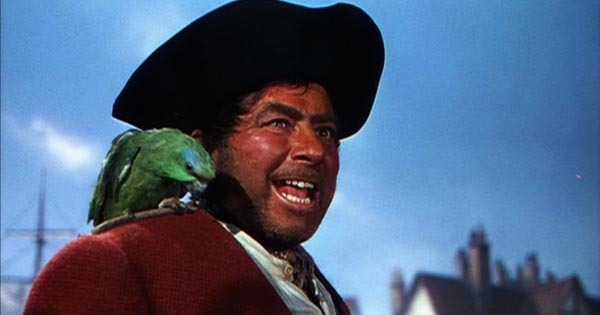
The “pirate voice” we recognize today was heavily shaped by actor Robert Newton, who played Long John Silver in Disney’s 1950 film version of Treasure Island. Newton used an exaggerated West Country English accent, and audiences loved it. Later movies copied it until “pirate” became less a historical identity and more a vocal setting somewhere between “farm dog” and “haunted door hinge.”
That does not mean no pirate ever rolled an R. Some sailors from southwestern England probably did speak with accents that sound pirate-like to modern ears. But the idea that every pirate sounded like the mascot of a seafood restaurant is pure pop culture.
So, did Blackbeard say “Arrr”? Maybe once, if he stubbed his toe. But he probably did not introduce himself with, “Arrr, I be here for yer booty,” unless he had an unusually advanced sense of brand management.
Myth 4: Pirates Always Flew the Skull-and-Crossbones Flag
The movie version
A pirate ship appears on the horizon, and there it is: a black flag with a white skull and crossbones. Everyone screams because, apparently, no merchant ship ever noticed the cannon first.
The reality
The Jolly Roger was real, but movies make it seem much more uniform than it was. Pirate flags came in different designs, colors, and symbols. Some showed skeletons, bleeding hearts, hourglasses, swords, or full figures of death. Some were black. Some were red. Some pirates used national flags or false colors to trick targets until they were close enough to attack.
That last part matters. A pirate ship flying a pirate flag all day would be like a burglar wearing a shirt that says “Hello, I Am Burglary.” Pirates needed deception. They often approached under friendly or neutral colors, then raised a terrifying flag only when escape was difficult for the victim.
The point of the flag was psychological warfare. If a merchant crew surrendered quickly, pirates could take the ship without a costly fight. Fighting was dangerous. Cannonballs are famously poor conversationalists. A scary flag could save pirates time, ammunition, and blood.
Movies also tend to treat the skull-and-crossbones as the one official pirate logo, as if pirates had a branding department and a style guide. In truth, the Jolly Roger was more of a family of fear-based designs than a single trademark. Real pirates understood marketing, but their target audience was “terrified merchants,” not Halloween costume shoppers.
Myth 5: Every Pirate Had an Eye Patch, Peg Leg, Hook, and Parrot
The movie version
A proper pirate captain must look like he lost a fight with a furniture store: peg leg, hook hand, eye patch, sword, pistol, giant hat, and one emotionally unstable parrot. Bonus points if the bird insults people.
The reality
Some sailors did lose limbs or eyes. Life at sea was dangerous. Battles, storms, infections, falling rigging, splintering wood, and primitive medicine could turn a minor injury into a lifelong problem. A disabled sailor was not unusual in the age of wooden ships.
But the full pirate costume is mostly an invention of fiction and illustration. The peg leg and parrot image owes much to Treasure Island and its unforgettable Long John Silver. A single great fictional character helped create an entire visual template.
The eye patch has its own popular theory: pirates supposedly wore patches to keep one eye adjusted to darkness for fighting below deck. It is a clever idea, and experiments have suggested it could work in principle. The problem is evidence. There is little solid historical proof that Golden Age pirates commonly used eye patches this way.
Parrots are another case of “possible but exaggerated.” Sailors did travel through regions where colorful birds could be bought, traded, or captured. A pirate might have carried an exotic animal as a valuable curiosity. But every pirate captain walking around with a squawking tropical sidekick? That is entertainment, not evidence.
Real pirates probably looked less like themed restaurant decorations and more like rough sailors: worn clothing, practical gear, weapons when needed, and the general facial expression of someone who has not enjoyed fresh vegetables in six weeks.
Myth 6: Pirates Were Noble Rebels With Hearts of Gold
The movie version
The pirate is a lovable rogue. He steals, yes, but only from worse people. He loves freedom, hates tyranny, protects children, respects women, saves the day, and looks fantastic in eyeliner. He is basically a wet cowboy.
The reality
This myth is complicated because real pirates were not simply mindless monsters. Some pirate crews did have written articles. Some elected captains. Some divided plunder by shares. Some compensated injured crew members. Compared with brutal conditions aboard many merchant and naval ships, pirate ships could offer sailors a strange form of rough workplace democracy.
That does not make pirates heroes. They robbed ships, threatened crews, used violence, and often participated in the same cruel economies as the societies around them. Many pirates targeted ships involved in Atlantic trade, including ships connected to slavery, but pirates were not automatically abolitionists. Some sold enslaved people for profit. Others forced captives into service. The reality is morally messy, not movie-clean.
Hollywood loves the freedom angle because it is fun. A pirate captain can ignore kings, governors, taxes, manners, and pants that fit properly. But real piracy thrived in a world of empire, war, trade, poverty, and weak law enforcement. Some pirates had once been privateersstate-approved raiders with legal permission to attack enemy shipsbefore peace made their old work illegal. Others were unemployed sailors after wars ended. Some chose piracy because it offered a chance at profit in a harsh economy.
The “noble pirate” myth survives because we like rebels better than robbers. But the truth is sharper: pirates could be democratic among themselves and merciless to outsiders. They could reject authority while exploiting the vulnerable. They could be fascinating without being good.
Why Pirate Myths Refuse to Sink
Pirate myths survive because they are useful stories. Buried treasure gives us adventure. Walking the plank gives us suspense. The Jolly Roger gives us instant danger. “Arrr!” gives us a joke anyone can perform badly at parties. Eye patches and parrots give us a costume. Noble rebellion gives us permission to cheer for criminals without feeling too guilty.
Movies did not create every pirate myth from scratch. Many came from novels, plays, old newspapers, sensational biographies, and folklore. But movies amplified them. Film is powerful because it turns history into images, and images stick. Once you have seen a pirate captain standing under a black flag with thunder behind him, a historian calmly explaining maritime economics has a difficult job.
Still, the real history is better than the myths in many ways. The true world of piracy includes global trade, colonial politics, naval warfare, shipboard labor, mutiny, propaganda, archaeology, and the birth of modern celebrity criminals. Blackbeard was not just a spooky beard with a hat. His flagship, Queen Anne’s Revenge, had a history before piracy as a French slave ship called La Concorde, which reminds us that pirate stories are tied to the darker systems of the Atlantic world.
The more we learn, the less pirates look like cartoons and the more they look like products of their time: violent, strategic, desperate, theatrical, and sometimes weirdly organized. In other words, much more interesting than “Arrr.”
Experiences Related to Pirate Myths: What These Stories Teach Modern Readers
One of the funniest experiences many people have with pirate history is realizing how much of their “knowledge” came from movies watched before they were old enough to pronounce “maritime commerce.” A child sees a pirate with a parrot and accepts it as fact. A teenager watches a swashbuckling duel and assumes real pirates spent half their day fencing on wet decks. An adult visits a museum exhibit and suddenly thinks, “Wait, where is the treasure map?” That little moment of confusion is where real history becomes exciting.
Pirate myths are a great reminder that pop culture is often our first history teacherand sometimes that teacher wears a fake mustache. Movies are not research papers. They compress events, simplify motives, and give everyone better lighting. But they also spark curiosity. Many people first become interested in maritime history because of fictional pirates. The trick is to enjoy the fantasy while knowing when to lower the gangplank into reality.
For writers, teachers, bloggers, and content creators, pirate myths are a gold chest of lessons. First, simple images travel farther than complex facts. A skull flag is easier to remember than a discussion about privateering law. Second, stories become believable when repeated. If every movie pirate says “Arrr,” audiences eventually assume pirates really spoke that way. Third, humor helps correction. Telling someone “Actually, pirates mostly stole cargo and participated in violent Atlantic trade networks” is accurate, but it may clear the room. Saying “Pirates were less buried-treasure bankers and more floating armed robbers with terrible HR policies” lands better.
Families can use these myths as fun learning moments. Watch a pirate movie, then ask: What parts were real? What parts were invented? Why would filmmakers choose the invented version? That conversation turns entertainment into media literacy. Children learn that history is not just a list of dates; it is a detective story about evidence, exaggeration, and who gets to tell the tale.
Travelers can also find pirate history in real places. Coastal forts, maritime museums, old ports, shipwreck exhibits, and historic seashores often tell stories far more layered than the average blockbuster. Standing near the waters where pirates sailed makes the past feel less like a costume party and more like a dangerous business shaped by wind, trade, politics, and fear.
The best experience, though, is the shift in perspective. Once you know the myths, pirate movies become even more entertaining. You can enjoy the sword fights while whispering, “Highly unlikely.” You can admire the treasure map while thinking, “Poor financial planning.” You can hear “Arrr!” and silently thank Robert Newton for accidentally becoming the unofficial vocal coach of every Halloween pirate ever.
That is the joy of debunking pirate myths. It does not ruin the adventure. It adds another layer. The fantasy gives us fun; the history gives us depth. Together, they make pirates exactly what they have always been: trouble on the horizon, wrapped in a very good story.
Conclusion
The six biggest pirate mythsburied treasure, walking the plank, universal “Arrr” speech, constant skull flags, mandatory eye patches and parrots, and noble outlaw heroismtell us more about movies than about actual pirates. Real pirates were more practical, more violent, more diverse, and more historically complicated than their screen versions. They used fear as a weapon, profit as motivation, and sometimes democracy as a survival tool. They did not need every Hollywood accessory to be terrifying.
So the next time a movie pirate stomps on deck with a parrot, a map, a hook, and a vocabulary made entirely of “Arrr,” enjoy the show. Just remember: the real pirate probably wanted your cargo, your ship, and your cooperationnot directions to the nearest buried treasure franchise.

