
Skincare
Top 10 Mysterious Nautical Legends and Superstitions
Aug
The ocean has always been excellent at keeping secrets. It is dark, enormous, moody, and capable of making even the most confident sailor reconsider every life choice that led them to stand on a wet deck at 3:00 a.m.
Before radar, satellite navigation, weather apps, and emergency beacons, sailors relied on experience, instinct, stars, wind patterns, and a surprisingly large collection of superstitions. Some beliefs were practical warnings dressed in spooky clothing. Others were simply humanity’s attempt to explain why the sea occasionally behaves like a giant, salty prankster.
From cursed ghost ships and monstrous tentacles to glowing masts and forbidden whistles, nautical legends have survived because they blend danger, imagination, and a little bit of “better not risk it.” Here are ten of the most mysterious nautical legends and sailor superstitions that continue to haunt maritime folklore.
1. The Flying Dutchman: The Ghost Ship That Never Reaches Port
Few maritime legends are as famous as the Flying Dutchman, the ghost ship condemned to sail forever without reaching land. Most versions of the story place the cursed vessel near the stormy waters around the Cape of Good Hope, where sailors historically faced brutal winds, rough seas, and a strong chance of questioning whether their employer had insurance.
According to legend, the Dutchman’s captain stubbornly tried to round the cape during a violent storm. Depending on the version, he either challenged God, cursed the heavens, ignored his crew, or made the sort of decision that would make a modern safety officer faint into a clipboard. As punishment, he and his ship were doomed to wander the oceans forever.
Sailors believed that seeing the Flying Dutchman was a bad omen. A ghostly ship on the horizon could supposedly predict disaster, death, shipwreck, or at minimum a truly terrible week at sea. In reality, some sightings may have been caused by mirages, especially a phenomenon called looming, in which atmospheric conditions make distant ships appear to float above the horizon.
Still, knowing the science does not completely ruin the mood. A ship hanging in the sky at sunset is exactly the kind of thing that makes a person whisper, “Absolutely not,” and head below deck.
2. Davy Jones’ Locker: The Ocean’s Most Unwelcome Storage Unit
Davy Jones’ Locker is one of the most enduring phrases in nautical folklore. It refers to the bottom of the sea, especially as the resting place of drowned sailors, sunken ships, and anything unfortunate enough to go overboard without a life jacket.
The exact identity of Davy Jones remains unclear. Some stories describe him as a sea devil, others as a monstrous sailor, and still others as a supernatural figure connected to King Neptune. What matters is that nobody wanted to meet him. “Going to Davy Jones’ Locker” became a darkly humorous way to describe drowning or losing something to the sea.
The phrase appeared in English maritime culture centuries ago and eventually became part of popular language. It even remains connected to naval traditions. In modern crossing-the-equator ceremonies, Davy Jones often appears as part of King Neptune’s royal court, helping initiate inexperienced sailors into the ranks of seasoned “Shellbacks.”
In other words, Davy Jones may be terrifying in folklore, but in naval tradition he also has a side job in ceremonial hazing. The sea contains multitudes.
3. The Kraken: When a Squid Becomes Everyone’s Worst Commute
The Kraken is the legendary sea monster of Norse folklore, usually imagined as a colossal squid or octopus large enough to drag ships beneath the waves. Ancient stories described it as a creature so massive that sailors might mistake its body for an island.
For centuries, the Kraken seemed like pure fantasy. Then scientists confirmed that giant squids are real. These elusive animals can reach impressive lengths, live far below the surface, and possess giant eyes, powerful beaks, and tentacles lined with suckers. That is more than enough equipment for a creature starring in everyone’s nightmares.
The real giant squid is not known for attacking wooden ships or collecting sailors like snacks. However, its existence helps explain why sailors may have believed in the Kraken. A half-seen tentacle, a huge carcass washed ashore, or a strange creature surfacing during rough weather could easily become a tale of a sea monster with a grudge.
Marine science did not kill the Kraken legend. It merely gave the monster a scientific name and made it slightly worse at sinking galleons.
4. Sea Serpents: The Original “You Won’t Believe What I Saw” Story
Long before viral videos, sailors were reporting mysterious creatures twisting through the waves. Sea serpents appeared in maps, travel journals, paintings, and tavern stories across Europe and North America. Some were said to have horse-like heads. Others had enormous humps, shining scales, or jaws large enough to swallow a rowboat.
One famous nineteenth-century report came from the crew of HMS Daedalus, who described seeing a massive serpent-like creature in the South Atlantic. The account became a major sensation, partly because respectable officers insisted they had witnessed something extraordinary.
Modern researchers suggest that many sea-serpent sightings may have involved known animals seen under strange conditions. Oarfish, which are long and ribbon-like, can look serpent-shaped when moving near the surface. Giant squids, basking sharks, whales, seals, and even drifting debris may also have played a role.
The lesson is not that sailors were foolish. The ocean changes perspective. A familiar object can become mysterious when it appears far away, in poor light, during bad weather, after three days of sleep deprivation, and while someone nearby is insisting it has “definitely got horns.”
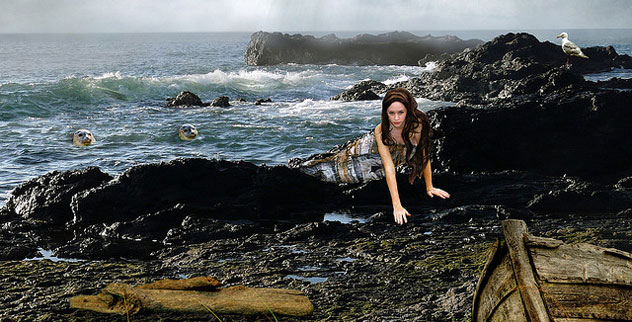
5. Mermaids and Sirens: Beautiful, Dangerous, and Probably a Manatee
Mermaids are among the oldest and most recognizable creatures in nautical mythology. Usually depicted as beings with the upper body of a human and the tail of a fish, mermaids could be helpful, seductive, prophetic, or catastrophically bad news depending on the story.
Sirens are often mixed up with mermaids, although their origins are different. In ancient Greek mythology, sirens were dangerous singers whose music lured sailors toward destruction. Early artistic depictions showed them more like bird-women than fish-tailed sea maidens. Over time, stories blended together, and the modern image of the singing mermaid took over.
There may be a practical explanation for some mermaid reports. Manatees, dugongs, seals, and other marine animals can appear oddly human-like from a distance. Add heat haze, exhaustion, moonlight, and a sailor who has not seen land in months, and suddenly a sea cow becomes a glamorous aquatic celebrity.
It is not the manatee’s fault. It is doing its best. It just has terrible publicity.
6. St. Elmo’s Fire: The Ghostly Blue Light on a Ship’s Mast
St. Elmo’s fire sounds like something a pirate would order at a tavern, but it is a real atmospheric phenomenon. It occurs when a strong electrical field causes the air around a pointed object, such as a ship’s mast, antenna, or rigging, to glow with bluish or violet light.
To sailors before modern science, this eerie light could look supernatural. Some viewed it as a sign of protection from St. Erasmus, the patron saint of sailors. Others saw it as a warning that a storm was nearby. Both interpretations were understandable because St. Elmo’s fire often appears during electrically charged weather conditions.
Today, mariners know that a glowing mast is not a magical blessing from the heavens. It is an electrical warning that should be taken seriously. The old sailors were not entirely wrong to feel nervous. A ship glowing in a storm is beautiful, mysterious, and also a strong hint that lightning may be preparing to make an entrance.
7. The Bermuda Triangle: The Sea Mystery That Refuses to Retire
The Bermuda Triangle is usually described as a region of the western North Atlantic bounded roughly by Florida, Bermuda, and Puerto Rico. For decades, it has been associated with stories of missing ships, vanished aircraft, strange compass behavior, time portals, aliens, Atlantis, and enough dramatic theories to fill several late-night television marathons.
The legend grew from reports of disappearances, including the 1945 loss of Flight 19, a group of U.S. Navy training aircraft. The mystery became even more popular in books, magazines, and television programs during the twentieth century.
However, scientific and maritime agencies have found no evidence that disappearances occur more frequently in the Bermuda Triangle than in other heavily traveled ocean regions. The area has busy shipping routes, unpredictable weather, powerful currents, hurricanes, shallow waters, and plenty of opportunities for human error.
That may be less thrilling than an underwater alien city, but it is also more useful. The Bermuda Triangle is not proof that the ocean has supernatural powers. It is proof that the ocean does not need supernatural powers to be dangerous.
8. The Mary Celeste: The Real Ghost Ship Mystery
The Mary Celeste was not a ghost ship in the supernatural sense, but it became one of history’s most famous maritime mysteries. In December 1872, the American merchant brigantine was found drifting in the Atlantic Ocean near the Azores. The ship was seaworthy enough to sail, its cargo was largely intact, and there was food and water aboard.
What was missing was the entire crew.
Captain Benjamin Briggs, his wife, his young daughter, and seven crew members had vanished. The ship’s lifeboat was gone, but there was no confirmed evidence of piracy, murder, sea monsters, mutiny, or a dramatic ghostly takeover by a cursed captain with questionable management skills.
Over the years, people have proposed many explanations. Some believe the crew abandoned ship after fearing an explosion caused by alcohol vapors from the cargo. Others suggest rough weather, a faulty pump, navigational errors, or panic. The truth remains uncertain because the people who knew what happened never returned to explain it.
The Mary Celeste survives because uncertainty is more powerful than a neat ending. A solved mystery makes a good article. An unsolved one gets a ghost-ship legend, a dozen theories, and permanent rent-free space in the human imagination.
9. The Albatross Curse: Do Not Annoy the Bird That Knows the Ocean Better Than You
Albatrosses have long been admired by sailors because they can glide for astonishing distances over open water. Their ability to appear effortlessly above waves made them seem almost supernatural. In maritime folklore, they were sometimes associated with the souls of dead sailors or regarded as signs of good fortune.
That reverence led to one of the best-known sailor superstitions: never kill an albatross.
The belief became especially famous through Samuel Taylor Coleridge’s poem The Rime of the Ancient Mariner, in which a sailor kills an albatross and brings disaster upon his ship. The dead bird is hung around his neck as punishment, creating the modern expression “an albatross around your neck.”
Not every sailor in history followed the exact same belief, and the superstition owes much of its fame to literature. Still, the idea makes emotional sense. A bird that appears during long, lonely voyages can feel like a companion, a guide, or a little piece of land-based sanity with wings.
Also, if an albatross can cross an ocean without reading a weather forecast, perhaps it deserves respect.
10. Whistling, Renaming Ships, and Other Ways to Offend the Sea
Sailor superstitions were not limited to monsters and ghost ships. Many focused on everyday behavior aboard a vessel. Whistling, for example, was often considered bad luck because it might “whistle up a storm.” In some traditions, a sailor could whistle only when the ship needed wind, but even then, moderation seemed wise. Nobody wanted to accidentally order a hurricane.
Renaming a ship was another risky move. Maritime folklore says that every vessel’s name is recorded in Neptune’s ledger. Changing the name without properly removing the old one could confuse or anger the sea gods, inviting bad luck.
This belief remains popular among modern boat owners, many of whom perform elaborate renaming ceremonies. The process may involve removing all traces of the old name, offering a drink to the sea, and formally introducing the vessel under its new identity.
Is it scientifically necessary? No. Is it an enjoyable excuse to pour a little champagne over the bow while making everyone wear nautical clothing? Absolutely.
Why Nautical Legends Still Matter
Nautical legends and sailor superstitions are more than spooky stories. They reveal how people made sense of an environment that was unpredictable, unforgiving, and often deadly. When sailors did not understand electrical charges, they saw holy fire. When they encountered giant squid, they imagined the Kraken. When a distant vessel floated strangely above the horizon, they saw the Flying Dutchman.
These stories also helped build community. Sailors shared legends to explain danger, entertain each other, preserve traditions, and make long voyages feel less lonely. A superstition could become a rule, a joke, a warning, or a ritual that reminded everyone aboard that the sea deserves respect.
Experiences at Sea: Why These Legends Feel Real When the Horizon Goes Dark
You do not need to believe in ghost ships to understand why sailors developed ghost-ship stories. Spend enough time near open water at night and the imagination begins doing unpaid overtime.
Picture a small vessel moving through calm water after sunset. The engine hums. The horizon disappears. The sky looks endless, but the ocean looks even more endless because it does not provide helpful landmarks, streetlights, or a nearby coffee shop. A distant light flickers once, then vanishes. Was it another boat? A buoy? A reflection? A ghostly captain trying to deliver mail from 1798? The sensible answer is usually “probably a buoy,” but the brain enjoys options.
Fog adds another layer. It changes distance, muffles sound, and makes ordinary noises feel suspicious. A bell from another vessel may seem closer than it is. A wave striking the hull can sound like footsteps. A seabird calling in the dark can resemble someone shouting from far away. Sailors learn quickly that the sea is full of sounds, but they also learn that not every sound needs an immediate supernatural explanation.
Fatigue plays a major role, too. Long watches, bad weather, and repetitive movement can make perception unreliable. A tired person looking across waves may mistake a floating log for an animal, a cloud bank for land, or a distant ship for something that appears to be hovering above the water. The ocean does not have to be haunted to look haunted.
Still, even experienced mariners often respect old traditions. A captain may laugh at the idea of a cursed ship name but still hesitate before changing it. A sailor may know that whistling cannot physically summon a storm yet avoid doing it during bad weather. These habits are not always about literal belief. They can be a form of respect for those who sailed before, survived difficult waters, and passed down the stories.
The most powerful nautical legends are not scary because they prove monsters exist. They are scary because they capture a real feeling: the sense that humans are small when surrounded by deep water, strong wind, black sky, and a horizon that refuses to explain itself.
That feeling is why the Flying Dutchman still sails, why Davy Jones still waits below, and why the Kraken still wraps its enormous imaginary tentacles around our curiosity. The sea remains one of the last places where science and mystery can share the same deck without arguing too loudly.
Conclusion
From the cursed Flying Dutchman to the glowing mast lights of St. Elmo’s fire, nautical legends combine real danger with human imagination. Some stories began with misunderstood animals, unusual weather, optical illusions, or unexplained disasters. Others grew from rituals that gave sailors comfort when the ocean offered none.
Whether you view these tales as folklore, history, entertainment, or a warning never to rename your boat without consulting Neptune, maritime superstitions still have a special pull. They remind us that the sea has always been beautiful, frightening, and just mysterious enough to make us look twice at the horizon.

