
Beauty Tools & Accessories
Kenya’s Crack in the Ground Leads to Debate Over Weather vs. New Continent
Jul
If Earth had a flair for drama, Kenya’s famous ground crack would be one of its better performances. One day, a road in the Rift Valley was doing normal road things. Then came heavy rain, a giant fissure, frightened residents, damaged homes, and headlines that essentially screamed, “Congratulations, Africa may be inventing a new continent.” That is a lot for one crack to carry.
But beneath the viral photos and apocalypse-adjacent captions sits a more interesting story, and thankfully, a more accurate one. The split in the ground near Kenya’s Mai Mahiu area sparked a debate that still hooks readers: was it just weather, or was it proof that East Africa is literally pulling apart? The best answer is not nearly as meme-friendly as “new continent just dropped,” but it is much smarter. Weather mattered. Tectonics mattered. And the truth lives in the messy middle, where geology usually hides while the internet oversimplifies it.
This is what actually happened, why the East African Rift matters, and why the phrase “weather vs. new continent” is a false choice that sounds great in a headline but falls apart under scientific scrutiny.
Why the Kenya Crack Became a Global Obsession
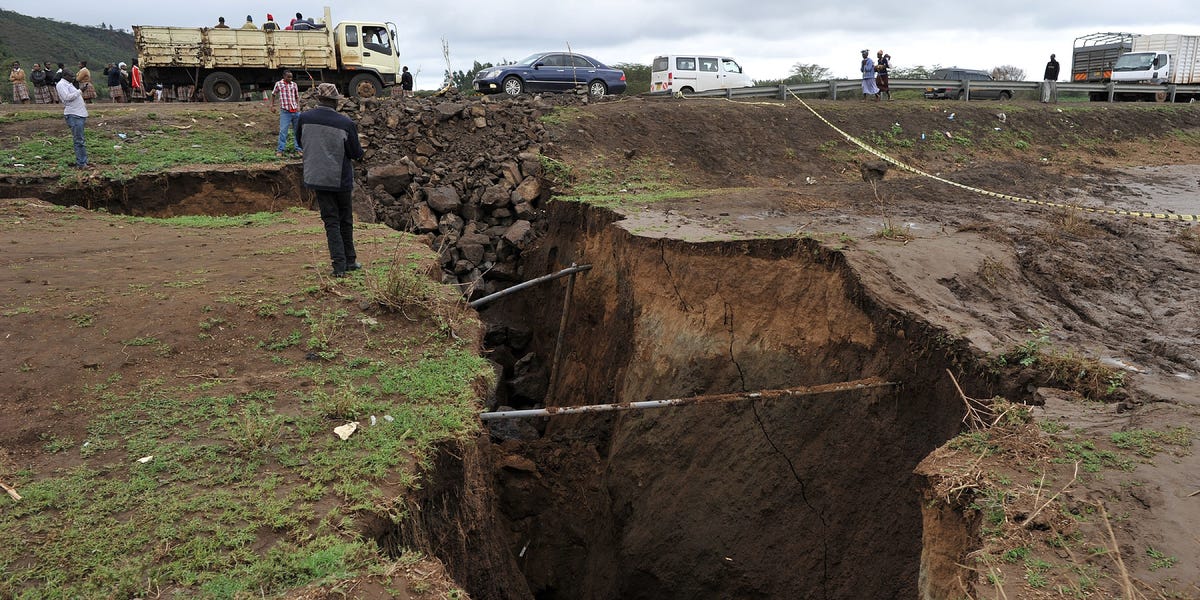
The reason the story exploded is simple: the visuals were incredible. In 2018, a large fissure opened in Kenya’s Rift Valley region after heavy rainfall. Reports described a crack roughly 50 feet deep and about 65 feet wide in places, and it damaged part of the Mai Mahiu-Narok road. Homes were affected. Families moved out. Drivers stared at the landscape as if the planet had suddenly decided to stop being subtle.
That kind of scene practically writes its own headlines. A giant tear in the ground? In the Rift Valley? In East Africa, where scientists have long said the crust is stretching? The leap from “road damaged by fissure” to “new continent incoming” was not exactly a long jump.
But headlines love a single cause, and geology rarely offers one. The public got two neat camps instead. One side said the crack was caused by intense weather, erosion, and groundwater. The other said it was a visible sign that Africa is splitting in two. Both sides grabbed part of the truth. Neither, by itself, told the whole story.
So, Was It Weather or Tectonics?
The Weather Argument
The weather explanation is the one that feels most immediate because, well, the rain had just happened. According to geologists cited widely at the time, the fissure may have been a preexisting weak zone that had been filled with volcanic ash from nearby Mount Longonot. Heavy rainfall then washed away that loose material, exposing the gap and making the crack suddenly visible in a dramatic way.
That is a crucial point. Rain does not need to invent a fracture from scratch to create a disaster. It only needs to reveal a weakness, saturate soils, speed up erosion, reroute groundwater, and destabilize the surface enough for the landscape to fail in public. Earth does not always build new features overnight. Sometimes it simply yanks the tarp off old ones.
That helps explain why some scientists argued the fissure looked more like an erosion-related earth fissure than a brand-new tectonic rupture. In plain English: the storm may not have created the underlying weakness, but it likely made the weakness impossible to ignore.
The Tectonic Argument
Now for the part the “just weather” crowd sometimes underplays: this did not happen in a random parking lot in a geologically boring suburb. It happened in the East African Rift, one of the planet’s best-known active continental rift systems. This is not decorative scenery. It is a place where the crust is under stress, faults are active, volcanoes are part of the landscape, and the broader tectonic setting absolutely involves the slow separation of crustal blocks.
The East African Rift stretches thousands of miles from the Afar region toward Mozambique. It marks a broad zone where the Somali Plate and the Nubian Plate are moving apart. That motion is slow, measured in millimeters per year rather than “before lunch,” but it is real. Over geologic time, slow is not a weakness. Slow is a strategy.
So yes, the tectonic backdrop matters enormously. The Kenya fissure appeared in a region where faulting, crustal thinning, uplift, and volcanism are part of the long story. If you are looking for a place on Earth where a dramatic ground crack might relate to continental rifting, this is a strong candidate. That does not mean every crack equals instant continental breakup. It means the area is already primed with structural weaknesses created by deep Earth processes.
The Real Answer: Different Causes, Different Time Scales
This is where the debate gets smarter. Weather and tectonics were not competing to be the one true villain. They were operating on different clocks.
Tectonics built the stage over millions of years. It created the rift, the faults, the crustal stretching, the volcanic deposits, and the structural weaknesses in the region. Weather was the short-term trigger or revealer. It likely stripped away material, destabilized the ground, and exposed a hidden fracture in a spectacular fashion.
In other words, the rain did not personally apply for a permit to split Africa into two. It simply made an already fragile landscape fail dramatically enough for cameras to notice.
What the East African Rift Actually Is
The East African Rift is one of the rare places on Earth where scientists can watch a continent in the long process of being pulled apart. It is a continental rift, meaning it forms where the crust stretches, thins, and breaks along faults. Over time, continued extension can eventually produce new oceanic crust and a new ocean basin. That is how ancient continents have split before.
If that sounds familiar, it should. Today’s Atlantic Ocean exists because older continents rifted apart long ago. The East African Rift offers a modern example of an earlier chapter in that kind of story.
Still, perspective matters. The most responsible version of this story is not “Africa is splitting tomorrow.” It is “East Africa is part of a long-term tectonic process that, if it continues, could eventually separate a landmass and create a new ocean basin tens of millions of years from now.” That sentence is less catchy, but it has the advantage of not being nonsense.
Scientists have described the Horn of Africa as the part most likely to become separated eventually if rifting continues. But “eventually” in geology is doing heroic work here. We are talking about a timescale so vast that your cracked phone screen will not live to see the conclusion.
Why the “New Continent” Framing Is Both Right and Wrong
What the Headlines Got Right
The dramatic framing was not invented from thin air. East Africa really is rifting. The Somali and Nubian plates really are diverging. Faults, earthquakes, volcanic activity, and crustal stretching really are part of the region’s geologic identity. And if divergence continues long enough, a separate landmass and a new ocean basin are plausible outcomes.
So the “new continent” angle has a scientific foundation. It is not pure fantasy. The problem is timing and scale.
What the Headlines Got Wrong
The viral coverage often blurred a crucial distinction: a local fissure is not the same thing as a continent suddenly snapping like a cracker. A visible crack in the ground is a surface feature. Continental breakup is a massive tectonic process involving crustal thinning, faulting, magma, subsidence, and eventually the birth of new oceanic crust. Those are related ideas, but they are not interchangeable.
That is why the phrase “proof of a new continent” is too confident for a single fissure event. The crack in Kenya was important and visually dramatic, but it was not a grand opening ceremony for Ocean 2.0. It was one event inside a much larger tectonic environment.
Where Weather Fits Into the Bigger Science
Here is where the story gets even more interesting: weather and climate are not merely side characters in tectonic landscapes. They can influence how those landscapes behave.
Heavy rainfall can accelerate erosion, undermine roads, saturate soils, and expose buried weaknesses. That is the short-term part. But at longer timescales, climate can also affect rifting more subtly. Recent research tied to the East African Rift suggests that large changes in lake levels can alter stress on faults and influence slip rates over thousands of years. That does not mean every rainstorm is secretly doing plate tectonics. It means the surface and the deep Earth are not living separate lives.
Think of it this way: tectonics writes the architecture, but climate and weather can rearrange the furniture, punch through weak drywall, and occasionally reveal that the foundation has issues.
So if someone asks whether weather matters in the Kenya crack story, the answer is yes. If they ask whether the East African Rift still matters more broadly, the answer is also yes. Science can be annoyingly balanced like that.
Why This Matters Beyond a Viral Geology Story
This debate is not just about winning a trivia argument online. It matters because how we describe geologic hazards affects how people prepare for them.
If the public hears only “new continent,” the story sounds distant, cinematic, and oddly entertaining. It feels like a trailer for a movie that nobody alive will finish. But if the public hears “active rift terrain plus erosion, rainfall, faulting, and infrastructure vulnerability,” the story becomes useful. Roads can fail. Homes can be damaged. Land-use planning matters. Drainage matters. Monitoring matters. So does not building important infrastructure as if the ground underneath is emotionally stable.
Kenya’s Rift Valley is beautiful, economically important, and geologically complicated. That combination is excellent for tourism brochures and terrible for lazy science communication.
The Bigger Lesson: Geology Hates Simple Narratives
Humans love either-or questions because they are tidy. Was it weather or tectonics? Was it a crack or a continent? But Earth usually answers in layers.
The Kenya fissure was not “just weather” in a geologically meaningless location. Nor was it proof that a brand-new continent had suddenly arrived like an express delivery. It was a dramatic surface event in an active rift zone, likely exposed or amplified by heavy rainfall, within a region already shaped by deep tectonic forces. That is the honest version.
And frankly, it is the better story. A planet where atmosphere, water, rock, heat, and time all interact is much more interesting than one where a headline picks a single villain and calls it a day.
Experiences From the Rift: What This Story Feels Like on the Ground
The most powerful part of the Kenya crack story is not the phrase “new continent.” It is the human experience tucked inside it. For residents near the fissure, this was not a classroom discussion about plate boundaries. It was a day when the ground behaved in a way that humans instinctively hate. The surface that is supposed to be dependable suddenly looked negotiable.
Reports from the time described families watching cracks run through homes, people scrambling to move belongings, and drivers confronting a road that no longer made sense. That experience matters because geology is often discussed as something abstract, ancient, and safely far away. But in the Rift Valley, geology shows up in the commute. It shows up in property damage, detours, anxiety, and the nervous habit of staring at a fracture and wondering whether it was smaller yesterday.
For farmers and local landowners, a fissure is not just a scientific curiosity. It can change how land is used, where animals move, and whether a piece of property still feels secure. For transport workers, a damaged road is not a symbol of tectonic wonder. It is lost time, disrupted trade, higher costs, and risk. For local officials, it is the kind of event that forces emergency response and long-term questions at the same time: repair the road now, but also ask whether this corridor is vulnerable again next rainy season.
There is also a psychological experience to living in a place that suddenly becomes global news. People outside the region often react with fascination. People inside the region have to live with the aftermath. That gap is common in natural hazard stories. Outsiders see spectacle. Locals see consequences.
Then there is the experience of the landscape itself. Kenya’s Rift Valley is stunning. Escarpments, volcanic terrain, long valleys, and broad skies make it look as if the Earth’s crust has been carefully staged for a documentary narrator with a very serious voice. In places like this, the beauty and the danger are roommates. The same geologic forces that create unforgettable scenery also create instability. That duality is part of daily life in rift environments.
For geologists, the experience is different again. A crack like this is a field lesson with real stakes. It invites questions about fault geometry, erosion, sediment infill, volcanic deposits, groundwater flow, and how surface processes interact with deep structure. It is the sort of event that can be both scientifically fascinating and socially disruptive, which is exactly why researchers and hazard planners have to talk to each other.
And for ordinary readers everywhere, the Kenya crack offers a humbling experience of its own. It reminds us that the ground under our feet is not a static platform. It only feels permanent because human lives are short and geologic time is rude. The Earth is always moving, adjusting, cracking, and rebuilding. Most of the time it does so quietly. Every now and then, though, it does it loudly enough to stop traffic, rattle nerves, and remind us that “solid ground” is sometimes more of a hope than a promise.
Conclusion
So what caused Kenya’s famous crack in the ground? The cleanest answer is this: heavy rain likely exposed or worsened a surface expression of weakness in a landscape already shaped by active rifting. The weather did not cancel tectonics, and tectonics did not make rainfall irrelevant. Both belonged in the story; they just belonged at different scales.
The East African Rift remains one of the world’s most remarkable tectonic systems, and yes, it may someday help create a separate landmass and a new ocean basin. But the Kenya fissure was not a countdown clock to tomorrow’s map. It was a reminder that deep Earth processes and surface weather can collide in ways that are dramatic, disruptive, and easy to misunderstand.
If there is a final lesson here, it is that geology rarely rewards oversimplification. The planet prefers nuance, long timelines, and the occasional giant crack just to keep everyone humble.

