
Hair Care
Italian Photographer Shows What Childhood Looks Like In Different Corners Of The World (30 Pics)
Jun
Childhood is the one country we all came from, even if the address looked wildly different. For some children, it smells like dusty football fields, mango trees, school uniforms, and grandmother’s soup. For others, it looks like mountain paths, crowded city streets, painted faces, woven baskets, plastic sandals, bare feet, or a toy that has survived more adventures than an action movie hero.
Italian photographer Massimo Bietti has built a moving body of travel portrait photography that captures children in different corners of the world. His portraits, often shared in galleries featuring 30 or more images, are not glossy travel brochures or “look how exotic” postcards. They are quieter than that. They are direct, human, and sometimes so full of personality that you can almost hear the child thinking, “Yes, you may take my picture, but make it quickI have important kid business to handle.”
The result is a visual reminder that childhood around the world is both universal and deeply shaped by place. A child in Papua New Guinea, Ethiopia, India, Russia, Norway, Vanuatu, Malaysia, Peru, or South Sudan may grow up surrounded by different languages, clothing, landscapes, expectations, and resources. Yet the expressions Bietti catchescuriosity, shyness, mischief, pride, boredom, wonderneed no translation. Eyebrows, as it turns out, are international.
Who Is Massimo Bietti?
Massimo Bietti is an Italian photographer known for portraits that focus on faces, culture, and everyday humanity. His work often centers on people photographed during travels across remote villages, rural communities, and culturally rich regions. Rather than staging elaborate scenes, Bietti tends to let the subject’s face do the storytelling. That approach works especially well with children because children rarely hide their emotions behind polite adult packaging. If they are curious, you see it. If they are skeptical, you definitely see it. If they are amused by the photographer, the camera becomes part of the joke.
In his childhood portraits, Bietti shows children not as symbols of poverty, innocence, hardship, or cuteness alone, but as individuals. This matters. A strong child portrait should never feel like a souvenir collected from someone else’s life. It should feel like a brief meeting. The best of Bietti’s photographs create exactly that feeling: the viewer is invited to pause, look closely, and recognize a person before recognizing a place.
Why These 30 Pics Feel So Powerful
A gallery titled “Italian Photographer Shows What Childhood Looks Like In Different Corners Of The World (30 Pics)” immediately promises variety: different countries, faces, clothing, backgrounds, and moods. But the real power is not simply in difference. It is in the balance between difference and sameness.
One portrait may show a child standing against a rugged natural landscape. Another may show a child wrapped in traditional clothing. Another may reveal a face dusted by outdoor play, a shy half-smile, or a gaze so serious it could negotiate a mortgage. Each frame carries cultural details, but the emotional core remains familiar. Children everywhere play, observe, copy adults, test boundaries, form friendships, and learn how the world worksusually while getting dirty enough to alarm laundry detergent executives.
These images remind viewers that childhood is not one standardized experience. It is not always bedrooms painted in pastel colors, lunchboxes with cartoon characters, and scheduled soccer practice. In many parts of the world, childhood includes helping family, walking long distances, caring for siblings, learning through community rituals, or growing up close to animals, land, and weather. The pictures do not need to lecture us. They simply place faces in front of us and let the viewer do the emotional math.
Childhood Around the World: Different Settings, Shared Feelings
One of the most interesting things about Bietti’s portraits is how much they say without relying on dramatic action. The children are often still. They look at the camera. They occupy their environment naturally. That stillness gives viewers time to notice the small details: fabric textures, hairstyles, sunlight, posture, hand placement, background colors, and expressions that hover between confidence and caution.
Clothing Tells a Story
Children’s clothing in these portraits often reveals climate, tradition, family customs, and daily life. A sweater in a colder region, bright fabric in a warm village, school clothing in an education setting, or handmade accessories can say more than a paragraph of explanation. Clothing becomes a map of belonging. It shows how children are introduced into community identity before they even understand the full meaning of it.
Faces Carry the Universal Language
Faces are the heart of portrait photography. In Bietti’s work, the children’s eyes often dominate the frame. Some faces are serious, almost royal. Some are playful. Some look slightly suspicious, as any sensible child should when a stranger points a camera at them. That range of expression is what keeps the gallery from becoming sentimental wallpaper. The children are not presented as one emotion. They are complicated, just like adults, only shorter and usually better at climbing things.
Backgrounds Add Context Without Stealing the Scene
A good background supports the subject instead of swallowing them. In these portraits, landscapes and village settings often provide a sense of place, but the child remains central. This is important for ethical storytelling. The image is not saying, “Look at this distant location.” It is saying, “Look at this child, who lives in a real place, with real history, real family, and real dignity.”
The Importance of Photographing Childhood With Respect
Photographing children requires care. Children are not props, and childhood should not be turned into decoration for adult curiosity. Ethical visual storytelling means respecting dignity, privacy, cultural context, and the safety of the person being photographed. When a photographer works across cultures, this responsibility becomes even bigger.
That is why Bietti’s strongest images stand out: they feel observational rather than exploitative. The children are not reduced to stereotypes. A child in a remote region is not automatically shown as “poor.” A child in traditional dress is not treated as a museum exhibit. A child with a serious expression is not forced into a sad story. The viewer is allowed to wonder, but not to claim ownership over the child’s life.
This distinction is crucial. The internet loves quick emotional reactions. It is very good at turning complex human lives into captions, hashtags, and “Aww!” comments. But responsible photography asks us to slow down. The question is not only “Is this image beautiful?” but also “Does this image preserve the person’s dignity?” Great travel portrait photography should open curiosity, not flatten people into visual clichés.
What These Portraits Teach Us About Play
Play is one of the strongest threads connecting childhood across cultures. Children do not need expensive toys to invent worlds. Give them a stick, and suddenly it is a sword, a horse, a fishing pole, a microphone, or a highly advanced engineering tool. Give them mud, and congratulations, the construction industry has begun.
In many communities, play blends with daily life. Children may play while helping with chores, watching animals, walking with siblings, or waiting near adults at work. In other places, play happens in schools, playgrounds, apartments, alleys, fields, beaches, and courtyards. The setting changes, but the impulse remains the same. Children experiment with roles, rules, movement, language, and imagination. They rehearse adulthood while joyfully ignoring most adult safety recommendations.
Bietti’s portraits are not action shots of games, but they still point toward the role of play. The relaxed shoulders, curious looks, and playful glances suggest children who are actively engaged with their surroundings. Childhood is not only a stage of life; it is a way of exploring the world before the world gets too heavy.
Education, Opportunity, and the Bigger Picture
Looking at children around the world also invites a broader conversation about education and opportunity. Every child deserves the chance to learn, grow, and participate fully in society. Yet access to education, healthcare, safety, clean water, nutrition, and digital tools varies widely between countries and communities.
A portrait cannot explain all of that by itself. It cannot tell us a child’s school attendance, family income, future options, or daily responsibilities. But it can make the abstract personal. Statistics about children matter, but faces make them harder to ignore. A number tells us scale. A portrait tells us why scale matters.
This is where photography becomes more than art. It becomes a bridge between attention and empathy. Viewers may arrive for beautiful images, but they often leave thinking about childhood rights, cultural diversity, social inequality, and the simple truth that every child’s life has value long before it becomes useful to an economy.
Why Global Childhood Photography Captures Our Attention
There is a reason photo essays about children around the world spread widely online. They combine beauty, curiosity, and emotional recognition. We look at a child from a distant place and see someone unfamiliar. Then we notice the expression: the side-eye, the grin, the awkward pose, the confidence, the impatience. Suddenly the distance shrinks.
Global childhood photography also reminds adults of their own early years. Maybe you did not grow up in the same village, climate, or culture as the child in the picture, but you probably remember the feeling of being small in a world built by giants. You remember adults talking above your head. You remember being told to stand still for a photo while your entire body wanted to sprint into chaos. You remember the strange magic of ordinary days.
Bietti’s portraits work because they do not overexplain. They trust the viewer to notice. In a digital culture where everything screams for attention, a quiet portrait can feel almost rebellious. No filter fireworks. No dancing arrow. No caption shouting “You won’t believe number 17!” Just a child looking back.
Specific Examples of Childhood Across Different Corners
Across galleries of Bietti’s work, viewers encounter children from regions such as Papua New Guinea, Vanuatu, South Sudan, Ethiopia, India, Malaysia, Peru, Russia, and Norway. These places are geographically and culturally different, but the portraits do not present them as opposites. Instead, they create a mosaic.
Papua New Guinea and Vanuatu
Portraits from Pacific island communities often highlight closeness to nature, vivid textures, and expressive faces. The children may be framed by greenery, open air, or village surroundings. The mood is often earthy and immediate, as though the viewer has stepped into a moment between play, family life, and daily routine.
Ethiopia and South Sudan
Images from East Africa can carry striking contrasts of color, light, and expression. Children in these portraits may appear strong, watchful, and composed. Their faces challenge lazy assumptions. They are not asking for pity. They are simply present, and that presence is powerful.
India and Malaysia
Portraits from South and Southeast Asia often include rich visual detailbright fabrics, layered backgrounds, lively environments, and faces full of alertness. These images remind us that childhood can unfold in dense social worlds where family, street life, school, worship, and work exist close together.
Russia, Norway, and Peru
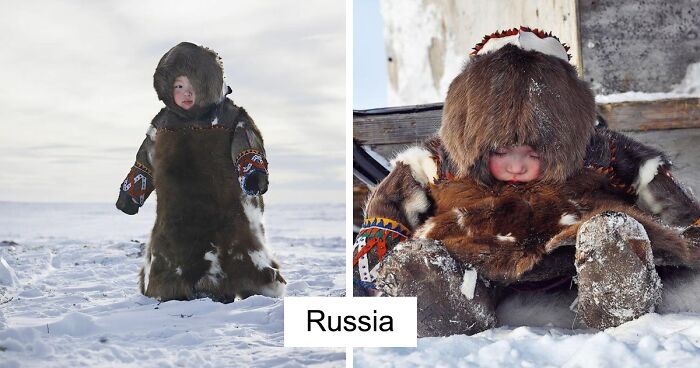
In colder or mountainous regions, the visual language shifts again. Clothing, weather, landscape, and posture change the tone of the portrait. Yet the child’s gaze remains the anchor. Whether surrounded by snow, hills, buildings, or rural paths, the subject is never just “local color.” The child is the story.
The Humor Hidden in Childhood Portraits
One underrated pleasure of these images is the accidental comedy of childhood. Children have a talent for looking both innocent and like they know exactly where the missing cookies went. Some stare into the camera with ancient wisdom. Others seem one second away from giggling. Some look deeply unimpressed, as if the photographer has failed a very important vibe check.
This humor is not disrespectful. It is part of what makes children human. Too often, global documentary photography becomes heavy, solemn, and emotionally polished. But real childhood includes goofy faces, stubborn moods, weird poses, dramatic complaints, and the universal childhood belief that a stick can improve almost any situation. Bietti’s portraits allow space for that personality.
How These Images Can Change the Way We See the World
The best travel photography does not make the world feel smaller by making everyone seem the same. It makes the world feel more connected by showing how differences and similarities exist together. Bietti’s childhood portraits invite us to appreciate cultural variety without treating it like a costume rack.
They also challenge the viewer to look beyond convenience. It is easy to scroll past images quickly, giving each child half a second before moving on to a recipe, a celebrity haircut, or a cat behaving like a tiny landlord. But these portraits reward slower looking. The longer you look, the more the image becomes a meeting rather than content.
That shift matters. When we see children from other countries as full human beingsnot symbols, not statistics, not background characters in someone else’s travel adventurewe strengthen the basic empathy that global citizenship requires. It sounds grand, but it starts simply: look, pause, respect.
500-Word Reflection: Personal Experiences These Photos Bring to Mind
Looking at a collection like “Italian Photographer Shows What Childhood Looks Like In Different Corners Of The World (30 Pics)” can make almost anyone travel backward in time. Not to a country, necessarily, but to the strange little planet of being a child. Childhood memories are rarely organized like official documents. They arrive as flashes: the smell of rain on hot pavement, the sound of a school bell, the feeling of dust on your knees, the terrifying power of an adult saying your full name.
What these portraits bring to mind most strongly is how children create belonging wherever they are. A child does not need perfect conditions to form memories. They remember the corner where friends gathered, the path to school, the tree that was obviously a spaceship, the neighbor who gave snacks, the cousin who cheated at games and denied it with Olympic-level confidence. The world of childhood is built from ordinary places charged with imagination.
These images also make us think about how adults often misunderstand children. Adults look for big milestones: grades, achievements, certificates, clean shirts. Children often remember smaller things: who listened, who laughed, who protected them, who let them ask questions, who made them feel seen. In that sense, Bietti’s photographs feel important because they do exactly that. They see children. Not as future adults, not as charity posters, not as cute decorations, but as people already living meaningful lives.
For readers in the United States or other highly commercial cultures, the portraits may also create a useful pause. Modern childhood is often surrounded by products: educational toys, activity kits, apps, sports gear, themed bedrooms, and birthday parties that require more logistics than a small wedding. None of those things are automatically bad. A good backpack can be a loyal friend. But these global portraits remind us that childhood is not measured by how many things a child owns. It is measured by connection, safety, curiosity, imagination, and the freedom to grow.
The photos also highlight resilience without romanticizing hardship. That balance is important. It can be tempting to look at children in rural or less wealthy settings and say, “They are happy with so little,” which sounds sweet but can become a lazy way to ignore inequality. Children deserve joy, but they also deserve healthcare, education, protection, nutrition, and opportunity. The lesson is not that children need less. The lesson is that children bring astonishing life to whatever world they are givenand adults are responsible for making that world fairer.
Finally, these portraits remind us that childhood is brief. One day, the child in the photo will be grown. The serious face may become a parent, teacher, farmer, artist, doctor, builder, driver, scientist, or storyteller. The shy smile may become a voice in a community. The mischievous stare may become leadership, which is slightly worrying but also promising. A photograph freezes one second, but it points toward an entire life. That is why these images stay with us. They are not only pictures of children around the world. They are pictures of possibility.
Conclusion
Massimo Bietti’s portraits of children around the world offer more than a beautiful gallery. They invite viewers to reconsider what childhood looks like when seen beyond borders, stereotypes, and familiar routines. The 30 pictures are powerful because they show both cultural difference and emotional connection. Clothing, landscapes, and daily surroundings may change from one country to another, but curiosity, playfulness, seriousness, humor, and dignity appear everywhere.
In a world that scrolls quickly, these portraits ask us to slow down. They remind us that every child has a story bigger than a caption and a future bigger than a photograph. Whether the setting is a Pacific island, an African village, a snowy northern landscape, a busy Asian street, or a mountain community in South America, childhood remains one of humanity’s most important shared experiences. Different corners of the world may shape it differently, but the heart of childhood still looks familiar: bright eyes, big questions, unpredictable moods, and the unstoppable urge to turn ordinary life into an adventure.
Note: This article discusses the themes and cultural significance of Massimo Bietti’s childhood portraits and does not reproduce the original images.

