
Hair Care
10 Awesome Facts About Owls
Aug
Owls have a way of making the night feel like it has secrets. One minute the yard is quiet, the next minute a soft “who-cooks-for-you” floats through the trees and suddenly every leaf looks mysterious. These birds are famous for their huge eyes, silent wings, spooky calls, and that classic head turn that makes them look like tiny feathered detectives. But behind the folklore and Halloween decorations, owls are highly specialized raptors with some of the most impressive adaptations in the bird world.
In this guide to 10 awesome facts about owls, we will look beyond the “wise old owl” stereotype and explore what makes these nighttime hunters so extraordinary. From sound-funneling facial disks to powerful talons, owl pellets, daylight hunters, and species that live in burrows instead of trees, owls are much more than birds that hoot at dramatic moments. They are ecological problem-solvers with feathers.
1. Owls Can Fly Almost Silently
One of the most famous owl facts is also one of the most astonishing: many owls can fly with barely a whisper. If a pigeon is a squeaky shopping cart in the sky, an owl is a luxury electric car with the lights off. Their wings are built for stealth.
Owl flight feathers often have comb-like edges and soft, fringed surfaces that help break up air turbulence. Instead of producing the loud flapping or rushing sounds made by many birds, these feathers smooth and muffle airflow. Large wings also allow owls to fly slowly without stalling, which is useful when sneaking up on mice, voles, insects, or other prey that would prefer not to become dinner.
Why Silent Flight Matters
Silent flight gives owls two major advantages. First, prey animals have less warning. Second, the owl can better hear faint sounds while flying. A rustle under grass, a tiny squeak beneath snow, or the movement of a rodent in leaf litter can become a dinner bell. For a hunter that depends on precision, quiet wings are not a party trick; they are survival equipment.
2. Owls Have Built-In Satellite Dishes on Their Faces
That round, flat owl face is not just adorable. It is functional. Many owls have a facial disk, a concave arrangement of feathers around the eyes and beak that helps direct sound toward the ears. Think of it like a satellite dish, except instead of catching television channels, it catches the suspicious shuffle of a mouse trying to mind its own business.
The shape of the facial disk varies by species. Barn owls have a famous heart-shaped face that helps funnel sound with remarkable accuracy. Great gray owls have an enormous facial disk that helps them detect prey hidden under deep snow. The disk can even be adjusted slightly by facial muscles, helping owls fine-tune what they hear.
Owls Hunt With Their Ears
Owls are often praised for night vision, but hearing is just as important. Some species can locate prey by sound alone. Their ear openings may be asymmetrical, meaning one ear is positioned higher or differently than the other. This helps the brain compare sound timing and intensity from both sides, allowing the owl to calculate where the sound came from in three-dimensional space.
3. Owls Cannot Move Their Eyes Like We Do
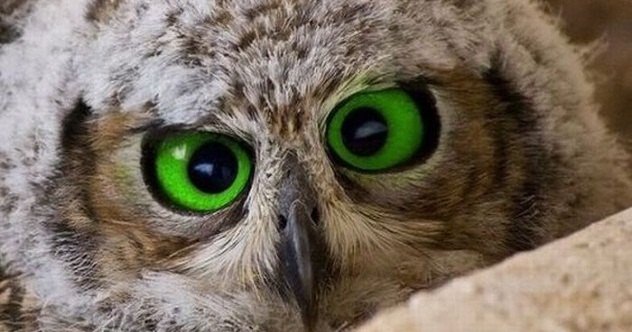
Owls look as if they are staring into your soul, your snack history, and your browser tabs. There is a reason for that intense gaze: their eyes are not round balls like human eyes. They are more tube-shaped and held firmly in place by bone structures. This design gives owls excellent forward-facing vision and depth perception, but it also means they cannot roll their eyes around the way humans can.
Because their eyes are mostly fixed, owls move their entire head to look around. That is why they seem to swivel with such dramatic confidence. If an owl wants to check something behind it, it does not glance sideways. It performs a full neck-powered surveillance maneuver.
Big Eyes, Better Night Vision
Owl eyes are large in proportion to their skulls, helping them gather more light in dim conditions. Many nocturnal owls have eyes packed with light-sensitive cells, making them excellent hunters at dusk, night, or before sunrise. Their forward-facing eyes also provide binocular vision, which helps judge distance accurately when striking prey.
4. Owls Can Turn Their Heads Up to About 270 Degrees
No, owls cannot spin their heads all the way around like a cartoon haunted-house prop. But they can rotate their heads about 270 degrees, which is still wildly impressive. Humans who try this usually end up needing a chiropractor, a regretful explanation, or both.
Owls can manage this flexibility because of special anatomical adaptations in their neck bones and blood vessels. Their bodies are designed to keep blood flowing to the brain even during extreme head rotation. This lets them compensate for their fixed eyes and scan their surroundings without moving their entire body.
Why the Head Turn Is So Useful
Staying still matters when hunting. If an owl can quietly rotate its head instead of shifting its body, it is less likely to reveal its position. That means better stealth, better awareness, and fewer missed meals. In the owl world, neck flexibility is basically a security camera system with feathers.
5. Not All Owls Are Night Owls
The phrase “night owl” exists for a reason, but it does not describe every owl. Many species are nocturnal, but others are active during the day or around dawn and dusk. Snowy owls, burrowing owls, northern pygmy-owls, and short-eared owls can all be seen hunting or moving during daylight hours depending on the season, location, and food supply.
This surprises people because owls are strongly associated with darkness. But nature rarely fits neatly into our sayings. In Arctic regions, for example, summer can bring long daylight hours, so snowy owls must be able to hunt when the sun is up. Burrowing owls often stand outside their burrows in open habitats during the day, looking like tiny landlords keeping an eye on the neighborhood.
Nocturnal, Diurnal, and Crepuscular Owls
Owls can be grouped by activity patterns. Nocturnal owls are most active at night. Diurnal owls are active during the day. Crepuscular owls prefer twilight hours around dawn and dusk. This variety helps different owl species avoid competition and take advantage of different prey opportunities.
6. Owls Swallow Prey Whole and Make Pellets
Owls do not have teeth, which means they cannot chew like mammals. When prey is small enough, an owl may swallow it whole. Later, its digestive system separates the soft, digestible parts from the parts it cannot use, such as bones, fur, feathers, teeth, and insect shells.
The indigestible material is packed into a compact owl pellet, which the bird regurgitates. Yes, this is a polite scientific way of saying the owl coughs up a little mystery bundle. Owl pellets are extremely useful for researchers, teachers, and curious students because they reveal what the owl has been eating.
Pellets Are Nature’s Tiny Evidence Bags
Dissecting an owl pellet can show skulls, jawbones, ribs, and other remains of prey animals. This helps scientists understand local food webs and owl diets. It also helps students learn ecology in a hands-on way. Nothing says “welcome to biology class” like finding a tiny rodent skull before lunch.
7. Owls Are Powerful Pest Controllers
Owls are not just mysterious; they are useful. Many species eat mice, rats, voles, rabbits, insects, and other animals that can become pests when populations grow too large. A single hunting owl can consume many rodents over time, making it a natural ally for farms, fields, forests, and suburban landscapes.
Because owls often catch slower, weaker, or more vulnerable prey, they can also help keep prey populations healthier. This is part of the role predators play in ecosystems. They are not villains in the food chain; they are quality control with talons.
Why Habitat Matters
Owls need suitable nesting places, hunting grounds, and enough prey to survive. Habitat loss, rodenticide poisoning, vehicle collisions, and human disturbance can harm owl populations. Supporting owl-friendly landscapes means protecting trees, grasslands, wetlands, deserts, and open spaces where different species live and hunt.
8. Owl “Ears” Are Often Not Ears at All
Many people see the tufts on a great horned owl or long-eared owl and assume those are ears. Reasonable guess, but wrong. Those tufts are feathers. The real ears are hidden under feathers on the sides of the head.
Scientists are still studying all the reasons owls have ear tufts, but they may help with camouflage, communication, or body language. On a great horned owl, the tufts can break up the bird’s outline, helping it blend into tree branches during the day. In other words, the “horns” are not horns, the “ears” are not ears, and the owl is apparently committed to confusing everyone.
Hidden Ears, Amazing Hearing
The real ears are far more impressive than the decorative tufts. In many owl species, ear placement and facial feathers work together to pinpoint prey. This is especially useful in darkness, tall grass, snow, or dense vegetation where vision alone is not enough.
9. There Are Many More Owl Species Than Most People Realize
When many people imagine an owl, they picture one large bird hooting from a tree. But owls are wonderfully diverse. North America alone has 19 owl species, including great horned owls, barred owls, barn owls, burrowing owls, snowy owls, short-eared owls, northern saw-whet owls, elf owls, and more.
Globally, owls live in forests, deserts, tundra, grasslands, wetlands, mountains, farms, and cities. Some nest in tree cavities. Some use abandoned nests built by other birds. Some live in burrows. Some are tiny enough to look like they accidentally wandered out of a toy store, while others are large, commanding hunters.
Tiny Owls and Giant Personalities
The elf owl, found in the American Southwest and Mexico, is famously tiny, yet it is still a capable hunter. Great gray owls look enormous because of their fluffy feathers and large facial disks, though much of that size is plumage. Snowy owls bring Arctic drama with white feathers and powerful wings. Each owl species has its own personality, habitat, and hunting style.
10. Owls Have Inspired Myths, Symbols, and Superstitions
Owls have fascinated humans for thousands of years. In some cultures, they symbolize wisdom. In others, they are linked with mystery, omens, night, or the spirit world. Their human-like forward-facing eyes make them feel strangely familiar, while their silent flight and nighttime calls make them feel supernatural.
It is easy to understand why owls became legends. Imagine living before electric lights, hearing a low hoot from a dark forest, and seeing two glowing eyes appear on a branch. Even the bravest person might suddenly remember an urgent appointment indoors.
The Real Owl Is Better Than the Myth
As fun as owl folklore can be, the real biology is even more impressive. Owls are not magical fortune-tellers or flying symbols of doom. They are highly adapted predators that help balance ecosystems. Their “mystery” comes from real traits: silent flight, night vision, precise hearing, camouflage, and patient hunting behavior.
How to Spot Owls Responsibly
Seeing an owl in the wild can feel like winning the nature lottery. But responsible owl watching matters. Owls can be sensitive to disturbance, especially around nests or daytime roosts. If you find one, keep your distance, use binoculars, and avoid playing recorded calls. Repeated call playback can stress birds or pull them away from important activities.
Look for clues instead. Owl pellets under trees, whitewash on branches, quiet mobbing behavior from smaller birds, or soft calls at dusk can all hint that an owl is nearby. The best owl watchers are patient and respectful. The owl is not a celebrity obligated to perform. It is a wild animal trying to survive, hunt, rest, and perhaps judge your hiking shoes from a safe distance.
Personal Experiences and Reflections: Why Owls Stay With Us
There is something unforgettable about the first time you hear an owl and actually know what it is. Many people remember the moment clearly: a camping trip, a quiet backyard, a winter walk, or a night drive along a country road. The sound seems to arrive from nowhere. It is not loud like a dog bark or musical like a songbird. It feels placed in the darkness, as if the woods have decided to speak in a low voice.
One of the best experiences related to owls is simply learning to slow down enough to notice them. In daily life, we are usually too loud, too bright, and too busy. Owls reward the opposite behavior. You have to pause. You have to listen. You have to let your eyes adjust to shadows. After a while, the night stops feeling empty. You begin to hear leaves moving, insects calling, branches shifting, and maybe, if you are lucky, the soft wingbeats of a bird passing overhead.
Another memorable owl experience comes from finding evidence rather than seeing the bird itself. Discovering an owl pellet beneath a tree can feel like opening a tiny detective case. What did the owl eat? Was it a mouse, a vole, a shrew, or a small bird? For kids, this can turn nature into a hands-on mystery. For adults, it is a reminder that entire dramas happen outdoors while we are asleep under blankets, completely unaware that a silent hunter is managing the local rodent population.
Owls also change the way people look at ordinary places. A suburban park becomes potential owl habitat. A barn becomes more than an old building; it may be shelter for a barn owl. A grassland at sunset becomes a hunting ground for short-eared owls. A desert burrow may hold a burrowing owl standing upright like a tiny security guard with feathers. Once you learn about owls, landscapes become layered with possibility.
For photographers and birdwatchers, owls teach patience better than almost any motivational poster. You may spend hours looking and see nothing but squirrels behaving suspiciously. Then, just when you are ready to give up, a shape separates from a tree trunk and becomes an owl. The camouflage is that good. The reward is not only the sighting, but the realization that the bird may have been watching you the whole time. Owls are experts at making humans feel delightfully unobservant.
Perhaps the most meaningful experience owls offer is a sense of connection to wildness. Even in a modern neighborhood filled with porch lights, traffic noise, and delivery boxes, an owl call can make the world feel ancient again. It reminds us that nature is not somewhere far away on a postcard. It is overhead, under the eaves, across the field, inside the tree line, and sometimes right outside the window.
That is why the topic of 10 awesome facts about owls is more than a list of trivia. Each fact opens a doorway into how animals adapt, survive, and fit into ecosystems. Silent feathers, facial disks, fixed eyes, flexible necks, pellets, talons, and strange calls all tell the same story: owls are built for their world with astonishing precision. They are not just symbols of wisdom. They are living proof that evolution has a flair for dramatic design.
Conclusion
Owls are awesome because they combine beauty, mystery, and biological engineering in one feathered package. They fly almost silently, hear with incredible accuracy, rotate their heads dramatically, swallow prey whole, help control pests, and come in a surprising variety of shapes and lifestyles. Some haunt forests at midnight. Some hunt over grasslands at dusk. Some stand outside burrows in broad daylight looking like they are waiting for a very important meeting.
The more we learn about owls, the more remarkable they become. They are not merely spooky birds from storybooks; they are essential predators and fascinating examples of adaptation. Protecting their habitats, avoiding harmful poisons, and observing them respectfully helps ensure that future generations can hear those unforgettable calls in the night.
Note: This HTML body is written in original American English for web publishing and is based on verified owl biology, conservation, and wildlife education information from reputable ornithology, conservation, university, museum, zoo, and government sources.

