
Beauty Unlocked
This Is How 30 Places That “GoT” Was Filmed In Look In Real Life
Aug
Game of Thrones gave viewers ice kingdoms, sun-baked trading cities, royal gardens, haunted forests, and castles that appeared to have been designed by an architect with a serious dragon problem. Yet much of that fantasy world was assembled from real places. Medieval streets, volcanic caves, Roman cellars, coastal fortresses, and even an ordinary country road became parts of Westeros and Essos after some clever framing, temporary construction, and generous help from visual effects.
Seeing these Game of Thrones filming locations in real life can be wonderfully disorienting. Some look almost exactly as they did on television. Others are missing towers, armies, snowstorms, or a digitally added dragon circling overhead. A few are busier and sunnier than their gloomy screen identities suggest. One famous landmark no longer exists at all.
From Northern Ireland’s rugged coast to Croatia’s polished limestone streets, here is how 30 memorable GoT filming locations look when the costumes, CGI, artificial smoke, and deeply suspicious royal weddings are removed.
Northern Ireland: Winterfell, the Kingsroad, and the Iron Islands
Northern Ireland was the production’s long-term home and supplied a remarkable range of landscapes. Within a few hours, the crew could move from green woodland to ruined abbeys, windswept beaches, ancient estates, and cliffs dramatic enough to make anyone begin speaking in prophecy.
1. Castle Ward Winterfell
Castle Ward in County Down provided the early exterior setting for Winterfell. In real life, the estate is greener, calmer, and noticeably short on brooding Stark children. The production added wooden structures, banners, livestock, and digital extensions around the historic farmyard to create the northern stronghold seen on screen.
2. The Dark Hedges The Kingsroad
This avenue of twisting beech trees became the Kingsroad when Arya traveled north after escaping King’s Landing. The real road is narrower and more delicate than it appears in the series, but the natural tunnel remains wonderfully eerie. It needs no castle, dragon, or threatening soundtrack to look enchanted.
3. Ballintoy Harbour Lordsport and the Iron Islands
Ballintoy Harbour stood in for the coastal settlement where Theon Greyjoy returned to the Iron Islands. Without gray filters and fictional ships, it is a tiny, picturesque harbor framed by dark rocks and restless water. It feels less like a center of political misery and more like a place to unpack sandwiches.
4. Cushendun Caves The Stormlands
The shadowy caves at Cushendun hosted one of Melisandre’s most unsettling supernatural moments. In daylight, the location is less terrifying but still highly atmospheric. The curved stone chambers were formed naturally, meaning the production team barely had to decorate before introducing its deeply alarming magical birth scene.
5. Tollymore Forest Park The Forests of the North
Tollymore’s mossy stones, bridges, streams, and old trees appeared in several northern scenes, including the discovery of the direwolf pups. In reality, it is a public forest park with marked trails rather than a wilderness full of White Walkers. The scenery, however, already has the layered, ancient appearance of a fairy tale that has gone slightly wrong.
6. Downhill Strand Dragonstone Beach
This long beach beneath the cliffs became part of Dragonstone, including the shoreline where Melisandre burned representations of the Seven. On an ordinary day, the strand is spacious, windy, and peaceful. Mussenden Temple sits dramatically above it, although the television series carefully framed and altered the landscape to preserve its fictional identity.
7. Inch Abbey Robb Stark’s Camp
The ruins of Inch Abbey appeared around Robb Stark’s military camp and the scene in which he was proclaimed King in the North. The real abbey is a quiet collection of weathered stone walls beside the River Quoile. There are no cheering soldiers now, although enthusiastic visitors have probably whispered “King in the North” more often than local historians would like.
Croatia: King’s Landing, Qarth, and Meereen
Croatia supplied some of the show’s most recognizable architecture. Dubrovnik became the definitive version of King’s Landing from the second season onward, while Split and nearby fortresses helped construct Daenerys Targaryen’s world across the Narrow Sea.
8. Dubrovnik Old Town King’s Landing
Dubrovnik’s terracotta roofs, limestone lanes, massive walls, and blue Adriatic backdrop gave King’s Landing its distinctive appearance. The real city is brighter and cleaner than the capital shown on television. Digital towers, royal banners, ships, and crowded medieval neighborhoods were added, but the essential beauty belonged to Dubrovnik from the beginning.
9. Fort Lovrijenac The Red Keep
Standing on a rocky outcrop outside Dubrovnik’s walls, Fort Lovrijenac appeared as parts of the Red Keep and the setting for royal conversations and military preparations. Its real courtyard is compact compared with the grand spaces shown on screen. Camera angles and digital scenery made the fortress seem integrated into a much larger royal complex.
10. The Jesuit Staircase Cersei’s Walk of Atonement
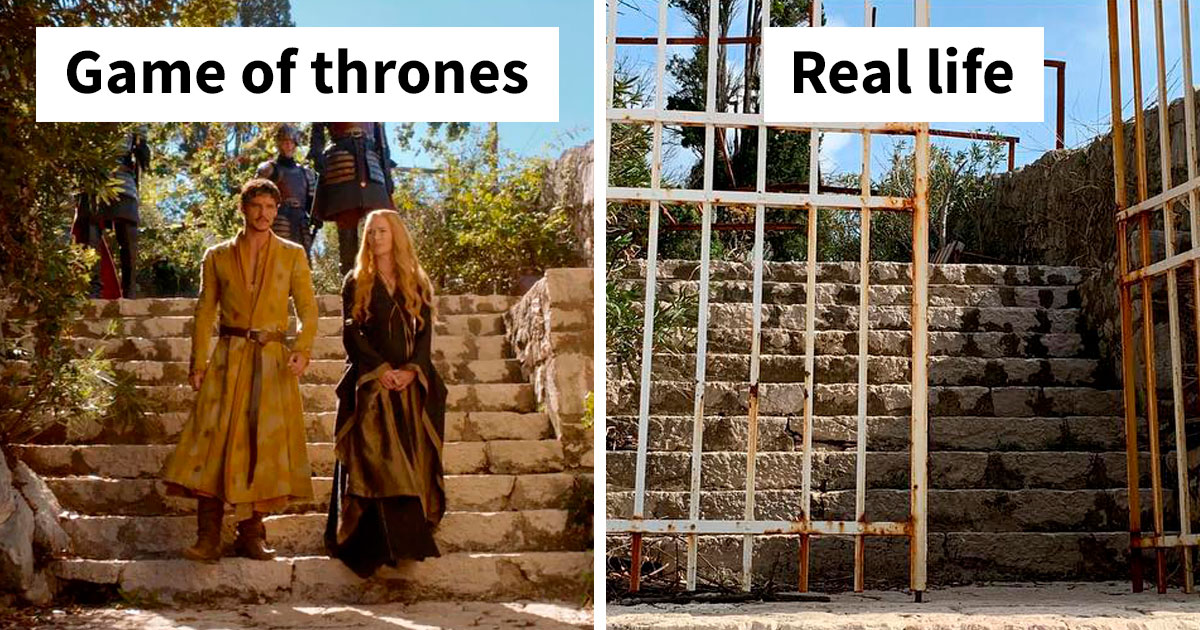
The elegant baroque staircase leading to St. Ignatius Church became the beginning of Cersei Lannister’s infamous walk. In real life, the steps are surrounded by cafés, apartments, and curious visitors rather than hostile crowds. They remain instantly recognizable, proving that one memorable television scene can permanently change how people view an otherwise graceful staircase.
11. Trsteno Arboretum The Red Keep Gardens
About a half-hour drive from Dubrovnik, Trsteno Arboretum supplied the shaded gardens where royal secrets were exchanged. Its stone pavilion, fountain, paths, and Mediterranean plants required little transformation. The gardens feel peaceful in person, although fans may instinctively expect Lady Olenna to appear and deliver an insult sharp enough to trim the hedges.
12. Lokrum Island Qarth
Lokrum, a wooded island just offshore from Dubrovnik, portrayed parts of the wealthy city of Qarth. The real island contains monastery ruins, gardens, rocky swimming spots, and wandering peacocks. Production design supplied the exotic wealth and fictional architecture, but Lokrum’s warm stone and dense vegetation created the setting’s luxurious foundation.
13. Diocletian’s Palace Cellars Meereen
The vaulted cellars beneath Diocletian’s Palace in Split became chambers beneath Meereen, including spaces associated with Daenerys’s dragons. In reality, the Roman passageways are busy with visitors and market stalls. Their thick stone walls and shadowy arches still look cinematic, even when the only creature making noise is a tourist searching for the exit.
14. Klis Fortress Meereen’s Exterior
Perched above Split, Klis Fortress provided commanding exterior views of Meereen. The screen version added pyramids, walls, and dense city structures around it. The real fortress is more isolated, overlooking valleys, mountains, and the distant Adriatic. Its steep stone pathways already communicate power without requiring a single Unsullied soldier.
Spain: Dorne, Braavos, Volantis, and Dragonstone
Spain entered the series with a collection of palaces, cathedrals, badlands, bridges, and rugged coastlines. These locations expanded the visual identity of the show, providing settings that ranged from the refined Water Gardens of Dorne to the windswept home of House Targaryen.
15. The Royal Alcázar of Seville The Water Gardens of Dorne
The Alcázar’s tiled halls, carved arches, reflecting pools, and lush courtyards became the palace of House Martell. It looks remarkably similar in real life because elaborate scenery was already built into the historic complex. The major difference is that visitors encounter tour groups rather than spear-carrying guards and politically complicated sand snakes.
16. The Roman Bridge of Córdoba The Long Bridge of Volantis
Córdoba’s stone bridge became the enormous Long Bridge of Volantis. The production digitally surrounded it with buildings, statues, markets, and a much larger urban skyline. In person, the bridge is broad and impressive but far less congested. Its view toward the old city remains grand, even without fictional architecture stacked around it.
17. Plaza de Toros de Osuna Daznak’s Pit
Osuna’s bullring served as the foundation for the fighting pit where Daenerys faced rebellion and made a dramatic dragon-assisted departure. The real arena is smaller and more orderly than the enormous stadium depicted in the episode. Digital crowds, upper tiers, and surrounding buildings transformed it into a spectacle worthy of Meereen.
18. Girona Cathedral The Great Sept of Baelor
Girona Cathedral’s monumental staircase represented the steps outside the Great Sept. The surrounding old city also appeared as parts of Braavos and King’s Landing. In real life, the cathedral dominates a lively historic district filled with narrow lanes and restaurants. Thankfully, explosive green wildfire is not included with admission.
19. The Arab Baths of Girona Braavos
Girona’s Romanesque bathing complex contributed to the shadowy interiors of Braavos. Its stone columns, central pool, and filtered light already possess the mysterious atmosphere required by Arya’s storyline. The site is smaller than viewers may expect, demonstrating how careful camera placement can make a historic room feel like an entire secret world.
20. Bardenas Reales The Dothraki Sea
The eroded clay and sandstone formations of Bardenas Reales became part of the Dothraki Sea. Unlike the grassy plains often associated with the Dothraki, this region looks dry, sculptural, and almost extraterrestrial. Its bare hills and dusty tracks needed little digital encouragement to appear remote and hostile.
21. San Juan de Gaztelugatxe Dragonstone
The winding stone staircase leading to this Basque islet became the approach to Dragonstone. The small chapel at the top was replaced digitally by the Targaryen castle, but the dramatic causeway is real. The climb contains more than enough steps to make travelers understand why fictional rulers preferred dragons.
22. Castle of Zafra The Tower of Joy
This isolated fortress rises from a rocky ridge in central Spain and appeared in Bran Stark’s crucial vision of the Tower of Joy. The real castle is compact, remote, and surrounded by open countryside. Its lonely silhouette required minimal alteration, making it one of the locations that looks most naturally suited to Westeros.
Iceland: Beyond the Wall
Iceland offered glaciers, lava fields, caves, waterfalls, and mountains so unusual that visual effects sometimes seemed unnecessary. The country’s landscapes became the frozen northern world where maps grew vague and sensible travel plans ended.
23. Thingvellir National Park The Vale and the Bloody Gate
Thingvellir’s rocky fissures and broad valleys appeared during journeys through the Vale, including the route toward the Bloody Gate. In reality, it is a protected historic and geological landscape rather than a militarized mountain passage. Its towering rock walls nevertheless create a natural corridor that looks purpose-built for an ambush.
24. Grjótagjá Cave Jon and Ygritte’s Cave
Grjótagjá is the geothermal cave closely associated with Jon Snow and Ygritte’s romantic refuge. Its water can appear intensely blue beneath the dark volcanic ceiling. The location is smaller and less conveniently arranged than television suggests, and bathing conditions have varied because geothermal temperatures can become dangerously high.
25. Dimmuborgir The Wildling Camp
Dimmuborgir’s twisted lava formations helped represent the land beyond the Wall and the area around Mance Rayder’s camp. In real life, the black rock pillars and arches form a marked walking area. Without snow and artificial camps, the landscape still resembles the remains of a fortress designed by volcanic trolls.
26. Kirkjufell Arrowhead Mountain
Kirkjufell’s pointed profile became the “mountain shaped like an arrowhead” seen in visions and during the expedition north. The real mountain stands near a road and small coastal community, often reflected in nearby water. Different camera angles and winter conditions made its already distinctive shape appear more ominous on screen.
Malta and Morocco: Early King’s Landing and the Cities of Slaver’s Bay
27. Mdina Gate, Malta King’s Landing
Before Dubrovnik assumed the role, Malta’s fortified city of Mdina portrayed parts of King’s Landing during the first season. Its baroque gate and honey-colored walls remain almost unchanged. The real “Silent City” is cleaner, quieter, and less likely to contain a confrontation between royal guards and suspicious northerners.
28. The Azure Window, Malta Khal Drogo’s Wedding
Daenerys and Khal Drogo’s wedding was filmed near Gozo’s famous Azure Window, a huge natural limestone arch rising from the sea. Visitors today cannot reproduce the view: the formation collapsed during a storm in 2017. The coastal setting remains beautiful, but the absent arch makes this location a striking reminder that natural landmarks are not permanent film sets.
29. Aït Benhaddou, Morocco Yunkai
The earthen towers of Aït Benhaddou became the slave city of Yunkai. This fortified settlement already looks fantastical, with clustered mud-brick buildings rising above the desert landscape. Digital additions increased its scale, but the warm colors and layered walls seen in the series are unmistakably present in real life.
30. Essaouira, Morocco Astapor
Essaouira’s seafront ramparts, stone gateways, and Atlantic harbor represented Astapor, where Daenerys acquired the Unsullied. The real city is breezy, artistic, and famous for seafood, crafts, and whitewashed buildings. Remove the fictional soldiers and tense negotiations, and the intimidating slave city becomes an inviting Moroccan coastal destination.
What Visiting These Game of Thrones Locations Feels Like
Visiting a filming location is different from visiting a traditional landmark. At a famous castle or cathedral, travelers usually arrive knowing the history. At a Game of Thrones location, they may arrive knowing exactly where a fictional character stood while having no idea what the building was originally used for. The best visits allow both stories to exist at once.
Dubrovnik provides the strongest feeling of stepping directly into the show. The walls, roofs, staircases, and sea views are recognizable from several directions, so a walk through the Old Town can feel like moving through a giant outdoor set. Then a delivery scooter passes, church bells ring, and a restaurant host offers a menu. King’s Landing instantly becomes a living Croatian city again. Early morning is the best time to appreciate that contrast before cruise passengers fill the lanes.
Northern Ireland offers a more scavenger-hunt-style experience. Many locations are natural spaces with no permanent sign announcing the exact camera position. A harbor may look ordinary until a guide displays a still from the episode. A forest clearing suddenly becomes the place where the Stark children found their direwolves. This “scene framing” experienceholding up a screen image and aligning it with the landscapeis often more entertaining than posing with a plastic sword, although nobody is stopping you from doing both.
Iceland delivers a different reaction. Its landscapes are so strange that the television version can seem less exaggerated than the real one. Steam drifts through volcanic ground, dark lava towers rise beside snowy trails, and mountains change appearance with every shift in weather. Travelers should remember that these are genuine natural environments, not controlled sets. Paths can be slippery, winds can become severe, caves can be unstable, and geothermal water is not automatically safe for bathing simply because two actors once had a romantic scene nearby.
Spain’s locations reward visitors who enjoy architecture. At the Alcázar of Seville, the pleasure comes from realizing how little needed to be invented. The palace’s carved plaster, geometric tiles, orange trees, and pools already possess the richness associated with Dorne. Gaztelugatxe has the opposite effect: the digital castle is absent, leaving only a chapel at the end of the climb. The staircase remains spectacular, but tired visitors may conclude that Daenerys should have installed an elevator before beginning her campaign.
Morocco creates perhaps the most powerful separation between fiction and reality. Aït Benhaddou and Essaouira have long histories, local communities, religious traditions, working markets, and identities far deeper than their appearances in a television series. Recognizing Yunkai or Astapor is fun, but exploring the real architecture and culture turns a fan excursion into meaningful travel.
The most satisfying approach is therefore not to treat these destinations as abandoned props. Buy from local businesses, follow access rules, avoid blocking roads for photographs, and learn the authentic history behind each site. The television connection may inspire the journey, but the real locations are what make it memorable. Westeros was imaginary; the landscapes that convinced millions of viewers it existed are wonderfully, stubbornly real.

