
Beauty Unlocked
Architect David Adjaye’s Formidable Mole House in London
Jul
Some houses are polite. They sit quietly on their street, behave nicely in photographs, and never ask you to think too hard. Mole House in London is not one of those houses. Designed by David Adjaye for artist Sue Webster, this startling live-work home in Hackney is the kind of project that makes the word “renovation” feel comically inadequate. This was not a simple upgrade with better lighting and a fancier faucet. It was a rescue mission, an archaeological dig, a structural intervention, and an architectural argument all rolled into one.
What makes Mole House so compelling is not just its unusual origin story, though that story is certainly doing a lot of heavy lifting. The property was once associated with William Lyttle, the eccentric former resident nicknamed the “Hackney Mole Man” because he spent decades tunneling beneath the house. By the time Webster acquired it, the Victorian building had become a local legend, part ruin and part cautionary tale. Rather than flatten that history into a neat before-and-after narrative, Adjaye leaned into it. He treated the site as something layered, haunted, and strangely precious.
The result is a home that feels both primitive and sophisticated, bunker-like and luminous, raw and highly composed. It is formidable not because it shouts, but because it holds its ground. Mole House is a lesson in what happens when an architect resists the urge to erase the past and instead uses design to choreograph a conversation between damage, memory, and modern life. In a city where redevelopment often means sanding every surface smooth, this house proudly keeps a few scars visible. Honestly, good for it.
Why Mole House Matters in London’s Residential Architecture Scene
London has no shortage of dramatic private homes, but many of them rely on predictable tricks: lots of glass, a pristine extension, maybe a heroic staircase if everyone is feeling ambitious. Mole House takes a different route. Its power comes from adaptation rather than spectacle. It works with a damaged shell, an infamous history, a difficult triangular plot, and the practical needs of an artist who needed room to live and work without turning the house into a sterile white box.
That alone makes it noteworthy. But the project matters even more because it fits into a larger thread in David Adjaye’s career. He has long been interested in buildings that feel rooted in material, story, and atmosphere. His work often uses weight, shadow, texture, and carefully controlled light to create spaces that are emotionally charged rather than merely visually impressive. Mole House brings those instincts into a domestic setting, where the challenge is not monumentality for its own sake, but intimacy with backbone.
This is also a house shaped by collaboration. Sue Webster was not just a homeowner asking for nicer finishes and a better kitchen island. She is a contemporary artist with a strong visual identity and an obvious attraction to the strange, the discarded, and the psychologically loaded. Adjaye had already worked with Webster and Tim Noble on Dirty House, an earlier London live-work project. So Mole House was not a random commission. It was the continuation of a long design relationship built around the overlap between art, daily life, and architecture that knows how to flirt with darkness without becoming gloomy.
The Wild Backstory Behind the Mole House
Let’s address the giant tunnel system beneath the room. The house on Mortimer Road became famous because William Lyttle, later known as the Hackney Mole Man, spent years digging a sprawling network of underground passageways beneath the property. Reports described tunnels extending deep below the house and reaching outward in multiple directions. Over time, the digging destabilized the structure and alarmed neighbors, who dealt with everything from sinking ground to infrastructure worries. This was not quirky DIY. This was structural chaos with folklore attached.
After Lyttle was removed from the property and the site was made safe, the house sat as a damaged relic. Parts of its roof had collapsed. The structure had been compromised. The place had the aura of urban myth, as if a Victorian villa had swallowed a fever dream and never quite recovered. When Webster bought it at auction, she was not buying a turnkey home. She was buying a difficult object with a loaded public identity.
That history could easily have become a gimmick. Another architect might have turned the Mole Man legend into a superficial branding exercise, all wink and no depth. Adjaye did the opposite. He treated the property’s notoriety as a form of cultural sediment. The house was not valuable in spite of its strange past; it was valuable partly because of it. That is what gives Mole House its unusual authority. It does not exploit the story. It absorbs it.
David Adjaye’s Design Strategy: Excavation, Retention, Reinvention
He preserved the building’s hard-earned character
One of the smartest decisions in Mole House was refusing to prettify it into submission. The original masonry fabric was preserved, and thousands of reclaimed London bricks were used to repair damaged areas. The exterior render was retained, allowing the house to keep its rough, almost bunker-like appearance. That choice matters because it prevents the project from becoming too slick. Mole House still looks like it has lived through something, which, to put it mildly, it has.
Adjaye’s additions are deliberately legible as additions. Concrete bay windows edged in patinated bronze cut through the old envelope with confidence. A new roof treatment introduces contrast without trying to cosplay as Victorian restoration. In other words, the house does not pretend nothing happened. It also does not collapse into nostalgia. Old and new are allowed to stand next to each other like slightly suspicious relatives at Thanksgiving.
He dug down to create a better life above ground
Instead of simply patching the house and moving on, the design expanded the building at basement level. This move transformed the project spatially. The lower portions of the house became usable, open, and filled with light, while sunken landscaped gardens wrapped the perimeter. The excavation strategy helped generate a layered sequence of spaces that feel discovered rather than merely arranged.
That sense of discovery is central to the house’s appeal. Mole House is not a one-shot, instant-read interior. It unfolds. Multiple entrances acknowledge the history of burrowing and movement beneath the site. The house invites you to think in section, not just plan. You descend, turn, emerge, and reorient yourself. The architecture borrows some of the psychological energy of the tunnels without reproducing their danger or disorder. It domesticates mystery, which is not something most renovation projects can say with a straight face.
He used materials to tell the truth
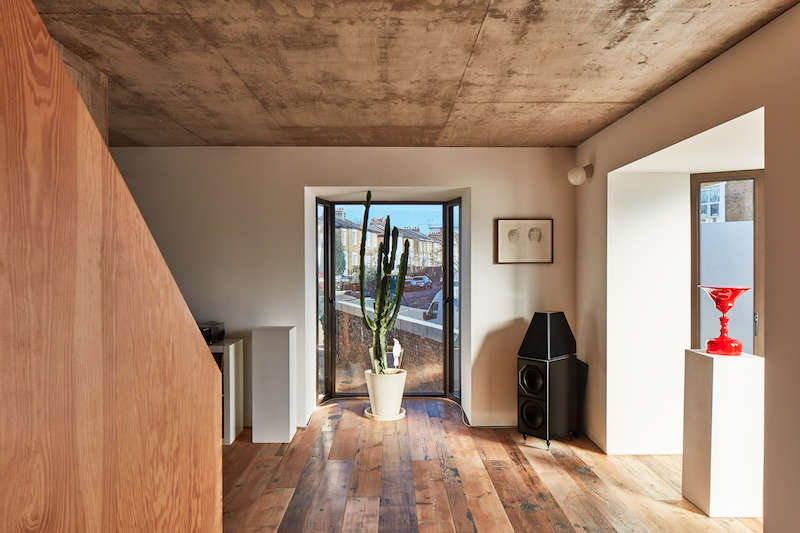
The material palette is controlled but expressive: concrete, brick, wood, bronze, slate, and glass. Nothing feels fussy. Nothing is there to beg for attention like a desperate influencer at a product launch. Yet the house is full of tactile drama. Concrete surfaces carry weight and memory. Wood adds warmth and relief. Bronze frames lend depth and a slightly weathered richness. Reclaimed brick ties the project to London’s fabric and to the building’s own wounded history.
Inside, even the structural logic becomes part of the experience. A cross-shaped concrete element helps organize the plan and support the floors, giving the interior a sculptural center of gravity. The house feels grounded, almost geological. That is exactly right for a project born from collapse, excavation, and repair.
Inside Mole House: Light, Flow, and the Live-Work Idea
If the exterior gives you toughness, the interior gives you release. Natural light plays a starring role throughout Mole House. Full-height windows and doors line the floors, and the design uses skylighting and large openings to draw daylight deep into the plan. The effect is important because the house could have become oppressively heavy. Instead, it balances mass with permeability.
The layout supports Webster’s life as an artist without making the place feel like a glorified workshop. The lower level houses studio space, while the upper levels are dedicated more fully to domestic life, including living areas, bedrooms, and a study. That separation is subtle but meaningful. Adjaye had explored similar live-work questions in Dirty House, where studio and home were kept distinct enough to avoid the fatigue of doing absolutely everything in one visual register. Mole House builds on that lesson with greater complexity and a much stranger site.
What is especially effective is the way the house avoids the common trap of “creative living” clichés. There is no fake warehouse swagger here, no generic industrial-chic performance. Instead, the architecture creates conditions that are genuinely useful for an artist: height, daylight, privacy, multiple routes through the space, and a material backdrop that can coexist with objects, artworks, collections, and mess. Real creative life is rarely immaculate. Mole House seems to understand that.
Why the House Feels So Formidable
The word “formidable” suits Mole House because the project has unusual composure. It is not trying to charm you with softness. It does not rely on sweetness or decorative ease. Instead, it projects strength through restraint. The preserved shell, the weighty materials, the excavated gardens, and the emphatic geometry all contribute to a house that feels deeply self-possessed.
Yet formidable does not mean cold. The home is humane precisely because it takes history seriously. It acknowledges ruin, effort, and eccentricity. It accepts that buildings can carry social memory, neighborhood lore, and emotional residue. In this sense, Mole House is not merely a renovation of a private residence. It is a case study in architectural salvage, where the goal is not to make the past disappear but to give it a better frame.
There is also something very London about that attitude. The city is forever building over itself, repurposing, excavating, and arguing with its own history. Mole House distills that condition into one intense domestic object. It is compressed urban archaeology: Victorian shell, tunnel legend, contemporary art life, and precision engineering all occupying the same address.
Mole House and David Adjaye’s Residential Legacy
For people who know David Adjaye mainly through major civic and cultural buildings, Mole House is a useful reminder that some of his sharpest ideas emerge in residential work. Private houses allow him to explore atmosphere, sequence, concealment, and material heft at a more intimate scale. They also show how consistently he has worked with artists, using architecture not just as shelter but as an extension of sensibility.
Mole House belongs to a lineage that includes Dirty House and other residences made for culturally engaged clients who want more than comfort alone. These houses often feature enigmatic exteriors, carefully managed light, and interiors that reveal themselves gradually. That pattern appears again here, but with a new degree of historical complexity. The challenge was not only to create a powerful home. It was to rescue one from absurdity and collapse without sanding away its identity.
And that may be the house’s greatest achievement. Mole House does not feel like a triumph over the site. It feels like a difficult peace treaty with it.
Experiencing Mole House: A Longer Reflection on Space, Memory, and Mood
To think about Mole House only as an architectural object is to miss half the experience. The project really comes alive when you imagine what it feels like to move through it. From the street, the house still carries a hardened, slightly battered presence, as if it remembers every rumor ever told about it. That first impression matters. It prepares you for a building that does not reveal itself all at once.
Then the sequence begins to shift. You encounter the entrances, the changes in level, the edges of the sunken gardens, and suddenly the house stops behaving like a conventional London residence. It starts acting more like a narrative. There is a mild sense of descent, of uncovering. You are not just entering a home; you are reading a site. The architecture turns circulation into interpretation.
That is where Mole House becomes emotionally rich. It does not erase the memory of tunneling, but neither does it sensationalize it. Instead, it transforms underground history into an above-ground spatial feeling: compression followed by release, enclosure followed by light, roughness followed by calm. The house seems to understand that drama is more effective when it is embedded in movement rather than pasted onto surfaces.
The live-work aspect adds another layer to that experience. For an artist, a home is rarely just a retreat. It is a machine for thinking, making, storing, pacing, noticing, and occasionally staring into space while pretending that counts as work. Mole House supports that kind of life because it has zones with different temperatures of energy. The studio spaces feel grounded and focused. The living areas open up. Daylight softens the weight of the materials. The whole house seems calibrated for oscillation between concentration and release.
There is also a quiet pleasure in how the building handles imperfection. Too many high-design homes are terrified of looking lived in. Mole House seems to welcome the friction of objects, collections, artworks, and personal habits. Its concrete, reclaimed brick, timber, and bronze do not ask for a museum-style distance. They invite contact. The house looks robust enough to absorb real life, which is a deeply underrated luxury.
Most of all, the project leaves the impression that architecture can be serious without becoming pompous. Mole House is bold, but it is not showy. It is moody, but not miserable. It is historically aware, but not trapped in reverence. You come away with the sense that the best houses are not the ones that erase conflict. They are the ones that organize it into something livable.
That is why Mole House lingers in the mind. It is not merely an unusual residence in London. It is a demonstration of how design can metabolize ruin, folklore, craft, engineering, and personality into one coherent place. Plenty of homes look expensive. Far fewer look inevitable. Mole House, against all odds, does.
Conclusion
Architect David Adjaye’s Mole House in London is formidable because it does what great renovation architecture rarely manages to do: it preserves strangeness while creating order. It rescues a damaged Victorian house without sterilizing its history. It gives artist Sue Webster a live-work environment that is practical, dramatic, and deeply personal. And it turns one of Hackney’s oddest addresses into a serious piece of contemporary residential architecture.
More than anything, Mole House proves that adaptive reuse can be emotionally intelligent. A house does not have to forget its past to become useful again. In the right hands, the scars become the story, the constraints become the design engine, and the weirdest building on the block becomes the one nobody can stop thinking about. Not bad for a place that once had more tunnels than common sense.

