
Hair Care
14 Hilarious Entries To The 2017 Comedy Wildlife Photography Awards
Jul
Wildlife photography usually brings to mind misty mountains, dramatic sunsets, and animals staring nobly into the distance. Then a fox uses a golf green as a restroom, an owl loses its grip, and three elephant seals appear to launch an operatic world tour. Nature, it turns out, has excellent comic timing.
The 2017 Comedy Wildlife Photography Awards celebrated precisely those unscripted moments. More than 3,500 photographs arrived from 86 countries, capturing animals looking shocked, sleepy, embarrassed, theatrical, and occasionally as if they had made several poor decisions before breakfast. The competition eventually crowned Tibor Kercz’s owl photograph, “Help,” as its overall winner.
The 14 images below were highlighted during the 2017 submission period. They range from grand African mammals to an insect small enough to conduct meetings on the edge of a leaf. Each photograph succeeds because it combines real animal behavior, careful composition, patience, and a fraction of a second in which wildlife accidentally becomes stand-up comedy.
Why the Comedy Wildlife Photography Awards Matter
Photographers Paul Joynson-Hicks and Tom Sullam founded the competition to make people laugh while drawing attention to wildlife conservation. Instead of presenting environmental awareness as a lecture filled with gloomy statistics, the contest uses humor as an invitation. A funny wildlife photo catches the eye; curiosity encourages the viewer to learn more about the animal and its habitat.
That combination gives the contest unusual reach. You do not need to recognize the species or understand camera settings to appreciate an owl hanging from a branch like someone who missed the last step of a ladder. The joke is immediate, but the animal remains wild, fascinating, and worth protecting.
The 14 Funniest Wildlife Photography Entries
1. “Help!!!” by Tibor Kercz
Photographed in Ópusztaszer, Hungary, “Help!!!” shows three little owls sharing a curved branch. Two are sitting upright, calmly watching the world. The third is hanging below them, apparently reconsidering every choice that led to this moment.
The humor comes from the social arrangement. The struggling owl looks desperate, while its companions display the emotional involvement of two passengers ignoring someone who has dropped a suitcase on the train platform. Golden backlighting turns the scene into a beautiful portrait, proving that slapstick can still have excellent production values.
Kercz captured the incident as part of a four-image sequence. The photograph later became the overall winner of the 2017 Comedy Wildlife Photography Awards and also helped the photographer secure the portfolio prize. Young owls genuinely can be awkward while learning to perch and fly, so the apparent crisis is less unusual than its perfectly timed presentation suggests.
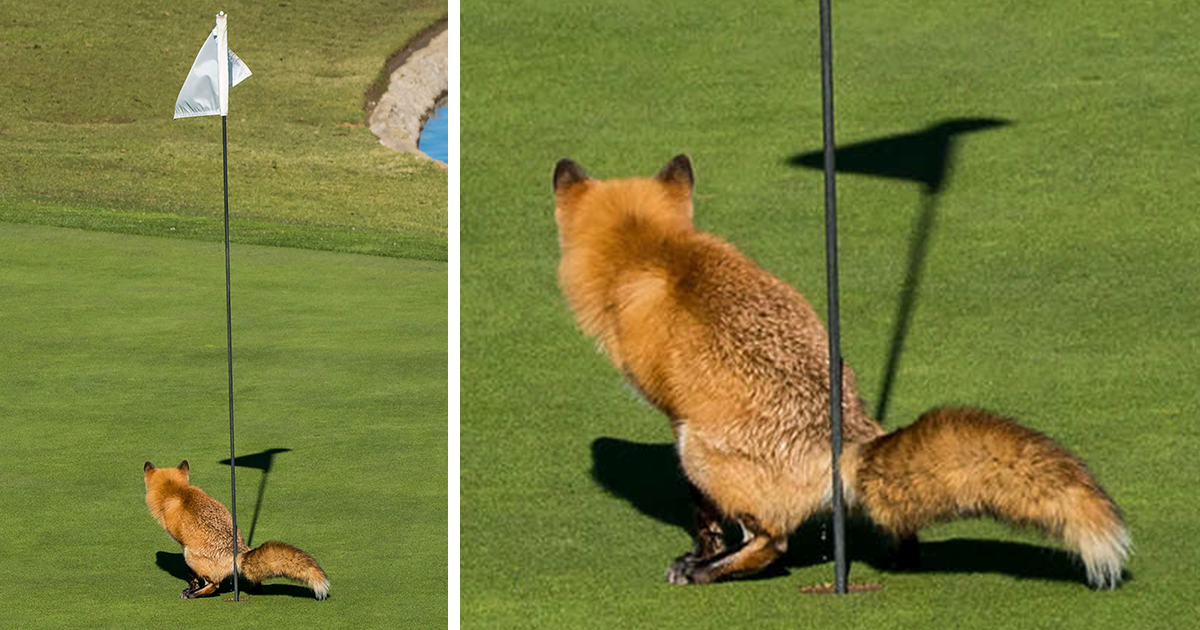
2. “Must Have Three-Putted” by Douglas Croft
A red fox squats beside the flagstick on a beautifully maintained golf green in San Jose, California. The fairway is immaculate, the pond sparkles nearby, and the fox is making a personal contribution that the groundskeeping team probably did not request.
The title imagines the animal as a frustrated golfer reacting to a disastrous three-putt. The flagstick divides the composition neatly, while the fox’s fluffy tail gives the scene a suspiciously dignified finish. It is a reminder that wildlife does not recognize country-club rules, dress codes, or the concept of a cleaning deposit.
3. “Stopped by a Toll Collector” by Katarina Denesova
On a dark road in Queensland, Australia, a tiny white owl stands directly in the path of an approaching vehicle. Headlights illuminate the bird while the pavement disappears into darkness behind it.
The owl’s posture suggests complete authority. It is not lost; it is working the night shift. Drivers may proceed only after presenting exact change, a valid migration permit, and perhaps one mouse. The enormous road surrounding the miniature subject makes the encounter even funnier. A creature barely taller than a shoe appears to have shut down an entire transportation system.
4. “WTF?!” by George Cathcart
Two elephant seals in San Simeon, California, create one of the finest reaction shots in the collection. One seal faces the camera with its mouth open and eyes widened, while the other leans toward it as though delivering gossip too unbelievable to process quietly.
The picture works because their expressions seem intensely human. One appears to be saying, “You did what?” while its companion waits for the scandal to settle. In reality, elephant seals are vocal animals whose calls and physical displays play important roles in communication and social hierarchy. The camera simply froze one exchange at the exact moment it resembled a beachside soap opera.
5. “Outsourcing Seatbelt Checks” by Graeme Guy
In Kenya’s Masai Mara, an airplane approaches a landing strip while an adult giraffe and calf stand in the foreground. Forced perspective places the larger giraffe’s head directly beside the aircraft, making it appear to be conducting an unusually thorough safety inspection.
The photograph combines two completely ordinary elementsa landing plane and grazing giraffesto create an absurd new story. The adult looks ready to check the pilot’s paperwork, while the calf observes as a trainee. Few airport employees can match a giraffe for height, visibility, or the ability to examine the top of a small aircraft without using a ladder.
6. “Kung Fu TrainingAustralian Style” by Andrey Giljov
A kangaroo stands upright in the Australian landscape with its forearms raised and one paw extended. The pose resembles a martial-arts master demonstrating a defensive technique before an invisible opponent.
Kangaroos naturally use their powerful legs, tails, and forelimbs during confrontations, but this isolated gesture looks wonderfully choreographed. The animal seems moments away from announcing that patience defeats strengthor from asking someone to hold its water bottle. The open landscape provides a clean stage, allowing the angular arms and serious expression to carry the joke.
7. “I’m OK” by Yamamoto Tsuneo
Captured in Madagascar’s Analamazaotra Special Reserve, this photograph shows a black-and-white indri lemur wrapped around a tree. One hand forms a near-perfect “OK” gesture beside its head.
The lemur’s wide green eyes make the reassurance less convincing. Its body is twisted among the branches like someone who attempted an advanced yoga position after watching half of an online tutorial. Still, the hand signal is clear: everything is under control, nobody should call for assistance, and the tree has definitely agreed to this arrangement.
8. “Three Tanors” by Roie Galitz
Three elephant seals on South Georgia Island raise their heads and open their mouths simultaneously. The result resembles a trio of classical singers reaching the enormous final note of an opera.
Each performer contributes a different expression. One leans forward enthusiastically, another appears deeply committed to the high note, and the third has the commanding posture of a soloist who knows the spotlight belongs to him. The photographer’s tight framing removes distractions and gives the singers a proper stage. Somewhere beyond the frame, an imaginary conductor is probably asking the percussion section to calm down.
The image also demonstrates how context creates humor. Open mouths can indicate calling, threat displays, or other natural behavior. Place three of them together in one photograph, however, and the audience immediately hears music that was never recorded.
9. “Pirate in Disguise” by Andres Vejar
An owl in Chile has a loose feather stretched across one eye. With the other bright yellow eye staring directly at the camera, the bird resembles a pirate wearing the world’s softest eye patch.
The illusion is simple but effective. The feather supplies a costume, the hooked beak looks suitably nautical, and the owl’s stern expression says it has already claimed the tree and buried treasure nearby. It is the kind of portrait that makes viewers wonder whether the owl says “who” or “arrr,” although asking directly would probably be unwise.
10. “Pikachu!” by Nadav Bagim
Not every memorable wildlife photograph requires a lion, bear, or enormous telephoto lens. In Ramat Gan, Israel, Nadav Bagim photographed a tiny yellow springtail standing at the edge of a green leaf.
Its rounded body, dark markings, and upright antennae invite a comparison with the famous electric cartoon character named in the title. The shallow depth of field transforms the leaf into a miniature cliff and the blurred background into a dreamlike landscape. The photograph is cute, technically precise, and proof that comedy wildlife photography can operate at a scale most people accidentally walk past.
11. “Hello? Are You Awake?” by Kristine Mayes
Three small birds occupy a branch in Vancouver, British Columbia. The bird in the center has lowered its head and closed its eyes, while a companion leans toward it with the concerned curiosity of someone checking whether a meeting participant has fallen asleep.
The third bird looks away, perhaps pretending not to be involved. Their arrangement creates a complete workplace comedy: one exhausted employee, one overly attentive colleague, and one individual who has mentally left the conference. The expressive body language does all the storytelling without requiring exaggerated action.
12. “Trouble in Parad’ice” by Peter Odeh
Two chinstrap penguins stand against the pale Antarctic sky. One keeps its head lowered toward its chest while the other looks over with an expression that could be concern, suspicion, or the beginning of an uncomfortable relationship discussion.
The title turns the icy scene into a romantic dispute. Perhaps someone forgot an anniversary. Perhaps one penguin liked another penguin’s beach photo. Whatever happened, the silent treatment has officially reached subzero temperatures. The clean gray background and matching upright postures make the subtle contrast between the two heads especially noticeable.
13. “Oooh MatronCarry On Up the Jungle!” by Gill Merritt
A male lion in Tanzania throws back his head, opens his mouth, and raises one paw dramatically across his chest. He could be roaring, yawning, coughing, or delivering the emotional climax of a Broadway musical.
The swept-back mane adds theatrical volume, while the half-closed eyes suggest a performer completely absorbed in the song. It is easy to imagine an orchestra swelling behind him as he explains that being king is harder than everyone thinks. The photograph turns a powerful predator into a magnificent diva without diminishing the lion’s beauty.
14. “The Operating System Cannot Run” by Victoria Stanley
A penguin on Isla Martillo in the Beagle Channel twists its head backward and points its beak toward the sky. Its flippers rise behind its body at odd angles, creating an animal silhouette that appears incorrectly assembled.
The title treats the pose as a technical malfunction. The penguin has encountered an unexpected error, rebooting is in progress, and customer support recommends turning the bird off and on again. What makes the image so effective is that nothing has been staged. A routine stretch or call becomes a visual puzzle when photographed from exactly the right angle.
These entry names, photographer credits, and locations match the collection highlighted during the 2017 submission period.
What Makes a Funny Wildlife Photo Successful?
Timing Beats Staging
The best funny wildlife photos are candid. A photographer cannot direct an owl to slip on cue or ask three seals to open their mouths simultaneously. The humor depends on recognizing behavior, anticipating movement, and pressing the shutter during a moment that may last less than a second.
Composition Creates the Punchline
Timing alone is not enough. “Outsourcing Seatbelt Checks” works because the giraffe and airplane align within the frame. “Must Have Three-Putted” benefits from the flagstick beside the fox. Remove those visual relationships, and the joke becomes weaker. Strong composition guides the viewer toward the punchline without explaining it.
Human Interpretation Adds the Story
Animals are not deliberately imitating golfers, pirates, singers, or malfunctioning computers. People supply those narratives by recognizing familiar gestures and situations. This tendency to see human emotion in animal expressions is part of the contest’s charm, provided viewers remember that the underlying behavior belongs to a wild animal with its own biological purpose.
Respect for Wildlife Comes First
No humorous image is worth stressing an animal or damaging its habitat. Ethical wildlife photography means keeping a safe distance, following local rules, avoiding nests and dens, and never feeding or provoking a subject to manufacture a reaction. A genuine moment is both funnier and more meaningful than a staged disturbance.
Field Experience: The Reality Behind a Hilarious Wildlife Photograph
Seeing a winning image can create the impression that wildlife photography is a series of delightful encounters in perfect light. The practical experience is usually less glamorous. A photographer may spend hours sitting quietly in damp grass, carrying heavy equipment, watching an animal do almost nothing. The subject turns away. The sun disappears. A mosquito discovers the only exposed square inch of skin. Then, just as the photographer considers packing up, something wonderfully strange happens.
Capturing that moment requires preparation. A camera must already be raised, focused, and configured for movement. Wildlife rarely waits while someone searches through menus. A fast shutter speed can freeze a bird losing its balance or a kangaroo extending a paw. Continuous shooting helps record an entire sequence, but judgment remains important. Hundreds of technically sharp frames may contain only one image with the expression, spacing, and posture needed to tell a funny story.
Patience also changes the way a photographer sees animals. After observing a colony, family group, or feeding area for long enough, patterns emerge. A bird may return repeatedly to the same branch. Young mammals may play after feeding. Penguins may stretch, preen, argue over space, and then settle as though nothing happened. Understanding those rhythms helps the photographer anticipate activity instead of chasing it.
There is often a delayed reaction when the comic frame finally appears. In the field, the photographer may concentrate on exposure and focus rather than humor. The real laugh comes later while reviewing images. A half-second gesture that seemed ordinary at the time suddenly looks like a salute, dance move, dramatic confession, or failed attempt to operate heavy machinery.
Titles add another layer to the experience. A good title does not merely describe the animal; it unlocks the visual joke. A fox beside a flagstick becomes “Must Have Three-Putted.” A giraffe near a landing plane becomes an outsourced seatbelt inspector. The words encourage viewers to notice a relationship already present in the frame rather than forcing an unrelated gag onto it.
The most satisfying outcome is not simply laughter. A successful photograph can make viewers care about an unfamiliar animal. Someone amused by a tiny springtail may become curious about life in garden soil. A person who laughs at vocal elephant seals may read about their migrations and protected breeding beaches. Humor lowers the barrier between the audience and conservation, replacing distance with affection.
That is the deeper experience represented by the Comedy Wildlife Photography Awards. Behind every instant joke are hours of observation, technical practice, restraint, missed opportunities, and respect for unpredictable subjects. The animals provide the performance. The photographer’s job is to be ready, remain unobtrusive, and recognize when nature has quietly delivered the punchline.
Conclusion: Nature Is Funnier Than Fiction
The 14 hilarious entries to the 2017 Comedy Wildlife Photography Awards show that comedy exists everywhere: on golf courses, Antarctic ice, African plains, dark Australian roads, and even the edge of a leaf. The animals are not performing for an audience, which is exactly why the results feel so genuine.
Tibor Kercz’s dangling owl became the year’s overall winner, but every photograph contributes something memorable. Together, the images celebrate patient observation, creative storytelling, animal behavior, and conservation. They also confirm an important universal truth: no matter how elegant a species appears in documentaries, somebody eventually takes a picture of it looking completely ridiculous.

