
Beauty Unlocked
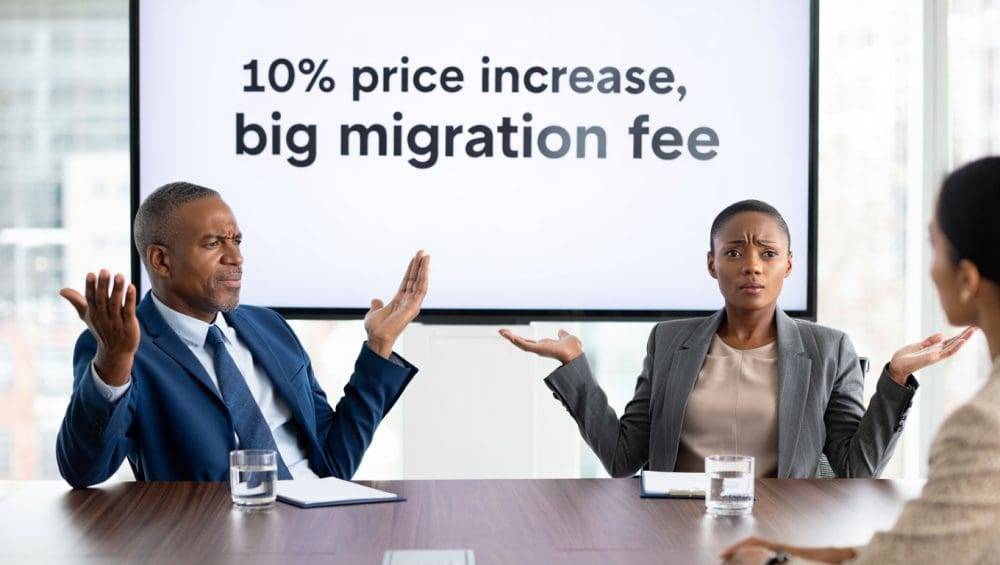
The $7,500 Migration Fee That Just Cost a Vendor $80,000 ARR. Really, $240,000.
Jun
Some SaaS deals die dramatically. The champion leaves. Procurement discovers a secret clause. Legal circles one sentence in red ink like it just committed tax fraud.
And sometimes a deal dies because of a $7,500 migration fee.
That number may look small next to an $80,000 annual recurring revenue contract. In a spreadsheet, it feels like a rounding error wearing business casual. But in the real world, where buyers have calendars, budgets, committees, nerves, and at least one current vendor begging for a second chance, a migration fee can become the tiny pebble that derails the very expensive train.
This is the lesson inside the now-famous SaaS pricing story: a buyer was ready to switch vendors after years with an existing solution. The new vendor was lined up. Budget was approved. The contract was ready. Then the buyer saw a $7,500 migration fee, paused, reconsidered, and the deal slipped away. Not forever, maybe. But out of the quarter. Possibly out of the year. Possibly out of the vendor’s future entirely.
The vendor thought it was protecting $7,500. What it really risked was $80,000 ARR. Over three years, that becomes $240,000 in contract value. In other words, the math did not math. It showed up late, forgot its calculator, and ordered nachos.
Why a Small Migration Fee Can Become a Giant Deal Killer
Migration fees are not automatically evil. Moving data, configuring workflows, mapping permissions, rebuilding integrations, training users, cleaning messy exports, and making old systems talk to new ones can take real labor. Anyone who has ever opened a customer’s “clean CRM export” and found 17 versions of the same company name knows migration work can be less like software implementation and more like digital archaeology.
The problem is not that vendors charge for work. The problem is when the fee appears at the wrong moment, feels detached from value, and creates friction right when the buyer needs momentum.
In SaaS sales, momentum is precious. A buyer who has already decided to switch has crossed several psychological bridges. They have admitted the old tool is no longer enough. They have convinced internal stakeholders. They have compared alternatives. They have imagined a better future. They have maybe even said the dangerous words: “Let’s move forward.”
At that exact moment, adding an unexpected fee is like handing the buyer a permission slip to hesitate. And hesitation is where deals go to catch a cold.
The Real SaaS Pricing Lesson: ARR Beats One-Time Fees
Annual recurring revenue is the heartbeat of a SaaS company. It is predictable, renewable, measurable, and valuable because it represents ongoing customer commitment. One-time fees, including setup, migration, onboarding, and implementation charges, may help offset short-term costs, but they are not the same as recurring revenue.
That distinction matters. A $7,500 migration fee may look good on this month’s invoice, but it does not build the same durable business value as an $80,000 ARR customer. It does not renew next year. It does not expand into more seats. It does not become a reference account. It does not increase net revenue retention. It does not send your investors a fruit basket.
Recurring revenue is the asset. One-time revenue is the snack. Snacks are nice. Nobody is anti-snack. But if you burn down the kitchen to protect the pretzels, something has gone terribly wrong.
The Buyer’s Brain: Why $7,500 Feels Bigger Than It Is
From the vendor’s side, the fee may feel rational. “We need to cover the migration team.” “This customer has complex data.” “Professional services cannot be free.” All fair points.
From the buyer’s side, however, the fee triggers a different set of questions:
- Why am I paying extra just to become your customer?
- Why was this not included earlier?
- Will there be more surprise fees later?
- Is implementation going to be harder than promised?
- Is my current vendor actually good enough?
That last question is lethal. A migration fee does not only add cost. It gives the incumbent vendor time to fight back. The current vendor can discount, upgrade, assign a senior customer success manager, promise a roadmap feature, or suddenly discover the “strategic account” treatment that was apparently hiding behind a filing cabinet.
Switching vendors already carries risk. A buyer has to worry about data quality, user adoption, executive patience, implementation delays, training gaps, broken integrations, and the possibility that everyone will blame them if the rollout flops. The new vendor’s job is to reduce that anxiety, not add a toll booth at the entrance.
Migration Is Not Just a Service. It Is Part of the Product Experience
Many SaaS companies treat migration as an operational afterthought. Sales sells the dream. Product shows the demo. Marketing promises transformation. Then professional services arrives with a statement of work and a look that says, “So, about your data…”
That gap is dangerous because onboarding is not a side quest. It is the first real customer experience after the signature. It is where promises become workflows, where excitement becomes adoption, and where buyers decide whether they made a smart decision or accidentally bought a subscription-shaped headache.
A smooth migration shortens time to value. It helps users see benefits faster. It reduces internal resistance. It makes the buyer look good. And in B2B SaaS, making the buyer look good is an underrated growth strategy. Nobody champions a tool that makes them look like they invited chaos to the quarterly business review.
When Migration Fees Make Sense
To be fair, not every migration fee should disappear. Some customers require heavy custom work. Some need unusual security reviews, custom integrations, data transformation, sandbox testing, compliance documentation, and training across multiple teams. If the work is truly complex, charging for it may be reasonable.
The smarter question is not “Should we ever charge migration fees?” The smarter question is “How do we charge without slowing the deal, damaging trust, or sacrificing long-term ARR?”
1. Include Standard Migration in the Subscription
For most mid-market and enterprise deals, the vendor should consider bundling standard migration into the first-year contract. This keeps the offer simple: sign the annual contract, and we will get you live. The buyer sees the vendor as a partner, not a meter running in the background.
2. Waive the Fee for Multi-Year Commitments
If a customer is willing to commit to two or three years, waiving a migration fee becomes an easy trade. The vendor gives up one-time revenue in exchange for stronger contract value, better forecasting, and reduced renewal risk. That is not generosity. That is math wearing a nice blazer.
3. Turn the Fee Into a Credit
Another option is to charge the migration fee but credit it back after launch, renewal, or expansion. This protects the vendor from unserious buyers while reassuring committed customers that the fee is not a penalty for choosing the product.
4. Make Premium Migration Optional
A basic migration package can be included, while premium services are priced separately. For example, the standard package might include data import, basic configuration, and one admin training session. Premium migration might include custom integrations, white-glove project management, workflow redesign, and department-specific enablement.
5. Disclose Fees Early
If a fee must exist, reveal it early. A fee disclosed at the beginning is a pricing component. A fee revealed at the end is a plot twist. Buyers enjoy plot twists in movies, not procurement.
The Hidden Cost: Time Kills Deals
The biggest cost of the $7,500 migration fee was not the $7,500. It was time.
Once the buyer paused, the deal moved from “ready to sign” to “let’s revisit.” That phrase should make every sales leader sit up straight. “Let’s revisit” sounds polite, but in pipeline language it often means “this deal has wandered into the fog wearing flip-flops.”
Time gives competitors oxygen. Time gives finance a chance to reallocate budget. Time gives internal skeptics a microphone. Time gives the buyer a reason to delay until next quarter. Time gives the incumbent vendor the opportunity to say, “We can match that,” which is the B2B equivalent of an ex texting “u up?” during a breakup.
For SaaS vendors, reducing friction at the finish line is critical. Every extra step creates a chance for the deal to stall. Every surprise cost creates a trust question. Every handoff creates risk. A migration fee may be financially logical, but if it slows the close, it may be strategically expensive.
ARR Math: Why $240,000 Matters More Than $7,500
Let’s look at the simple version:
- Migration fee: $7,500 one time
- Annual contract: $80,000 ARR
- Three-year value: $240,000
- Migration fee as a percentage of three-year value: 3.125%
The vendor risked a quarter-million-dollar relationship to protect a fee worth just over three percent of the three-year contract value. That does not mean every vendor should eat every onboarding cost. It does mean the decision should be made at the deal level, not blindly enforced as a pricing rule.
In SaaS, the best customers often become more valuable over time. They add seats. They buy add-ons. They refer peers. They join webinars. They provide testimonials. They help product teams understand real-world use cases. They make renewals easier because success compounds.
A migration fee can block not just the first contract, but the entire customer lifetime value behind it. That is the real reason the $7,500 fee was so expensive.
What SaaS Vendors Should Do Instead
Migration should be positioned as a growth accelerator, not a toll. Vendors that want to win more competitive deals should rethink how migration is packaged, sold, and delivered.
Build Migration Into the Sales Narrative
Do not wait until legal or procurement to explain implementation. Show the buyer exactly how the switch works. Give them a migration timeline, roles and responsibilities, risks, milestones, and success criteria. Make the process feel boring in the best possible way. In enterprise software, “boring” often means safe, controlled, and unlikely to ruin anyone’s Tuesday.
Use Migration as a Competitive Weapon
If switching is the buyer’s biggest fear, make switching your strongest promise. Create migration playbooks by competitor. Offer data-import templates. Publish onboarding checklists. Provide executive-ready rollout plans. Equip champions to explain the transition internally.
A vendor that says “we make migration easy” has a message. A vendor that proves it has an advantage.
Align Sales, Customer Success, and Professional Services
One common reason migration fees create friction is that different teams optimize for different metrics. Sales wants the deal closed. Professional services wants cost recovery. Customer success wants a healthy launch. Finance wants margin discipline. The buyer wants one coherent experience.
The solution is alignment. Decide in advance which deals qualify for waived fees, which require paid services, and which should include migration in the contract. Create guardrails so reps do not negotiate randomly and services teams do not feel ambushed.
Measure Time to Value, Not Just Services Margin
If a migration team is judged only by utilization and services revenue, it will naturally defend fees. But if the company also tracks activation, time to value, renewal rate, expansion, and net revenue retention, migration becomes part of the growth engine.
The question changes from “Did we collect $7,500?” to “Did we launch a customer who will renew, expand, and advocate?” That is a much better question.
What Buyers Should Learn From This Story
Buyers can also use this lesson. When evaluating a SaaS vendor, ask about migration early. Ask what is included. Ask what costs extra. Ask who owns the project plan. Ask how long similar migrations take. Ask what happens if the migration runs late. Ask whether training, integrations, data cleanup, and support are included.
Most importantly, compare total cost of ownership, not just license price. A cheaper subscription with expensive services may be more costly than a higher subscription with strong onboarding included. The best SaaS purchase is not the one with the lowest sticker price. It is the one that reaches value fastest with the least drama.
The Bigger Trend: Buyers Want Less Friction
B2B software buyers have become less patient with opaque pricing and surprise fees. They are used to consumer-grade buying experiences, transparent checkout flows, and fast setup. Enterprise SaaS will never be as simple as ordering socks online, but buyers increasingly expect clarity.
That does not mean every SaaS product must publish every enterprise price on its website. Complex solutions often require custom pricing. But buyers still expect the process to feel honest, consistent, and predictable. Hidden fees create distrust. Clear packaging creates confidence.
In competitive markets, trust is a feature. Low friction is a feature. Fast onboarding is a feature. Transparent pricing is a feature. A vendor may think it sells software, but the customer experiences the entire journey: buying, migrating, launching, adopting, renewing, and expanding.
Field Notes: Experiences From the Migration Trenches
Anyone who has worked around SaaS migrations has seen the same movie in different costumes. The buyer begins excited. The demo was great. The leadership team approves the project. Everyone agrees the current tool is clunky, slow, outdated, overpriced, underused, or all of the above. Then migration planning begins, and suddenly the old system looks strangely charming. Not good, exactly, but familiar. Like a couch with one broken leg that still knows your shape.
In one common scenario, the new vendor underestimates how messy the customer’s data will be. The customer says, “We have about 20,000 records.” The export reveals 20,000 records, 6,000 duplicates, 900 mystery fields, 300 inactive users, and a custom property named “Do Not Touch Final Final 2.” The vendor then explains that cleanup is out of scope. The customer hears, “Congratulations, you bought software and a problem.”
Another familiar experience happens when sales promises a smooth migration but never defines “smooth.” To sales, smooth means the customer signs and implementation gets scheduled. To the customer, smooth means no downtime, no missing data, no confused employees, no angry department heads, and no emergency meeting titled “Platform Transition Concerns.” Those are very different definitions. When expectations are not aligned, the migration fee becomes a symbol of everything the buyer fears: extra cost, extra complexity, and extra blame.
The best vendors treat migration like a customer success moment before customer success officially begins. They bring in implementation experts early. They explain the data model. They show examples of past rollouts. They tell the buyer what can go wrong before it does. This does not scare good buyers away; it builds trust. Adults buying enterprise software know that migrations have risks. What they want is not fairy dust. They want competence.
On the buyer side, the best teams create an internal migration owner before signing. This person does not need to be technical, but they must be organized, empowered, and comfortable chasing people for answers. Migrations fail when everyone assumes someone else owns the details. They succeed when there is one clear captain, one project plan, and one shared definition of launch success.
The most useful migration conversations are specific. Instead of asking, “Is migration included?” buyers should ask, “Which data objects are included, how many historical records will be imported, which integrations will be tested, how many training sessions are covered, what happens if data mapping changes, and what support do we receive after go-live?” That may sound less fun than clicking through a shiny demo, but it is far more likely to prevent a post-signature faceplant.
For vendors, the practical lesson is simple: do not let a small fee become the emotional center of a large deal. If migration costs are real, explain them early and tie them to outcomes. If the deal is strategic, consider waiving or crediting the fee. If the customer is high-value, protect the long-term relationship. The goal is not to “win” the migration-fee negotiation. The goal is to win the customer.
Because at the end of the day, a buyer rarely remembers the exact line-item logic. They remember how the vendor made them feel at the moment of commitment. Did the vendor reduce risk or increase it? Did the vendor act like a partner or a toll collector? Did the vendor make switching feel easier or harder?
That is why the $7,500 migration fee is such a powerful story. It is not really about $7,500. It is about timing, trust, friction, and the discipline to choose durable revenue over short-term billing. In SaaS, the smartest money is not always the fee you collect today. Sometimes it is the fee you waive so the customer can start, succeed, renew, expand, and stay.
Conclusion: Do Not Trip Over Pennies on the Way to ARR
The $7,500 migration fee that cost a vendor an $80,000 ARR deal is more than a pricing anecdote. It is a warning label for every SaaS company that treats onboarding as a billing opportunity instead of a growth opportunity.
Migration fees can be justified. Implementation work has costs. Teams deserve margin. But context matters. If a one-time charge creates doubt, slows urgency, gives the incumbent vendor time to respond, and risks a three-year contract worth $240,000, the vendor is not protecting revenue. It is protecting the wrong revenue.
The better path is clear: make pricing transparent, reduce switching friction, align migration with customer success, and optimize for lifetime value. SaaS companies win when customers reach value quickly and confidently. They lose when a small line item becomes a big reason to pause.
So yes, charge for complex work when necessary. But when the customer is ready, budget is approved, and $80,000 ARR is sitting on the table, maybe do not let a $7,500 fee walk into the room wearing a deal-killer costume.

