
Skincare
61 Times People Asking For Photo Edits Received Unexpected Comedy Gold Instead
Jul
Asking the internet to edit a photograph is a little like handing a raccoon your car keys. Something impressive might happen, but you should probably prepare for chaos. A person may upload an innocent vacation picture and ask for a distracting stranger to be removed. Minutes later, the stranger is commanding an alien spaceship while the original subject has been replaced by a confused alpaca.
That unpredictable exchange has become one of the funniest traditions in online visual culture. Professional designers, hobbyist editors, and people who apparently own unlimited supplies of free time take ordinary photo edit requests and interpret them with mischievous precision. They technically follow the instructions, but not necessarily the intention behind them. Viral collections and artists such as James Fridman have helped turn deliberately literal photo manipulation into a recognizable comedy genre.
The following examples celebrate that genre: tattoo sleeves that become actual sleeves, requests for “more space” that lead directly to the moon, and professional headshots that look suitable for applying to Starfleet. The edits may be ridiculous, but the creativity behind them is seriously impressive.
Why Unexpected Photo Edits Are So Funny
The Request Becomes the Setup
Most funny photo edit requests work like compact visual jokes. The original message creates a reasonable expectation: remove an object, improve the background, open someone’s eyes, or make a person look taller. The edited image then delivers a completely different interpretation.
Psychologists often explain this kind of humor through incongruity and benign-violation theories. Something breaks the expected pattern, but it remains harmless enough to be enjoyable. In other words, replacing an unwanted elbow with an entire Muppet is surprising, but nobody needs to call an ambulance.
Technical Skill Makes the Nonsense Better
The best funny Photoshop edits are not funny because they look terrible. They are funny because the absurd additions are often blended with professional lighting, convincing shadows, matching perspective, and suspiciously careful masking. The editor may have spent 40 minutes making a giant gummy bear look physically present in a photograph that deserved only 12 seconds of attention.
Photoshop first reached the public in 1990, and digital image editing has since grown from a specialist craft into an everyday activity available on computers and phones. Yet image manipulation itself is much older than modern software; photographers were combining, retouching, and altering pictures long before layers, healing brushes, and generative tools existed.
The Audience Helps Finish the Joke
Photo-edit request threads are participatory comedy. One person supplies the photograph, another creates the edit, and the audience ranks the results, adds captions, and proposes even stranger alternatives. The funniest version is often not the most realistic one. It is the edit that notices an ambiguous word and enthusiastically drives through that loophole in a clown car.
61 Photo Edit Requests That Took a Hilarious Turn
These condensed examples are inspired by widely shared photo-edit request threads and viral visual-comedy collections. They have been paraphrased and analyzed rather than copied, preserving the comic premise while presenting it in an original format.
- The lawn-care emergency: A house sitter requested something alarming on the grass, and editors treated the yard like a disaster-movie set.
- The full tattoo sleeve: A traveler wanted convincing arm tattoos. Naturally, someone gave him a colorful shirt sleeve instead.
- The realistic zebra: A fake zebra needed greater realism, so the rider was dropped into increasingly improbable wildlife situations.
- The open-ended invitation: “Make this creative” became permission to trap the subject inside machinery, movies, and miscellaneous nightmares.
- The bearded volunteer: A man with a strong sense of humor offered his picture, and the internet immediately stress-tested that claim.
- The blurry photograph: “Please fix this” inspired paintings, cartoons, face replacements, and almost everything except conventional sharpening.
- The awkward family pose: A simple request for better spacing turned relatives into background characters in an action sequence.
- The floating baby: Removing the adult holding a child created a levitating infant with unexplained supernatural abilities.
- The woman standing alone: Everyone else disappeared, but pirates, monsters, and cinematic destruction arrived to keep her company.
- The pearl in an oyster: A Venus-inspired portrait evolved into seafood advertising, jewelry design, and premium mermaid confusion.
- The tattoo-removal request: An editor concealed facial tattoos beneath enough hair to make a mountain goat feel underdressed.
- The strangely seated cat: One unusual feline pose became a motorcycle ride, royal portrait, yoga lesson, and potential furniture catalog.
- The enormous fan: “Make something funny” produced a person standing beside a fan large enough to alter regional weather patterns.
- The hiking father: A quiet tent photograph became Mount Rushmore, an animated adventure, and an aggressively heroic travel poster.
- The water-catching pose: A tourist pretending to catch a fountain stream received buckets, plumbing equipment, and questionable hydration methods.
- The conveyor-belt vacation: A factory employee asked for an exotic destination and was transported there through industrial logistics.
- The mysterious background object: Removing one visual distraction somehow required introducing dinosaurs, celebrities, and a suspicious quantity of fire.
- The disappearing boyfriend: Editors removed the man but promoted the nearby dog, scenery, and random wildlife into romantic leads.
- The hand-free turtle: Once the supporting hand vanished, the turtle became a skateboarding ninja with an unusually demanding training schedule.
- The chasing bear: A runner requested a bear behind her and received gummy bears, teddy bears, and one very determined cartoon resident.
- The missing leg: A festival pose needed one leg restored. Editors supplied limbs belonging to athletes, animals, and possibly construction equipment.
- The blurry celebrity selfie: A Nicholas Cage picture needed clarity, so editors clarified everything except whether the celebrity was actually Nicholas Cage.
- The strange empty hand: Removing a wine glass left an awkward grip, which was filled with fish, vegetables, and deeply unsuitable household objects.
- The unwanted elbow: A tiny elbow in the foreground became the entrance point for puppets, monsters, and a full supporting cast.
- The larger smile: A request for a happier expression escalated into cartoon teeth visible from neighboring counties.
- The taller friend: Instead of adjusting height, editors stretched bodies, shortened companions, or introduced architecture for comparison.
- The sneaking shark: A beachgoer wanted a realistic shark, so one arrived wearing a trench coat and attempting aquatic espionage.
- The fear-of-water challenge: A man in a kayak requested an ocean and received a puddle, bathtub, sink, and carefully watered lawn.
- The ring across the face: Removing a dark circular object led to podcast microphones, helmets, halos, and advanced facial engineering.
- The adventurous niece: One ordinary action shot became horseback riding, skateboarding, cliff diving, and an insurance company’s worst morning.
- The instant meme: A child’s serious expression gained mathematical equations, dramatic album covers, and several fake academic qualifications.
- The zombie apocalypse: A person holding a bat requested zombies but also received dancers, musicians, and less threatening forms of undead employment.
- The closer couple: Editors brought two spouses together physically, geographically, and sometimes at a molecular level.
- The “nice broads” request: One ambiguous word produced wooden boards, highway signs, and other broad objects instead of glamorous companions.
- The ex-removal project: The former partner disappeared while bears, movie characters, and increasingly questionable replacement dates entered the frame.
- The vacation clowning pose: An awkward stance was repurposed for horseback riding, pole dancing, and careers never discussed with a guidance counselor.
- The sleeping mother: A request for random nap locations placed Mom in churches, concerts, offices, and situations requiring excellent travel insurance.
- The distracting stranger: Editors removed the person but preserved a floating head, mysterious outline, or evidence that something terrible had happened.
- The improved backdrop: A dull location became outer space, a battlefield, a luxury resort, and at least one low-budget musical.
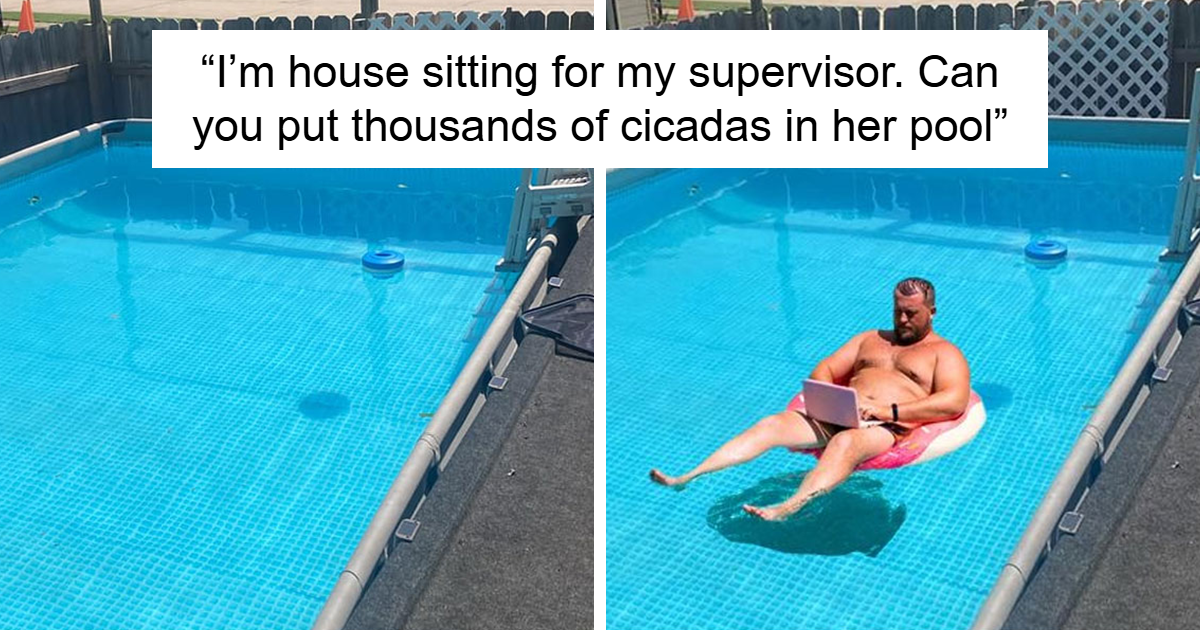
- The supervisor’s pool: Thousands of cicadas were requested, but submerged vehicles and relaxed strangers proved much more concerning.
- The leaning tower: A tourist wanted better alignment with a landmark and was repositioned beside cows, rockets, dogs, and gravity-related problems.
- The confidence-restoring hair: A bald man received hairstyles from rock stars, cartoon characters, household brushes, and emotionally unavailable wigs.
- The blank-wall pose: A woman wanted a livelier location and was relocated underwater, onstage, and into events she had not rehearsed for.
- The concert obstruction: Removing two people from a treasured concert picture somehow introduced even more people, including performers who were never there.
- The woman in red: One person was removed, recolored, duplicated, disguised, and occasionally turned into an architectural feature.
- The bigger biceps: A modest muscle enhancement became an arm capable of lifting cars, buildings, and the editor’s entire portfolio.
- The closed eyes: Editors technically opened them by adding enormous cartoon eyes, binoculars, and glasses suitable for astronomical research.
- The arcade stranger: A woman was removed from the background but returned as a ghost, pixel character, or prize inside the machine.
- The shredded tires: A harmless prank request transformed a vehicle into a burned-out wreck requiring police, firefighters, and marital counseling.
- The nicer weather: Clear skies were ignored in favor of thunderstorms, tornadoes, and clouds apparently managed by a heavy-metal album designer.
- The gambling fortune: A casino table needed $30,000, so editors supplied stacks of money and several reasons for the family to stage an intervention.
- The giant mother: Removing Mom from a favorite portrait made her larger, more powerful, and capable of looming over the entire city.
- The video-game makeover: A GTA-style request produced health bars, mission prompts, chess pieces, and suspiciously low character statistics.
- The missing beach background: A seaside setting became a religious painting, celestial banquet, and inexplicable encounter with a giant hand.
- The slimmer arm: Editors reduced the arm so dramatically that it resembled spaghetti, string, or a minor line-drawing accident.
- The bald-head typo: A request to cover a “bold” head inspired typography jokes, motivational slogans, and extremely confident hair.
- The creative boyfriend portrait: A perfectly normal man was dressed for ballet, suspended above cliffs, and assigned several dangerous hobbies.
- The man who needed removing: Instead of deleting one person, editors multiplied him until the photograph appeared to host his annual convention.
- The fuller hairstyle: A husband requested more hair and received less hair, someone else’s hair, or a magnificent animal-based solution.
- The Ferrari replacement: A yellow car was removed, but the promised Ferrari was interpreted through toys, logos, and vehicles from unrelated centuries.
- The professional headshot: A polished business portrait emerged as a pilot, elf, science-fiction officer, and candidate for interplanetary middle management.
Why These Funny Photo Edits Keep Going Viral
They Deliver a Complete Joke in Seconds
A funny edited picture requires almost no introduction. The viewer reads the request, looks at the result, and understands the gap between what was intended and what was delivered. That makes hilarious photo manipulation ideal for social feeds, where every post is competing against videos, headlines, advertisements, and someone’s 14-picture brunch carousel.
The strongest edits also reward a second look. At first, the image may seem normal. Then the viewer notices a miniature shark carrying a briefcase, a suspiciously muscular arm, or a background character who has been replaced by a garden gnome. That delayed discovery works like a second punchline.
The Joke Feels Collaborative
These posts invite audiences to imagine their own solutions. Once one editor turns “make me look cooler” into a freezer scene, another may place the subject in Antarctica. A third may simply add sunglasses to the refrigerator. The humor grows through friendly competition.
Healthy editing communities establish boundaries around that competition. Large request forums commonly prohibit bullying, fraudulent alterations, explicit manipulations, and trolling on serious or paid requests. Those rules matter because playful editing works best when the person submitting the photograph understands the joke and remains part of the fun.
How to Request a Funny Photo Edit Without Regretting Everything
Be Clear About Whether You Want Comedy
State whether you need a genuine correction, humorous alternatives, or both. “Please remove the person on the left; joke versions are welcome after one realistic edit” gives editors useful boundaries.
Avoid Sharing Sensitive Images
Do not post private documents, identifying information, intimate photographs, or images of people who have not agreed to public sharing. Once a picture circulates widely, controlling future copies can be difficult.
Do Not Target Someone’s Insecurity
Funny edits should play with wording and situations rather than humiliating a person’s body, disability, age, or appearance. The cleverest joke is rarely “this stranger looks bad.” That is not visual comedy; it is middle-school behavior with better software.
Keep Obvious Fiction Obvious
A shark in a trench coat is unlikely to mislead anyone. A realistic alteration presented as documentary evidence is different. Modern AI-assisted tools make convincing edits easier to create, increasing the importance of context and disclosure. Historical satire and playful manipulation can be valuable, but deceptively altered images can damage trust when viewers cannot tell whether they are seeing comedy, advertising, news, or fabrication.
Experiences From the Wild: What These 61 Edits Teach Us
Browsing dozens of funny photo edit requests creates a strangely predictable emotional journey. At first, you admire the technical work. Then you begin studying the request for linguistic weak points. By the twentieth example, you no longer read “remove the man in the background” as a normal instruction. You read it as an invitation to remove every man on Earth except the one in the background.
The most memorable experience is realizing how much humor depends on attention. A rushed editor sees a straightforward task. A comic editor notices that “give me hair” does not specify where the hair should come from, what species originally owned it, or whether it must remain attached to the head. The request contains the raw material; the editor simply finds the hidden trapdoor.
These exchanges also reveal how creativity benefits from constraints. The editor is not starting with a blank canvas. There is a person, an existing pose, a background, and a sentence describing the desired result. Those limitations make the challenge more interesting. A woman holding her hand awkwardly cannot be moved, so the editor must decide what object could explain the pose. A fish? A bowling ball? A tiny royal scepter? Each answer creates a different story.
Another lesson is that craftsmanship matters even when the final idea is ridiculous. The funniest result may feature a giant bear, but the bear still needs to match the scene’s lighting. A badly pasted object produces a quick chuckle. A perfectly blended object makes viewers briefly accept the impossible before their brains file a formal complaint. That fraction of a second is where much of the comedy lives.
There is also something refreshing about seeing photo-editing technology used to make images less perfect. Social platforms often encourage smooth skin, ideal lighting, carefully controlled bodies, and spotless backgrounds. Comedy edits travel in the opposite direction. They introduce mess, exaggeration, animals, explosions, and deeply unqualified celebrities. Instead of presenting an impossible standard of perfection, they expose the artificiality of editing by making the manipulation proudly visible.
However, the experience stops being enjoyable when consent disappears. A person who deliberately submits a photograph for humorous editing has accepted a certain amount of mischief. A stranger whose image is taken, altered, and mocked has not. That distinction should guide creators, publishers, and audiences. An edit can be technically legal or easy to create while still being unnecessarily cruel.
Accessibility deserves attention as well. Visual jokes often depend on small background details, facial expressions, and the relationship between the original request and the altered image. Descriptive alt text should explain both the setup and the punchline so readers using screen readers can participate in the humor rather than receiving a useless label such as “funny photo.” Research into meme accessibility emphasizes descriptions of actions, emotions, characters, and meaningful background details.
Ultimately, funny photo edit requests demonstrate a generous form of internet creativity. Someone provides an ordinary snapshot. Several strangers contribute imagination and technical labor. Thousands of viewers share the laugh. Nobody needed a studio budget, a film crew, or a 90-minute meeting about brand alignment. They needed one ambiguous sentence, one editable photograph, and at least one person willing to spend an unreasonable amount of time placing a shark in formalwear.
Conclusion
The appeal of unexpected photo edits is simple: they transform everyday communication into visual comedy. A request becomes a setup, skilled editing becomes the delivery system, and literal interpretation becomes the punchline. The best examples are surprising without being cruel, technically polished without taking themselves seriously, and absurd enough to remain memorable long after another flawless social-media portrait has vanished from the feed.
So the next time you ask the internet to remove a distracting object, improve your hair, or make the background more exciting, choose your words carefully. Somewhere, an editor is already opening a folder labeled “dinosaurs,” and that person has been waiting all day for an excuse.
Note: The scenarios in this article are original, condensed descriptions inspired by publicly shared photo-editing requests and visual-comedy traditions. They are presented for commentary and entertainment rather than as instructions for deceptive image manipulation.

