
Beauty Tools & Accessories
12 Brutally Honest Charts That People Who Hate People Will Understand
Jun
Some people wake up excited to mingle. Others wake up, check their calendar, see “team lunch,” and briefly consider becoming a lighthouse keeper. This article is for the second group: the politely exhausted, the socially selective, the “I like humanity in theory but please stop standing so close” crowd.
Of course, “people who hate people” is usually a dramatic way of saying something much more reasonable: people can be draining. Small talk can feel like running a marathon in dress shoes. Group chats multiply like wet gremlins. Meetings reproduce faster than office plants. And sometimes the most beautiful sentence in the English language is, “Actually, I can’t make it.”
Still, there is a difference between enjoying solitude and being painfully isolated. Research from psychology, workplace productivity, and public health consistently shows two things can be true at once: humans need meaningful connection, and many humans also need serious recovery time after too much noise, interruption, judgment, and forced togetherness. That tension is exactly why brutally honest charts about social life feel so funny. They turn private irritation into clean little lines, bars, and downward spirals.
Below are 12 imaginary-but-painfully-accurate charts that people who hate people will understand deep in their introverted bones.
Why “Hating People” Often Means “My Social Battery Is a Potato”
Before we start drawing emotional pie charts with invisible crayons, let’s clarify the mood. Introversion is not automatically shyness. Social anxiety is not the same as being antisocial. And enjoying alone time does not mean someone is broken, rude, cold, or secretly planning to live in a cave with excellent Wi-Fi.
Many people simply process social interaction as stimulation. A good conversation with a trusted friend might feel nourishing. A crowded party with loud music, six introductions, three “So what do you do?” questions, and one guy explaining cryptocurrency may feel like being attacked by confetti. The issue is not people in general. It is volume, unpredictability, obligation, and the pressure to perform friendliness on demand.
The following charts are funny because they exaggerate real patterns: meeting overload, social fatigue, the need for boundaries, awkward public behavior, and the universal mystery of why some people stand directly in the middle of a grocery aisle as if guarding a national monument.
12 Brutally Honest Charts People Who Hate People Will Understand
1. The Social Battery Line Graph
Chart concept: A line starts at 100% at 8:00 a.m., drops to 72% after one cheerful “Good morning!”, collapses to 38% after a surprise phone call, and hits 1% when someone says, “Let’s go around the room and introduce ourselves.”
This is the classic chart for people who do not dislike kindness but do dislike being perceived before coffee. The social battery is not imaginary. It is the lived experience of spending mental energy reading tone, managing facial expressions, choosing appropriate responses, and pretending not to notice that someone is telling the same story for the fourth time.
The funniest part is that the battery does not drain evenly. A two-hour conversation with a favorite person may feel easy. A five-minute conversation with a stranger who says “Smile!” may require three business days of emotional recovery.
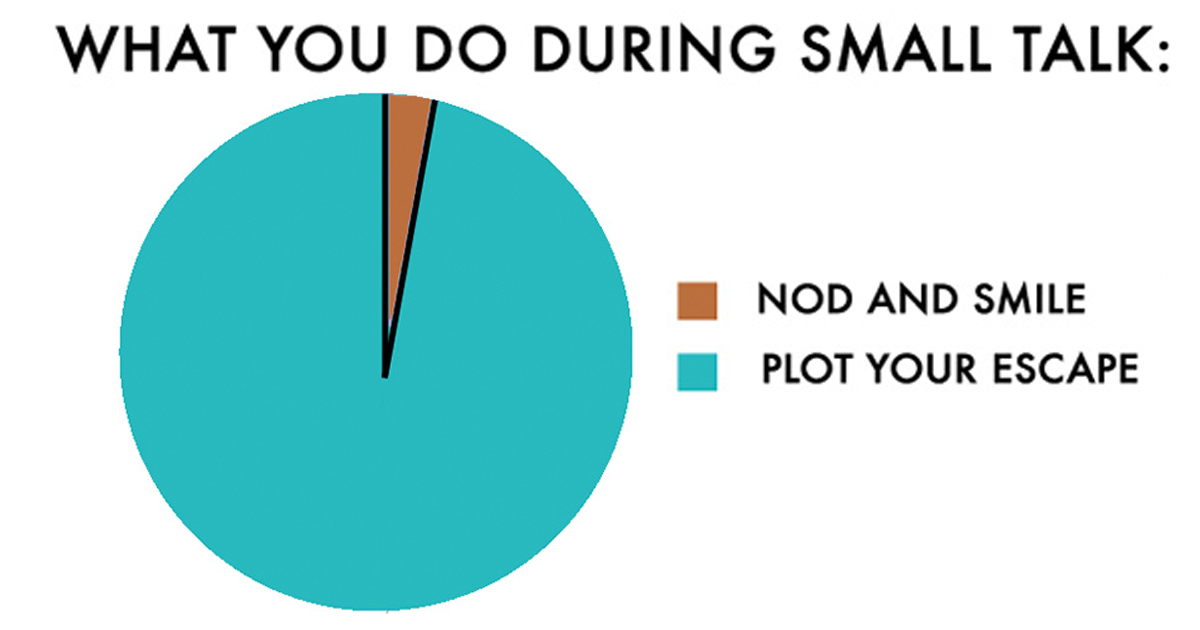
2. The Small Talk Pie Chart
Chart concept: 45% weather, 25% weekend plans, 15% pretending to remember someone’s name, 10% laughing at jokes you did not hear, and 5% desperately searching for an exit.
Small talk exists for a reason. It helps people test safety, build mild familiarity, and avoid opening conversations with, “So, what are your deepest regrets?” But for people who hate shallow social rituals, small talk feels like conversational packing peanuts: technically useful, spiritually annoying.
The chart becomes brutally honest when it reveals the hidden labor. You are not just discussing rain. You are performing normalcy. You are nodding at the right time. You are making sure your face says “interested adult” instead of “trapped raccoon.” That is a lot of work for a conversation about humidity.
3. The “Plans Sounded Fun Three Weeks Ago” Bar Chart
Chart concept: Excitement level when making plans: 92%. Excitement level one week before: 54%. Excitement level the day before: 19%. Excitement level while looking for parking: negative 700%.
This chart should be printed on every calendar app. The future self is wildly optimistic. The present self is wearing soft pants and negotiating with the universe. That concert, dinner, birthday party, or networking event sounded wonderful when it was abstract. Then the day arrives, and suddenly the couch has legal custody of your body.
People who hate people are not always flaky. Sometimes they are victims of time-delayed social ambition. They imagined being charming and available. Then reality arrived holding traffic, dress codes, and a room full of acquaintances asking where they work now.
4. The Meeting Overload Scatter Plot
Chart concept: As the number of meetings rises, meaningful work drops. Past five meetings per day, the chart simply becomes a skull wearing a headset.
Work meetings are a special category of human endurance sport. Some are useful. Many are ceremonies where adults gather to transform 12 minutes of information into 48 minutes of calendar smoke. For people who prefer focus, meeting overload feels less like collaboration and more like being slowly fed to a slideshow.
The brutally honest insight is that meetings often create the illusion of progress. Everyone speaks. Notes are taken. Someone says “circle back.” Then the actual work still waits, arms crossed, like a disappointed parent.
5. The Grocery Store Rage Heat Map
Chart concept: Mild irritation in the produce section, moderate irritation near checkout, extreme red danger zone around people who block the aisle with their cart while contemplating cereal as if selecting a baby name.
If you want to understand civilization, watch people in a grocery store. Some move with purpose. Others drift diagonally, stop without warning, hold family reunions near the eggs, and leave carts sideways like abandoned shipwrecks.
This chart resonates because public spaces require shared awareness. People who “hate people” often do not hate humanity. They hate avoidable friction: loud speakerphone conversations, aisle-blocking, line-cutting, and the ancient retail crime of standing too close while everyone waits for self-checkout to panic over an unexpected item in the bagging area.
6. The Group Chat Notification Growth Curve
Chart concept: One message becomes 14. Fourteen become 86. By lunch, the group chat contains three memes, two side arguments, a poll, a voice note, and someone replying “LOL” to a message from yesterday.
Group chats are modern villages, except the village bell rings every 11 seconds and someone keeps sending screenshots with no context. For socially selective people, notifications feel like tiny digital knocks on the skull.
The worst part is that silence becomes suspicious. If you do not respond, someone may ask, “Are you okay?” Yes. That was the point. The chart peaks when the group decides something that could have been handled by one direct message now requires 43 opinions and an emoji-based voting system.
7. The Elevator Conversation Probability Chart
Chart concept: Probability of wanting silence: 99%. Probability someone says, “Looks like somebody’s got a case of the Mondays”: unfortunately not zero.
Elevators are sacred short-distance silence chambers. The social contract should be simple: face forward, become temporarily furniture, exit with dignity. Yet some brave souls treat elevators as networking lounges with cables.
The chart is funny because the time is so short, but the discomfort is so concentrated. No one can escape naturally. Everyone watches the numbers. Someone comments on the weather inside a metal box with no windows. Society continues, but at what cost?
8. The “I’m Fine” Translation Table
Chart concept: “I’m fine” translates to “I need quiet,” “Please stop asking,” “I have used all available words,” or “My soul has left the chat.”
People who hate people often develop compact language. “I’m fine” is efficient. It prevents follow-up questions, emotional excavation, and surprise advice. Unfortunately, it can also confuse well-meaning friends who are trying to help.
The honest takeaway is that communication styles differ. Some people process feelings out loud. Others process them internally, preferably near snacks and no witnesses. A healthy relationship allows room for both. The goal is not to force everyone into endless emotional speeches. The goal is to make “I need quiet” acceptable without turning it into a courtroom drama.
9. The Public Phone Call Volume Scale
Chart concept: Normal speaking voice: acceptable. Speakerphone in public: criminally loud. Video call without headphones: the graph explodes and becomes a warning label.
Nothing unites quiet people faster than a stranger loudly conducting a personal call in a waiting room. Suddenly everyone becomes part of the relationship, the medical update, the banking issue, or the argument about who forgot to buy oat milk.
This chart captures a core truth: people who hate people usually crave boundaries. They do not want to supervise a stranger’s divorce while trying to renew a driver’s license. They want public life to contain a basic acoustic mercy.
10. The “Friend I Actually Like” Exception Chart
Chart concept: General desire to socialize: 12%. Desire to see one specific friend who understands silence, snacks, and leaving early: 97%.
This is the chart that proves the phrase “people who hate people” is mostly theatrical. Many socially drained people are deeply loyal. They may not want a crowd, but they do want their people: the friends who do not demand constant performance, the ones who can sit in the same room doing separate things, the ones who know that canceling plans is sometimes an act of mutual compassion.
Meaningful connection is different from social volume. One honest conversation can do more good than three crowded events where everyone is yelling over music and pretending to enjoy warm dip.
11. The Boundary-Setting Difficulty Curve
Chart concept: Saying yes to avoid discomfort: easy. Saying no politely: hard. Saying no without writing a 900-word apology: Olympic-level.
Boundaries sound simple until you try to set one with a person who treats your free time like public property. “No, thank you” should be enough, but many people feel pressured to provide evidence, documentation, and perhaps a notarized sadness report.
The brutally honest chart shows that resentment grows when boundaries shrink. People who always say yes may eventually become the people who “hate people,” not because they dislike others, but because they have trained everyone to expect unlimited access. A clear no is not rude. It is maintenance.
12. The Solitude Satisfaction Curve
Chart concept: One hour alone: peaceful. One evening alone: restorative. One full weekend alone: luxurious. Three weeks without meaningful contact: maybe time to text someone kind.
This final chart is the most important. Solitude can be medicine, but too much isolation can become a problem. The sweet spot is not the same for everyone. Some people need a packed social calendar to feel alive. Others need quiet, books, pets, solo walks, and a door that closes with authority.
The healthiest version of “I hate people” is not permanent withdrawal. It is discernment. It is choosing better company, better timing, better boundaries, and better recovery. It is knowing when you need silence and when you need connection that does not feel like a performance review.
What These Brutally Honest Charts Reveal About Modern Social Life
The joke behind these charts is not that people are terrible. The joke is that modern life asks us to be socially available in too many directions at once. We are expected to answer texts, reply to emails, attend meetings, comment on posts, join calls, remember birthdays, respond to group chats, network professionally, maintain friendships, support family, and somehow remain calm when someone sends “Can we talk?” with no context.
That is a lot of human contact, and not all of it is meaningful. Many people are not exhausted by love, friendship, or community. They are exhausted by shallow contact that demands energy without giving much back. A quick errand becomes tiring because of crowding. A workday becomes tiring because of interruptions. A social event becomes tiring because everyone is performing a version of themselves polished enough for public display.
This is why humor matters. A brutally honest chart turns frustration into recognition. Instead of thinking, “Why am I so weird?” the reader thinks, “Oh good, other people also want to hide behind a houseplant during forced networking.” Comedy gives people permission to admit that not every invitation is a blessing and not every conversation improves the day.
How to Survive People Without Becoming a Full-Time Hermit
Choose Quality Over Quantity
You do not need to be available to everyone to be a decent human being. A smaller circle of trusted people can be healthier than a crowded social life full of obligation. Choose relationships where silence is allowed, honesty is safe, and nobody takes it personally when you need a quiet night.
Protect Recovery Time
After a demanding social event, build in a buffer. Do not schedule brunch, errands, a phone call, and dinner with acquaintances on the same day unless you enjoy becoming emotionally crispy. Recovery is not laziness. It is how many people stay kind.
Use Clear, Low-Drama Boundaries
Try simple phrases: “I can’t make it this time,” “I’m keeping tonight quiet,” or “I’m not available for a call, but email works.” The fewer paragraphs you use, the less room there is for negotiation. Your peace does not need a PowerPoint defense.
Notice When Avoidance Becomes a Cage
There is a big difference between enjoying solitude and feeling trapped by fear, dread, or shame. If avoiding people starts interfering with work, relationships, school, daily tasks, or basic well-being, it may be time to seek support from a qualified mental health professional. The goal is not to become a party balloon. The goal is freedom: the ability to choose connection or quiet without panic running the meeting.
Experiences Related to “12 Brutally Honest Charts That People Who Hate People Will Understand”
Most people who relate to these charts have a greatest-hits album of social exhaustion moments. Mine would begin with the classic: agreeing to plans while in an unusually optimistic mood. At the time, dinner with six people sounded charming. I imagined laughter, sparkling conversation, maybe a dessert menu. Then the actual night arrived, and suddenly getting dressed felt like preparing for a diplomatic summit. The restaurant was loud, the parking was suspiciously far away, and someone suggested ordering “for the table,” which is how trust issues are born.
Another familiar experience is the office “quick question.” It is never quick. A quick question is a tiny meeting wearing a fake mustache. You are deep in focused work, finally solving the thing that has bothered you all morning, when someone appears beside your desk or sends a message that begins with “Got a sec?” A sec becomes eight minutes. Eight minutes becomes lost concentration. Lost concentration becomes staring at your screen like it betrayed you personally.
Then there is the grocery store obstacle course. You enter with a simple mission: eggs, bread, coffee, escape. But other shoppers have transformed the store into a slow-motion parade of confusion. Someone parks their cart diagonally in front of the exact shelf you need. Someone else reads every label in the pasta aisle with the intensity of a detective solving a cold case. A child screams near the frozen vegetables, and suddenly you understand why medieval monks valued silence.
Phone calls deserve their own chapter. Texting allows preparation. Email allows editing. A phone call, however, bursts into your life like a raccoon through a ceiling tile. Many people who “hate people” do not hate conversation; they hate being ambushed by conversation. A scheduled call is tolerable. An unexpected call triggers the ancient survival response: stare at the screen, wait for it to stop ringing, then text, “Sorry, missed this!” as if you were not watching it happen in real time.
Social events also come with the legendary exit calculation. The moment you arrive, some quiet part of your brain starts estimating when leaving becomes acceptable. Too early, and people ask questions. Too late, and your soul becomes soup. The perfect exit is elegant, brief, and nearly invisible. You thank the host, compliment something specific, and disappear before anyone can say, “Wait, we’re about to play a game.”
Yet the most honest experience is this: the right people do not feel like “people.” They feel like relief. A trusted friend can sit with you in comfortable silence. A good partner understands when you are out of words. A kind coworker sends the agenda before the meeting and earns a small statue in your heart. The charts are funny because they complain about humanity, but underneath the jokes is a serious wish: less noise, more consideration, fewer forced interactions, and deeper connections with people who do not drain the last 3% of your battery.
Conclusion
The best brutally honest charts about people who hate people work because they expose a truth many of us hide behind polite smiles: social life is not automatically refreshing. It can be funny, awkward, exhausting, meaningful, annoying, beautiful, and wildly inefficientsometimes before lunch.
Still, the point is not to reject everyone and move into a dramatic mountain cabin with only soup and grudges. The point is to understand your limits. Maybe you need fewer meetings, quieter weekends, better boundaries, smaller gatherings, or friends who know that silence is not a personal attack. Maybe you need more meaningful connection and less social clutter. Maybe you simply need people to stop using speakerphone in public, which is a reasonable dream for civilization.
So the next time your social battery drops from 82% to 4% because someone said, “Let’s do icebreakers,” remember: you are not alone. Ironically, many people who hate people are united by the same desireto be left alone just enough to remain pleasant when they finally come back.
Note: This article is based on synthesized information from reputable U.S. psychology, public health, workplace productivity, and social-behavior sources, rewritten in an original humorous SEO style without inserted source links.

