
Hair Care
10 Wacky Satirical Political Candidates
Jul
Politics can be serious business: budgets, wars, health care, taxes, potholes, debates, polls, and speeches that sometimes sound as if they were assembled from refrigerator magnets. But every so often, democracy opens the side door and lets in a candidate wearing a boot on his head, a comedian promising absolutely nothing, a pig nominated for president, or a cat with better campaign merchandise than half the human field.
Satirical political candidates are not just comic relief. At their best, they expose how campaigns work, how voters feel, and how ridiculous political theater can become when slogans replace substance. Some run to mock corruption. Some run to protest the two-party system. Some run because the rent is, indeed, too high. And some appear to run because someone left the filing paperwork unattended.
This list of 10 wacky satirical political candidates looks at real campaigns that turned elections into performance art. They may not have won office, but they won headlines, laughs, and occasionally a very uncomfortable conversation about whether the joke candidate was making more sense than the serious ones.
Why Satirical Political Candidates Matter
Funny candidates are easy to dismiss, but satire has a long history in American politics. Political cartoons, late-night monologues, parody ads, fake campaign buttons, and protest candidates all do the same basic job: they make power look less untouchable. When a satirical candidate enters a race, the campaign becomes a mirror. Sometimes the reflection is goofy. Sometimes it is painfully accurate. Often, it is both.
These campaigns also reveal voter frustration. A joke candidate usually rises when people feel the official choices are too polished, too scripted, or too disconnected from everyday life. Humor becomes a protest vote with confetti attached.
10 Wacky Satirical Political Candidates Who Made Democracy Weirder
1. Pat Paulsen: The Deadpan President America Almost Deserved
Comedian Pat Paulsen became one of the most famous satirical presidential candidates in American history. Best known for his work on The Smothers Brothers Comedy Hour, Paulsen launched a parody campaign in 1968 and kept returning to the presidential trail for decades.
His genius was not wild shouting or clown makeup. It was deadly serious nonsense. Paulsen spoke like a candidate who had swallowed a whole press conference and was still trying to digest it. His speeches mocked political double-talk, vague promises, and the habit of answering every question without actually saying anything.
Paulsen’s campaign worked because it sounded absurdly familiar. His slogans and statements were ridiculous, but only a few inches more ridiculous than real campaign language. He turned the empty phrase into an art form. In doing so, he became the unofficial patron saint of voters who have ever watched a debate and thought, “Did anyone answer the question?”
2. Pigasus: The Yippie Pig for President
In 1968, the Youth International Party, better known as the Yippies, nominated a pig named Pigasus for president during the protests around the Democratic National Convention in Chicago. It was outrageous, visual, and impossible for cameras to ignore.
The point was not that Pigasus had a detailed agricultural policy. The point was that the Yippies wanted to mock a political system they believed had become corrupt, violent, and out of touch. Their message was basically: if politics has become a barnyard, why not nominate an actual pig?
Pigasus was quickly taken by police, and several activists were arrested. That only made the stunt more famous. The candidate may have had no campaign manager, no tax plan, and no public speaking skills beyond snorting, but as political theater, Pigasus was shockingly effective.
3. Nobody for President: The Perfect Candidate, Technically Speaking
The “Nobody for President” campaign became a countercultural classic in the 1970s. Popularized by figures including Wavy Gravy, the campaign used one of the simplest jokes in politics: Nobody keeps promises. Nobody cares. Nobody should have too much power.
The brilliance was in the wordplay. “Nobody” could be praised for every virtue missing in Washington. Nobody was honest. Nobody listened. Nobody would end pointless political drama. The campaign worked because it gave voters a funny way to express a not-so-funny feeling: disillusionment.
In a country where many voters have felt trapped between imperfect options, Nobody became the ultimate protest candidate. The campaign buttons practically wrote themselves, and the joke still works today because the complaint behind it has not gone out of style.
4. Gracie Allen: The Surprise Party Candidate
Long before celebrity campaigns became normal enough to stop surprising anyone, comedian Gracie Allen ran for president in 1940 under the banner of the Surprise Party. The name itself was a joke: her father was a Republican, her mother was a Democrat, and Gracie said she was born a surprise.
Allen’s campaign began as a radio gag with her husband and comedy partner George Burns, but it became a national publicity phenomenon. She went on a whistle-stop tour, gave speeches, and leaned into a style of cheerful nonsense that gently roasted political rituals.
What made Allen’s run special was its warmth. She did not sound angry at politics. She sounded amused by it. Her campaign poked fun at campaign conventions, gender expectations, and the grand seriousness of political ambition. In an era when women had far less political representation, Allen’s fake candidacy also carried an accidental edge: why did the idea of a woman president seem so laughable to begin with?
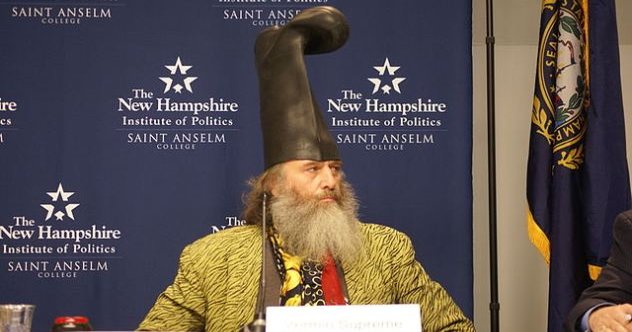
5. Vermin Supreme: Free Ponies, Mandatory Toothbrushing, and the Boot Hat
No list of wacky satirical political candidates is complete without Vermin Supreme, the perennial candidate known for wearing a boot on his head and carrying an oversized toothbrush. His platform has included mandatory toothbrushing, zombie apocalypse preparedness, time-travel research, and free ponies for Americans.
On the surface, Supreme looks like pure chaos. Underneath the glitter and absurdity, however, his act is a sharp critique of campaign promises. Politicians regularly offer benefits without explaining trade-offs. Supreme simply takes that logic to its cartoon conclusion: why not promise everyone a pony?
Over the years, Vermin Supreme has appeared in presidential primaries, debates, forums, and alternative political events. His staying power comes from a rare ability to be both ridiculous and pointed. The boot is funny. The point beneath it is sharper than it first appears.
6. Stephen Colbert: The Favorite Son of South Carolina Satire
In 2007, Stephen Colbert turned his TV persona into a presidential campaign, announcing that he would run in South Carolina. The campaign was part parody, part media experiment, and part love letter to the absurd rituals of American elections.
Colbert’s run mocked the way candidates pander to local voters, court sponsors, and transform personal biography into campaign mythology. His connection with Doritos added another layer, turning snack-food branding into a joke about corporate influence in politics.
The campaign did not become a serious ballot threat, but that was never the real goal. Colbert demonstrated how quickly modern media can transform a joke into a campaign story. He also showed that a fake candidate with a clear comic message can sometimes get more attention than real candidates with full policy platforms and extremely normal haircuts.
7. Deez Nuts: The Teen Prank That Polled Better Than Expected
In 2015, a 15-year-old from Iowa named Brady Olson filed paperwork using the name “Deez Nuts” as an independent presidential candidate. What could have remained a teenage prank became national news when the name appeared in polling and attracted surprising levels of support in hypothetical matchups.
The campaign was funny because it was immature. It was also revealing because some voters were willing to pick the joke over major-party candidates. That did not mean they wanted a meme in the Oval Office. It meant they were annoyed enough to use a poll as a complaint box.
Deez Nuts became a perfect example of internet-age political satire. The paperwork was easy, the name was viral, and the media ecosystem did the rest. In an earlier era, the joke might have stayed in a high school hallway. In 2016 politics, it became a national headline.
8. Jello Biafra: Punk Rock for Mayor
In 1979, Jello Biafra, lead singer of the Dead Kennedys, ran for mayor of San Francisco. His campaign was partly serious, partly punk performance, and completely allergic to business-as-usual politics.
Biafra’s run used satire to attack corporate power, bland civic messaging, and political image-making. He reportedly built parts of his platform in the scrappy spirit of punk: direct, confrontational, and not especially interested in asking polite permission. His campaign included theatrical gestures and proposals that mixed humor with genuine criticism of urban politics.
What made Biafra memorable was that he did not simply make jokes from the outside. He entered the system, used its own tools, and made the mayoral race stranger. Punk music often says, “Anyone can start a band.” Biafra’s campaign said, “Anyone can run for mayor, and maybe they should, especially if City Hall has become too comfortable.”
9. Jimmy McMillan: The Rent Is Too Damn High
Jimmy McMillan, founder of the Rent Is Too Damn High Party, became a viral political figure during New York races with a message so simple it could fit on a protest sign, a T-shirt, and the inside of every renter’s exhausted soul.
McMillan was not merely a joke candidate. Housing affordability was, and remains, a serious issue. But his presentation was so memorable that it entered meme history: black gloves, dramatic facial hair, booming delivery, and one unforgettable slogan repeated with the force of a church bell.
The satire came from compression. While other candidates buried housing policy under paragraphs of cautious language, McMillan reduced the matter to one sentence. It was funny because it was blunt. It was effective because, for many people, it was true.
10. Limberbutt McCubbins: The Demo-Cat Candidate
Limberbutt McCubbins, a tabby cat, became one of the most memorable joke names of the 2016 presidential cycle. The feline candidate was presented as a “Demo-cat,” proving that political puns are legally required to happen whenever an animal nears a campaign form.
Limberbutt’s campaign mocked the flood of novelty filings that appeared during the 2016 race. At a time when the presidential field was already crowded, the idea of a cat entering the race felt only slightly more absurd than the daily news cycle.
The cat campaign also pointed to a larger truth about online politics: attention is currency. A funny name, a cute animal, and a clever hook can travel faster than a white paper on tax policy. Limberbutt was never going to occupy the White House, but for a moment, the campaign occupied the internet beautifully.
What These Satirical Campaigns Reveal About Real Politics
The funniest candidates often expose the least funny problems. Pat Paulsen mocked empty rhetoric. Pigasus mocked establishment power. Nobody for President mocked voter alienation. Vermin Supreme mocked impossible promises. Deez Nuts mocked the low barrier between political paperwork and viral fame. Jimmy McMillan turned a real housing crisis into a slogan nobody could forget.
Satirical political candidates succeed when they identify something voters already suspect. The system is too scripted. Campaigns are too expensive. Debates are too performative. Politicians promise too much. Voters are tired. Once the audience recognizes the truth under the joke, the joke sticks.
That is why these candidates remain popular in political history. They did not win power, but they won memory. Many serious candidates spend millions trying to create a message voters remember for one week. A man with a boot on his head and a promise of free ponies can linger for decades.
The SEO-Friendly Lesson: Humor Makes Politics Shareable
From a media perspective, wacky satirical candidates are built for attention. They have visual hooks, short slogans, emotional clarity, and instant contrast with traditional politicians. In modern content terms, they are highly shareable because the story can be understood in one sentence: “A pig ran for president,” “A cat filed for the White House,” or “A man built a campaign around rent being too high.”
But the deeper reason these stories last is not just novelty. It is meaning. Satirical campaigns give audiences permission to laugh at political frustration without ignoring it. They transform cynicism into comedy, and comedy into conversation.
Experiences and Reflections Related to Wacky Satirical Political Candidates
Anyone who has followed an election closely knows the strange emotional cycle of campaign season. At first, there is curiosity. Then come the speeches, the debates, the polls, the attack ads, the fundraising emails, the yard signs, and the sudden feeling that every candidate has personally moved into your living room. By the end, even serious voters may start craving a little comic relief.
That is where satirical candidates become oddly refreshing. They interrupt the script. A normal candidate says, “I am fighting for working families.” A satirical candidate says, “I will give every American a pony,” or “Nobody is perfect,” or “The rent is too damn high.” The joke cuts through the fog. Even when the platform is absurd, the emotional message is clear: politics has become too polished, too expensive, too rehearsed, and too detached from ordinary irritation.
Writing about these candidates is a reminder that satire is not the opposite of seriousness. In many cases, satire is what happens when seriousness has been ignored for too long. Pigasus was funny, but the anti-war anger around 1968 was not. Jimmy McMillan’s slogan became a meme, but housing costs were not a meme to renters. Vermin Supreme’s free ponies are ridiculous, but they mock the very real habit of politicians promising benefits without explaining the bill.
The best way to experience these stories is not to ask, “Could this candidate win?” Most could not, and some legally should not be trusted with anything more complicated than a scratching post. A better question is, “Why did people pay attention?” The answer is usually frustration mixed with delight. Voters enjoy seeing the powerful teased. They enjoy watching a debate stage become less predictable. They enjoy a candidate who says the quiet part loudly, even if the quiet part is wearing a cape.
There is also a civic lesson here. Democracy is not only voting for the likely winner. It is also speech, protest, parody, participation, and public imagination. Satirical political candidates remind people that the system belongs to citizens, not only consultants, donors, and people who say “robust framework” without blinking. A joke campaign can make politics feel accessible again. It says: you are allowed to notice absurdity. You are allowed to laugh. You are allowed to demand better.
Of course, satire has limits. A joke candidate can expose problems, but jokes alone cannot fix roads, write budgets, or negotiate legislation. The danger is treating politics as entertainment only. The value is using entertainment to pull people back into politics with sharper eyes. When satire works, the laugh is only the beginning. After the laugh comes the question: why did that feel so true?
That question is the real legacy of America’s wackiest satirical candidates. They may never have sat behind the Resolute Desk, but they forced voters to look at the campaign stage from a different angle. Sometimes that angle involved a pig, a cat, a comedian, a punk singer, or a man in gloves shouting about rent. Democracy has had worse mirrors.
Conclusion
Satirical political candidates are more than election-season oddities. They are protest signs with punchlines. Whether it is Pat Paulsen skewering political clichés, Gracie Allen turning a radio joke into a national tour, Pigasus mocking establishment power, or Vermin Supreme promising ponies with a straight face, each campaign reveals something real about public frustration.
The greatest trick of political satire is that it makes people laugh before they realize they are thinking. These 10 wacky satirical political candidates did not need victory speeches to matter. Their campaigns became part of political folklore because they exposed the absurdity already hiding in plain sight.
Note: This article is based on real public election history and reputable reporting, rewritten in original language for web publication.

