
Makeup
What Would Future Tanks Look Like? Here’s What the Experts Told Us
Sep
For more than a century, tank design followed a familiar recipe: add a larger gun, thicker armor, and a stronger engine, then hope the nearest bridge could support the result. That formula produced formidable machines, but it also created vehicles weighing more than 70 tons, consuming enormous quantities of fuel, and requiring a traveling maintenance shop to remain operational.
Future tanks will have to solve a different problem. Modern battlefields are crowded with inexpensive drones, precision-guided missiles, thermal sensors, electronic warfare systems, and long-range artillery. A tank can no longer rely on frontal armor and an intimidating silhouette alone. If it is easily detected, electronically isolated, or attacked from above, all that steel may simply become a very expensive target.
Research from the U.S. Army, Congressional Research Service, DARPA, defense manufacturers, military analysts, and lessons from Ukraine points toward a broad answer: the future main battle tank will still deliver direct fire and protected mobility, but it will be lighter, more automated, easier to upgrade, surrounded by unmanned helpers, and protected by sensors as much as armor.
Why Tanks Are Being Redesigned
The tank is not disappearing. Armies still need a protected vehicle capable of crossing dangerous ground, destroying fortified positions, supporting infantry, and surviving weapons that would turn lighter vehicles into modern art. However, the conditions under which tanks operate have changed dramatically.
Small reconnaissance drones can watch roads, assembly areas, and supply routes for hours. First-person-view drones can pursue vehicles into cover. Top-attack missiles target thinner roof armor, while networked sensors can pass a tank’s location to artillery before its crew realizes it has been spotted.
Combat experience has also reinforced an old lesson: tanks operating without infantry, engineers, air defense, electronic warfare, and artillery support are vulnerable. The future tank therefore cannot be designed as a lone steel superhero. It must function as one part of a connected combined-arms team.
Future Tanks Will Probably Be Lighterbut Not Exactly Light
One of the clearest trends in next-generation tank design is weight reduction. The U.S. Army launched the M1E3 Abrams program after concluding that continuing to add capabilities to the existing Abrams would also keep adding weight, complexity, and logistical demands. The Army has called for a lighter, more survivable design with improved operational mobility and a smaller sustainment footprint.
“Lighter” remains a relative term. Nobody should expect a main battle tank that can be parked beside a compact sedan without making the sedan nervous. A future American tank could still weigh around 60 tons. That would nevertheless be a meaningful reduction compared with heavily upgraded Abrams variants.
Why Weight Matters Beyond the Battlefield
A lighter vehicle can cross more bridges, travel on a wider range of roads, use fewer specialized transporters, and place less strain on tracks, suspension components, and recovery equipment. It may also be easier to deploy from ports and move between theaters.
The goal is not to remove protection indiscriminately. Designers are trying to replace some permanent armor mass with modular armor, active defenses, improved internal layouts, and systems that prevent a hit rather than merely absorbing it. It is the difference between wearing six winter coats and carrying an umbrella that can swat raindrops out of the airexcept the raindrops are anti-tank missiles, so quality control matters.
Active Protection Will Become Standard Equipment
Traditional tank armor is passive: a projectile hits the vehicle, and the armor attempts to stop it. Active protection systems take a more energetic approach. Their sensors detect an incoming missile or rocket, calculate its path, and launch a countermeasure intended to defeat it before impact.
Future tanks will likely combine two forms of active protection. Soft-kill systems can use smoke, electronic interference, infrared countermeasures, or decoys to confuse a weapon’s guidance. Hard-kill systems physically intercept the incoming threat.
These defenses will increasingly be integrated into the tank from the first design sketch instead of bolted on years later. Integrated sensors can provide better coverage, while the vehicle’s power, computing, and cooling systems can be sized appropriately.
The Roof Is Now Prime Real Estate
Protection will also expand upward. Tanks historically concentrated armor on the front, where enemy tanks and anti-tank guns were expected to engage them. Drones and top-attack weapons have made the roof a critical vulnerability.
Future designs may use stronger roof protection, overhead active-defense coverage, electronic counter-drone systems, laser-warning receivers, multispectral smoke, and remote weapons capable of engaging small aircraft. No single layer will be perfect. The likely solution is a defensive stack in which several imperfect systems work together.
Hybrid Power Could Transform More Than Fuel Economy
General Dynamics Land Systems introduced the AbramsX technology demonstrator with a hybrid power pack. Although AbramsX is not itself the Army’s production M1E3, it illustrates why hybrid-electric propulsion interests military planners.
Fuel efficiency is the obvious attraction. Tanks are thirsty, and every gallon must be transported through a supply system that can also be observed and attacked. Lower fuel consumption could mean fewer tanker trucks, smaller convoys, and more operating time between refueling stops.
Hybrid power also offers quieter movement at low speed and a “silent watch” capability. A tank could run sensors and communications without keeping its main engine roaring. That reduces fuel use, noise, and thermal signature while the crew observes an area.
Future vehicles will need abundant electrical power for radars, jammers, active protection, advanced sights, onboard drones, and high-performance computers. A hybrid system can serve as a mobile power station with a very large cannon attachedwhich is admittedly not how most utility companies describe their products.
Fully battery-powered main battle tanks remain unlikely in the near term. Battery weight, charging time, energy density, extreme temperatures, and battlefield infrastructure present serious challenges. Hybrid systems offer a more realistic bridge between conventional engines and increasingly electric vehicle systems.
Unmanned Turrets and Smaller Crews Are Likely
Many future tank concepts place the entire crew inside a protected compartment in the hull while using an unmanned turret. Cameras and digital sights replace traditional periscopes, and an automatic loader handles ammunition.
Removing people from the turret can reduce the volume that requires the heaviest armor. It may also allow a lower profile and improve crew protection by separating personnel from ammunition. An autoloader could reduce a traditional four-person crew to three.
That change has trade-offs. The missing fourth crew member does more than load shells. Crews maintain tracks, stand security, conduct inspections, handle supplies, and repair whatever has chosen the least convenient moment to break. Automation reduces space and manpower requirements inside the tank, but it does not magically tighten track or clean sensors at 2 a.m.
For that reason, future armored units may need more specialized maintainers, robotic support equipment, or revised crew structures even if individual tanks carry fewer people.
The Main Gun Will Evolve, Not Vanish
Despite predictions about lasers and electromagnetic cannons, future tanks will probably retain a conventional high-velocity main gun for years to come. Existing 120mm ammunition inventories, proven performance, and logistical infrastructure make continuity attractive.
The ammunition will become smarter and more flexible. Programmable multipurpose rounds can be configured to engage armored vehicles, infantry positions, walls, or troops behind cover. Improved sensors and fire-control computers will increase first-round accuracy, including while the tank and target are moving.
Some concepts explore larger-caliber guns for defeating heavily protected vehicles. Bigger weapons, however, bring larger ammunition, fewer stored rounds, greater recoil, and more weight. The winning design will balance destructive power with how much ammunition the crew can carry and how reliably an autoloader can handle it.
Secondary Weapons Will Focus on Drones
Remote weapon stations may become increasingly important. Machine guns, automatic grenade launchers, or small autocannons could engage infantry, light vehicles, and low-flying drones without exposing a crew member.
Electronic jammers and directed-energy systems may eventually join these weapons. Lasers could offer a low-cost shot against drones, but generating and cooling enough power on a moving armored vehicle remains difficult. In the immediate future, a mixture of electronic warfare, programmable ammunition, active protection, and conventional guns is more plausible than one miraculous death ray.
Every Tank Will Carry a Digital Nervous System
A future tank’s most important feature may be almost invisible: its software architecture. The U.S. Army wants the M1E3 to use modular open systems standards so hardware and software can be upgraded without redesigning the entire vehicle.
That matters because electronics evolve far faster than armor hulls. A tank may serve for several decades, while processors, cameras, radios, and drone countermeasures can become outdated within yearsor months during an intense conflict. Open interfaces could allow new sensors or applications to be installed more like components in a computer and less like organs in a highly uncooperative rhinoceros.
Software-defined systems also create cybersecurity risks. A connected tank must operate when satellite navigation is unavailable, communications are jammed, or networks are compromised. Future designs will need redundant navigation, secure data links, isolated critical controls, and graceful fallback modes. A crew must still be able to move and fight when the digital battlefield becomes digitally grumpy.
Artificial Intelligence Will Assist the Crew
Artificial intelligence is more likely to serve as a tireless assistant than an electronic commander. A modern tank crew may receive information from thermal cameras, radar, acoustic sensors, drones, friendly units, and higher headquarters. Processing all of it while moving across rough terrain is a recipe for information overload.
AI-enabled tools could identify possible threats, combine reports from several sensors, prioritize warnings, recommend routes, monitor mechanical health, and help the gunner track targets. Predictive maintenance software might detect a failing component before it leaves the tank stranded at the precise location everyone hoped it would not stop.
Human judgment will remain crucial, particularly for identifying targets and authorizing lethal force. Algorithms can misclassify objects, encounter deceptive signals, or fail in unfamiliar environments. The best systems will reduce workload while keeping the crew informed and in control.
Future Tanks Will Command Their Own Drones and Robots
The next-generation tank may be less a solitary vehicle than the central node of a small machine team. U.S. Army experiments with robotic combat vehicles and DARPA’s work on autonomous off-road navigation show where the concept is heading.
Unmanned ground vehicles could move ahead to scout routes, locate mines, draw enemy fire, carry supplies, or occupy dangerous observation positions. Small aerial drones could look over hills, inspect urban intersections, or identify threats beyond the tank crew’s direct line of sight.
A tank might launch a reconnaissance drone, receive its video through a secure link, and share target information with artillery or another vehicle. A robotic wingman could then investigate a suspected ambush point before soldiers enter the area.
These machines will not be flawless autonomous knights. Mud, vegetation, broken terrain, electronic warfare, damaged sensors, and lost communications are brutal teachers. Near-term robotic vehicles will likely perform limited tasks under human supervision rather than independently roam the battlefield making complex decisions.
What Future Tanks Could Actually Look Like
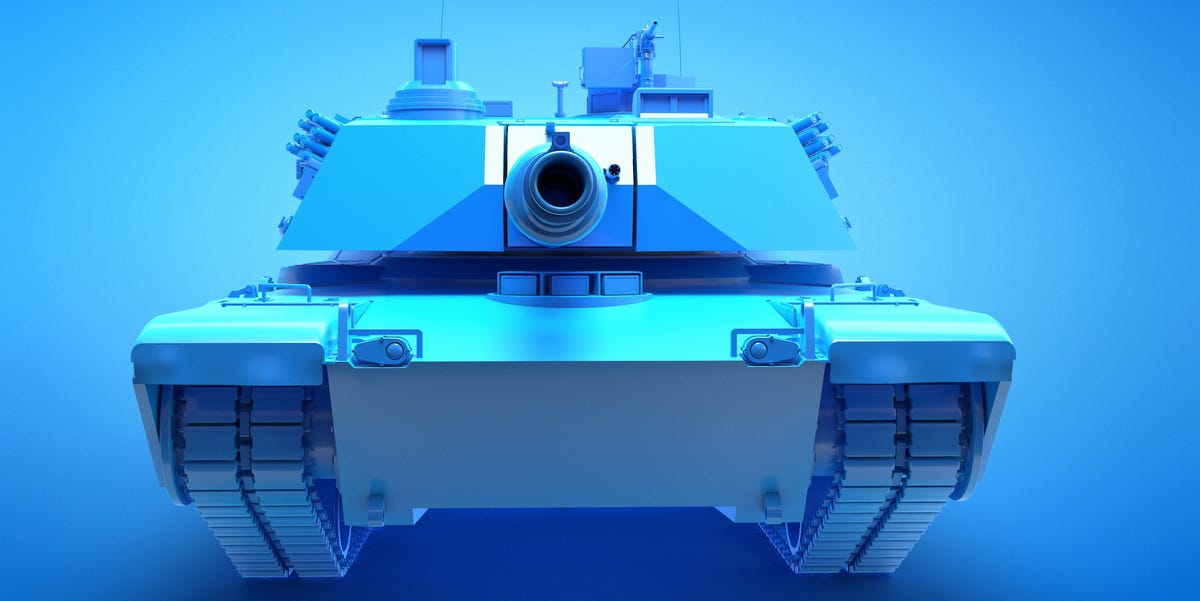
Combine these trends and a realistic future tank begins to emerge. It would probably have a lower silhouette, a compact or unmanned turret, three crew members seated in a protected hull compartment, and modular armor that can be adapted for different missions.
Its exterior would be crowded with radar panels, cameras, laser-warning sensors, antennas, smoke launchers, and active-protection interceptors. A remote weapon station would provide close defense and possibly counter-drone fire. The visual effect might resemble a traditional tank wearing an extremely expensive collection of smart doorbells.
Under the armor, a hybrid powertrain could reduce fuel consumption and supply electricity to sophisticated electronics. Digital controls and open architecture would permit frequent upgrades. The crew would view the battlefield through panoramic displays, with software highlighting threats and combining information from nearby drones, robots, infantry, and aircraft.
Most importantly, the tank would rarely operate alone. Its true protection would come from layered armor, active defenses, electronic warfare, air defense, concealment, rapid movement, supporting infantry, and a network of unmanned scouts.
An Experiential View: A Day Inside a Future Tank
The following scenario is an illustrative experience based on publicly discussed technologies, training concepts, and current development programsnot an account of a specific combat operation.
Imagine arriving at a future armored unit before sunrise. The tank waiting on the line is recognizably descended from today’s main battle tanks, but it appears shorter and cleaner. There are no crew hatches on the turret because nobody sits inside it. Cameras surround the vehicle, and flat radar panels are embedded along its sides. The turret roof carries a compact remote weapon station instead of an exposed machine-gun position.
The three-person crew climbs into the hull and sits side by side in an armored capsule. Each station has configurable displays rather than a narrow set of dedicated instruments. The driver can view stitched-together camera feeds that create a near-panoramic image. The commander sees friendly positions, drone reports, terrain data, and warnings from the tank’s defensive sensors. The gunner receives suggested target boxes, but verifies each object before taking action.
As the tank leaves its covered position, it moves on electric power for a short distance. The experience is not silenttracks weighing several tons still refuse to tiptoebut it is quieter than a conventional engine at full rumble. The crew feels the usual vibration and suspension movement, yet the displays remain stable and readable.
Before crossing an exposed ridge, the commander sends a small aerial drone forward. Its camera reveals an abandoned vehicle and disturbed soil near the road. Instead of discovering the possible minefield personally, which is a notably unpopular method, the crew directs an unmanned ground vehicle to inspect the route.
A warning suddenly appears: the defensive sensors have detected a possible laser designation. The turret automatically turns its sensors toward the threat sector while multispectral smoke deploys between the tank and the suspected observer. The commander receives suggested covered routes, chooses one, and shares the alert with nearby vehicles.
Later, a small hostile drone approaches at low altitude. The tank’s electronic countermeasure attempts to disrupt its control link. When the drone continues, the remote weapon system tracks it. A friendly short-range air-defense vehicle also receives the track, demonstrating an important reality: the tank is protected by the formation, not merely by gadgets attached to its roof.
Inside, the crew’s challenge is less about seeing the battlefield and more about managing it. Alerts compete for attention. The commander must decide which sensor reports are reliable, when to remain connected, and when electronic emissions might reveal the tank’s location. Automation helps, but discipline still matters.
At the end of the mission, diagnostic software identifies abnormal heat in a suspension component. Maintainers inspect it before failure rather than after the tank stops in the mud. Meanwhile, the crew cleans camera lenses, replenishes countermeasures, services the drone, and checks the tracks. The future has arrived, but it has not abolished maintenance.
This experience captures the largest transformation. Operating a future tank will feel less like commanding one armored vehicle and more like managing a mobile combat system surrounded by sensors and robotic teammates. The crew will still need courage, judgment, tactical skill, and an intimate understanding of terrain. Technology may improve the odds, but it will not repeal friction, fatigue, weather, or the enemy’s ability to invent unpleasant surprises.
Conclusion: The Tank Is Becoming a System, Not Just a Vehicle
Future tanks are unlikely to resemble science-fiction hovercraft. Tracks, armor, and large guns remain effective solutions to stubborn physical problems. The revolution will occur around those familiar components.
The next generation of tanks will likely be lighter, electrically powerful, digitally connected, actively protected, and designed for rapid upgrades. Smaller crews may operate from armored capsules beneath unmanned turrets. Artificial intelligence will organize sensor data, while drones and robotic vehicles scout dangerous terrain. Hybrid propulsion, counter-drone defenses, modular armor, and open software architecture will become as important as raw gun caliber.
None of these features will make tanks invincible. Experts and recent combat experience repeatedly point to the same conclusion: survival depends on combined arms, concealment, electronic warfare, disciplined movement, reliable logistics, and constant adaptation. The future tank will remain a powerful battlefield toolbut it will be one smart, well-connected member of a much larger team.
Research note: This article synthesizes publicly available information and analysis from the U.S. Army, Congressional Research Service, DARPA, Army Ground Vehicle Systems Center, Army University Press, GAO, CSIS, RAND Corporation, General Dynamics, National Defense Magazine, Defense News, Breaking Defense, and The War Zone. Specific capabilities and timelines may change as experimental vehicles are tested and requirements evolve.

