
Skincare
Dos and Don’ts of Arranging a Bookshelf – Bob Vila
Sep
A bookshelf is never just a parking garage for paperbacks. It is part storage system, part design feature, and part accidental autobiography. Guests may not know what you do for a living, but after spotting three gardening manuals, a biography of Abraham Lincoln, and a ceramic frog wearing a crown, they will certainly have theories.
The best bookshelf arrangements balance appearance with everyday usefulness. Books should be easy to find and remove. Decorative objects should have enough space to be noticed. Valuable volumes should be protected from sunlight, moisture, and physical damage. And the entire bookcase should be stable enough that a curious child, energetic pet, or overenthusiastic reader cannot turn it into a very expensive domino.
Whether you are styling a living-room bookcase, organizing a home library, or trying to make a basic shelving unit look less like a college dorm leftover, these bookshelf dos and don’ts will help you create a display that is functional, personal, balanced, and safe.
Before Arranging a Bookshelf, Start With a Blank Slate
Do remove everything first
Trying to improve a bookshelf by moving one object at a time is like trying to remodel a kitchen without removing the dirty dishes. You can do it, but every decision is influenced by the clutter already there.
Take down the books, frames, baskets, plants, and mysterious cables that no one remembers buying. Dust the shelves and inspect them for sagging, loose fasteners, splinters, or moisture damage. Wipe the books gently with a clean, dry cloth before returning them.
Once the bookcase is empty, you can see its proportions clearly. You may notice that one shelf is unusually tall, that adjustable shelves could be repositioned, or that the bottom section would work better with closed baskets than with decorative objects.
Don’t return every item automatically
A bookshelf should not become the witness-protection program for household clutter. Before restyling, divide everything into four groups:
- Books and objects that belong on the shelf
- Items that belong elsewhere in the home
- Things to donate, sell, recycle, or discard
- Items that need concealed storage
A frayed charging cable, six outdated catalogs, and a souvenir mug full of dead pens do not become decor merely because they are placed beside a hardcover novel.
The Essential Dos of Arranging a Bookshelf
Do decide how the bookshelf needs to function
Before choosing a color palette or arranging decorative bookends, determine the bookcase’s primary job. A working home library should prioritize retrieval. A living-room bookshelf may combine books with art and personal collections. A child’s bookcase needs accessibility, stability, and durable storage. An office shelf may require labeled categories, document boxes, and space for frequently used references.
Choose an organizing system that matches how you actually look for books. Useful options include arranging by:
- Subject or genre
- Author’s last name
- Book size
- Frequency of use
- Reader or family member
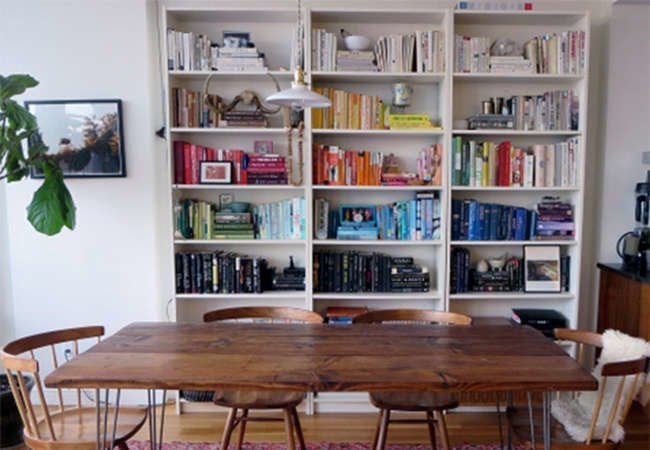
- Color within broader subject categories
Color-coded bookshelves photograph beautifully, but they are less helpful when you remember a book’s author and not whether its spine was teal or suspiciously bluish green. Function should win whenever the two are in conflict.
Do place heavier items on lower shelves
Large art books, encyclopedias, storage bins, and heavy sculptures generally belong near the bottom of the bookcase. This creates visual stability and lowers the unit’s center of gravity. It also reduces the consequences of an object falling.
Lighter pieces, such as small framed prints, woven baskets, and delicate accessories, can sit higher. Avoid placing heavy pottery or glass directly above a chair, reading nook, child’s play area, or pet bed.
Do anchor freestanding bookcases to the wall
A tall bookshelf should be treated as furniture that can tip, not as an immovable architectural feature. Use the anchoring hardware supplied by the manufacturer or an appropriate anti-tip kit installed into suitable wall framing or anchors.
Anchoring is especially important in homes with children or climbing pets. Do not place toys, remote controls, candy jars, or other tempting objects on upper shelves where a child may try to reach them by climbing.
Do mix vertical rows with horizontal stacks
Standing every book upright creates a traditional library appearance, but it can also produce one long, visually flat stripe. Add rhythm by alternating vertical groups with a few horizontal stacks.
Horizontal books can function as small platforms for a bowl, framed photograph, decorative box, or lightweight sculpture. Keep the stack stable, and avoid piling so many books that retrieving the bottom title requires an archaeological permit.
Use sturdy bookends to support upright volumes. Books should remain straight rather than leaning sharply, which can strain covers, bindings, and text blocks over time.
Do vary height, shape, and depth
An attractive shelf arrangement has peaks, valleys, and layers. Combine tall vertical books with lower stacks, rounded pottery with rectangular frames, and matte materials with a limited amount of glass or metal.
Not everything must line up against the back panel. A small framed print can lean behind a shorter object. A sculpture may sit slightly forward. Books can be aligned closer to the front edge so their spines are easier to see and dust does not collect on a large empty ledge.
Layering creates depth, but it should not block the books you read regularly. Decorative objects should complement access, not turn borrowing a novel into a tabletop obstacle course.
Do leave breathing room
Empty space is not evidence that you ran out of belongings. It is an active design element that helps the eye distinguish one grouping from another.
Leave some shelves partially open, particularly around larger pieces. Instead of scattering twelve tiny objects across one shelf, display two or three stronger items and allow space around them. The result will look calmer, more deliberate, and usually more expensiveeven when the objects came from a thrift store and one of them cost less than lunch.
Do begin with large anchor pieces
Place the largest books, artwork, baskets, or vessels first. Distribute them across the bookcase rather than clustering all visual weight on one side. Next, add medium-sized objects, followed by smaller accents.
Step back frequently to examine the entire bookcase. A shelf can look balanced from six inches away while the complete unit appears to be leaning visually toward Nebraska. Viewing the arrangement from across the room makes uneven gaps, repeated shapes, and overloaded areas easier to spot.
Do use personal objects selectively
The most memorable bookshelves reveal something about their owners. Consider displaying a travel souvenir, inherited bowl, child’s small artwork, vintage camera, handmade object, or framed letter. Personal pieces prevent the bookcase from looking like a furniture showroom where no one has ever experienced an emotion.
Selection is important. Displaying every family photograph, trophy, figurine, and vacation keepsake at once can overwhelm the books. Rotate sentimental items seasonally or store some in labeled boxes so the display remains meaningful instead of crowded.
Do repeat a few colors and materials
A limited amount of repetition helps separate objects feel connected. For example, distribute three blue accents diagonally across the bookcase, repeat warm wood tones on different levels, or use black frames in several locations.
Avoid placing every brass object on one shelf and every ceramic piece on another. Spreading related colors and materials creates movement and makes the arrangement feel integrated.
Do consider baskets and decorative boxes
Not everything worth keeping is worth displaying. Baskets and boxes can conceal charging cords, game controllers, office supplies, extra bookmarks, children’s materials, and other visually noisy necessities.
Larger containers generally work best on lower shelves. Choose styles that fit the bookcase with enough clearance to slide out easily. Labeling may be helpful in an office or family room, but labels should be simple and consistent.
The Important Don’ts of Bookshelf Styling
Don’t fill every available inch
Overcrowding makes books difficult to remove and decorative pieces difficult to appreciate. It can also place unnecessary stress on adjustable shelves.
If a shelf is packed so tightly that you must pull one book by the top of its spine, remove several volumes or create another storage area. Books should be snug enough to remain upright but loose enough to slide out without force.
Don’t arrange every shelf identically
Five shelves containing one horizontal stack, one vase, and one frame in precisely the same positions will feel less curated than cloned. Repeat certain colors or materials, but vary the composition.
One shelf might contain mostly books. Another may feature a larger piece of art with a short stack. A third can hold a basket and a small group of vertical volumes. Controlled variation gives the bookcase energy.
Don’t use too many tiny accessories
Small objects often disappear individually and become clutter collectively. Group related miniatures on a tray, inside a shallow bowl, or under a glass cloche. Another solution is to replace several small decorations with one larger object that has enough scale for the shelf.
When an accessory appears lost, it is probably too small, too isolated, or too similar in size to everything around it.
Don’t mix every material you own
Wood, brass, ceramic, glass, stone, wicker, acrylic, and leather can all look attractive. Using all of them on one narrow shelf, however, may resemble a yard sale organized during an earthquake.
Select two or three dominant materials and repeat them throughout the bookcase. Contrasting textures add interest, but some restraint keeps the overall display coherent.
Don’t ignore the back of the bookcase
The rear panel occupies a large visual area. Paint, removable wallpaper, grasscloth, or a contrasting finish can transform an inexpensive bookcase and help books stand out.
Choose a backdrop that supports the room rather than competing with the book spines. A bold pattern works best when the shelf contents are relatively restrained. A collection of colorful books may benefit from a quieter background.
Don’t sacrifice usefulness for a perfect photograph
Turning book spines inward can create a uniform neutral display, but it also hides titles and makes books harder to locate. It may work for a small decorative collection, but it is inconvenient for active readers.
Likewise, do not place frequently used books beneath fragile objects or at the bottom of tall horizontal stacks. A beautiful shelf that annoys you every day is simply clutter wearing formal clothes.
Don’t place books in damaging conditions
Direct sunlight can fade covers and dust jackets. Excessive moisture can encourage mold, while extremely dry or fluctuating conditions may contribute to brittle materials and distorted bindings.
Keep bookcases away from leak-prone areas, heating equipment, and strong air vents when possible. Avoid attics, damp basements, and garages for valuable collections. An interior room with relatively stable temperature and humidity is generally more suitable.
Store most books upright and supported by similar-sized neighbors. Oversized, heavy, or structurally weak volumes are often better stored flat in short stacks. Make sure the entire book is supported by the shelf and does not hang over the edge.
Don’t put a watering hazard above valuable books
Plants add color and life, but water and books remain famously incompatible roommates. Use watertight saucers, inspect pots for leaks, and remove plants from the shelf before watering.
For shelves containing rare books, signed editions, or irreplaceable photographs, consider artificial greenery or place live plants elsewhere. A cascading vine is charming; a cascading stream of potting water is less so.
A Practical Formula for a Five-Shelf Bookcase
There is no universal arrangement, but the following plan offers a reliable starting point:
- Top shelf: Use one or two lightweight statement pieces, such as framed art, a decorative bowl, or a trailing plant.
- Second shelf: Combine a vertical group of books with a medium-sized object and some open space.
- Middle shelf: Create a focal point with artwork, a favorite collection, or a featured book displayed face-out.
- Fourth shelf: Add a larger group of frequently used books, mixing upright titles with one short horizontal stack.
- Bottom shelf: Place heavy books, sturdy baskets, albums, or closed storage containers.
After arranging the main elements, add only enough smaller decor to connect the composition. Take a photograph from across the room. Photos flatten the scene and often reveal crowded spots, awkward gaps, and accidental repetition that are harder to notice in person.
How to Keep an Arranged Bookshelf Looking Good
A bookshelf is not a museum installation sealed forever behind velvet ropes. New books arrive, children grow, hobbies change, and somebody eventually puts a coffee mug where the framed photograph used to be.
Perform a light reset every few months. Return misplaced objects, dust the shelves, straighten leaning books, and remove anything that no longer belongs. Review the collection once or twice a year and donate books you no longer need, provided they are in usable condition.
Leave a little expansion space for new titles and meaningful objects. A bookshelf should be able to evolve without requiring a full design emergency every time you buy a novel.
Conclusion: Arrange for Real Life, Not Just a Shelfie
The best bookshelf arrangement is neither completely full nor suspiciously perfect. It makes books accessible, protects the collection, supports the room’s design, and includes enough personality to feel lived in.
Start with empty shelves, establish a practical organizing system, place heavy items low, mix vertical books with horizontal stacks, and use a few meaningful objects to create depth. Leave open space, limit tiny accessories, protect books from damaging conditions, and anchor tall furniture securely.
Most importantly, arrange the bookshelf for the people who use it. A slightly imperfect display containing beloved books and genuine memories will always be more interesting than a flawless arrangement assembled solely to impress the internet.
A Composite Bookshelf Makeover Experience: What Usually Works in a Real Home
The following case study is a realistic composite based on common bookshelf makeovers rather than a claim of personal, hands-on experience.
Consider a typical five-shelf bookcase in a family living room. Before its makeover, the shelves hold approximately 120 books, seven framed photographs, several school binders, a router, two candles, children’s craft supplies, travel souvenirs, and one lonely plant that has been leaning toward the window since the previous presidential administration.
The owners initially believe the solution is to buy matching storage containers and new decorations. After everything is removed, however, the real problem becomes obvious: the bookcase is not suffering from a decor shortage. It is suffering from too many unrelated jobs.
The first improvement comes from sorting. School binders move to the home office. Craft supplies go into a cabinet near the dining table where the children actually use them. Duplicate novels and outdated manuals enter a donation box. The router remains, but it is relocated to a ventilated basket designed to conceal electronics without blocking airflow.
Once the unrelated clutter is gone, the owners organize the remaining books by broad subject: fiction, history, cooking, travel, children’s books, and oversized art volumes. Within each category, books are arranged by approximate height. This system is not as visually dramatic as a complete rainbow, but everyone in the family can locate a title without conducting a color-based scavenger hunt.
The heavy art books move to the lowest shelf and lie flat in two short stacks. Children’s books occupy the next shelf, where young readers can reach them without climbing. A wide basket beside the books holds current library loans, preventing them from disappearing into bedrooms and collecting late fees like tiny paper-based criminals.
The middle shelf becomes the visual focus. A small framed landscape leans against the back, with a row of novels on one side and three horizontally stacked travel books on the other. A ceramic piece from a family trip sits on top of the stack. Because the objects differ in height and shape, the shelf feels layered without becoming busy.
The upper shelves receive fewer items. Two framed photographs replace the original seven, making the selected images more noticeable. The plant moves into a watertight pot on the top shelf, where it receives better light and cannot drip onto valuable books. A small bowl holds loose bookmarks that previously migrated around the room.
At first, the owners are tempted to fill the remaining gaps. They try adding candles, another vase, and several decorative boxes. A photograph taken from the opposite side of the room reveals that the bookcase has become visually heavy again. Removing four accessories immediately improves it.
The most important lesson from this kind of project is that bookshelf styling is usually an editing exercise, not a shopping exercise. The successful arrangement uses almost nothing new. It works because every remaining item has a reason to be there, the books are accessible, the heavy objects are safely positioned, and the blank spaces give the display room to breathe.
Several weeks later, the arrangement is not perfectly unchangedand that is a good sign. A current novel rests horizontally beside the reading chair, a child’s drawing has joined the middle shelf, and one travel book has been taken down for planning a vacation. The bookcase still looks organized because the underlying structure is strong enough to accommodate real life.
SEO Tags

