
Makeup
Chemistry Meets Mechatronics In This Engaging Art Piece
Aug
Most paintings politely remain where the artist puts them. Nathalie Gebert’s Anthofluid does not have that kind of patience. Its colors stretch, drift, mingle, fade, and disappear while a robotic system quietly prepares the next chemical performance.
The 2024 installation combines red-cabbage pigments, electrical reactions, fluid motion, pumps, electrodes, and an automated positioning mechanism. The result resembles a painting, a laboratory experiment, and a strangely soothing science-fiction aquariumall at once.
More importantly, Anthofluid demonstrates why the intersection of chemistry and mechatronics can be so engaging. The machine does not merely display an image. It continually produces, transforms, and erases images in real time.
What Is Anthofluid?
Anthofluid is an experimental media-art installation created by new-media artist and creative technologist Nathalie Gebert. Its working “canvas” is a thin transparent chamber made from sheets of Plexiglas. Inside that chamber flows a purple solution containing anthocyanins extracted from red cabbage.
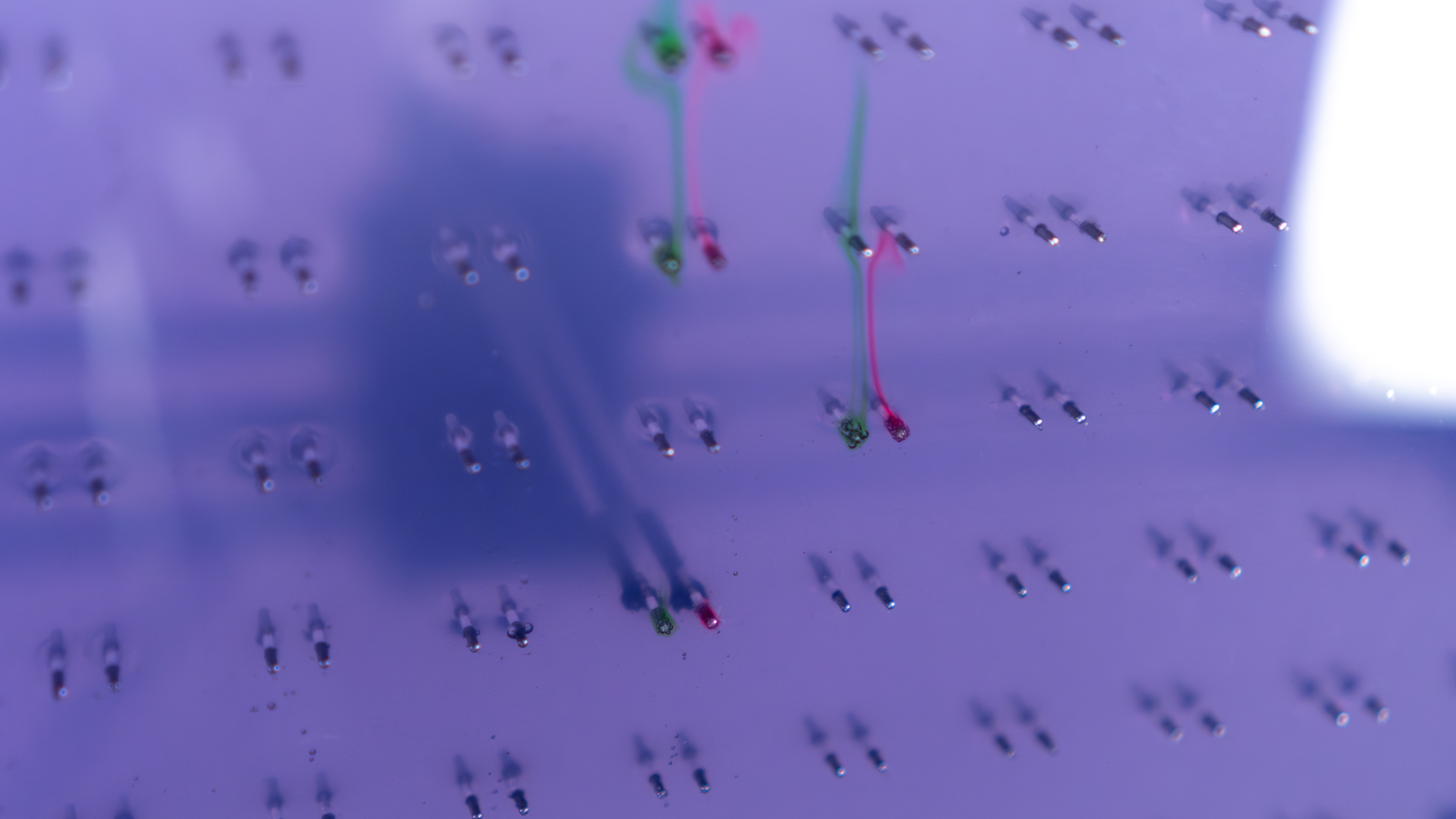
One wall of the chamber contains a grid of electrodes. Behind it, an X–Y gantry moves a pair of electrical contacts to selected positions. When the contacts energize two points on the grid, electrochemical reactions create temporary areas of contrasting color.
Four peristaltic pumps help move the cabbage solution between the display chamber and a larger reservoir. As the pumps fill the chamber, the purple liquid curls around the electrode grid in slow, branching streams. Even before the electrical drawing begins, the filling process looks like an artwork rehearsing backstage.
Once the liquid is in place, the gantry travels to different electrode locations. Colored tendrils emerge around the energized points, rising and spreading through the surrounding purple solution. The patterns may appear reddish near one electrode and greenish near another before gradually dissolving.
The composition is never fully permanent or perfectly repeatable. Control software determines where electricity is applied, but chemistry, heat, bubbles, diffusion, and fluid circulation influence what happens next. The machine gives the initial instruction; the liquid improvises the rest.
The Color-Changing Chemistry Behind the Art
Why Red Cabbage Is More Than a Salad Ingredient
Red cabbage contains anthocyanins, a family of water-soluble plant pigments responsible for many red, purple, and blue colors in fruits, vegetables, and flowers. They are also wonderfully dramatic molecules. Change their chemical environment and they may change their molecular form, altering the wavelengths of light they absorb and the color people see.
This behavior makes red-cabbage juice a familiar natural acid-base indicator. In acidic mixtures, the extract commonly becomes pink or red. Around neutral conditions, it tends to remain purple or bluish. In increasingly alkaline mixtures, it can shift toward blue, green, and yellow.
The classic classroom demonstration involves pouring cabbage indicator into cups containing lemon juice, vinegar, baking soda, soap, or water. It is an excellent experiment, although it usually ends with several suspicious-looking beverages that absolutely should not be served at lunch.
From Acid-Base Demonstration to Electrochemical Painting
Anthofluid pushes this familiar chemistry into a more complicated electrochemical setting. When voltage is applied across electrodes immersed in a conductive liquid, oxidation occurs at the anode and reduction occurs at the cathode. Reactions involving the water, dissolved substances, electrode materials, and pigment molecules can create different local chemical conditions.
Those changes affect the anthocyanin solution near each energized electrode. Instead of pouring a separate acid or base into the chamber, the installation uses electrical energy to generate localized transformations. Color effectively becomes an output of the circuit.
The exact reaction pathway may depend on factors such as electrode composition, current, voltage, solution concentration, temperature, and exposure time. That complexity is part of the appeal. The artwork does not reduce chemistry to a simple on-and-off switch. It reveals chemistry as a collection of interacting processes with visible consequences.
Heat produced around the active areas also helps set the colored material in motion. Temperature differences can encourage convection, while small gas bubbles produced during electrolysis may contribute additional movement. The resulting stains stretch upward, blur at their edges, and circulate through the chamber rather than staying fixed to one location.
In other words, electricity makes the mark, but fluid dynamics gives it personality.
Where the Mechatronics Enters the Picture
Mechatronics brings mechanical engineering, electronics, control systems, and software together in a single functional system. A modern robot arm is mechatronic. So is an automated production machine. So, less glamorously, is the washing machine that becomes emotionally unavailable when handed one unbalanced blanket.
In Anthofluid, the mechanical structure holds and moves the components. Motors position the X–Y gantry. Electronics control the motors, pumps, and electrical output. Software decides when and where actions occur. The fluid and electrodes form the chemical interface through which those electronic commands become visible.
The artwork therefore operates as a chain of translations:
- Software selects coordinates.
- Motor controllers convert coordinates into movement.
- The gantry positions electrical contacts.
- The circuit delivers current to chosen electrodes.
- Electrochemical reactions alter the pigment.
- Heat, diffusion, and convection turn the altered pigment into moving forms.
- The viewer interprets those forms as an evolving image.
No single subsystem creates the full experience. The beauty comes from their cooperation.
The X–Y Gantry as a Robotic Paintbrush
An X–Y gantry moves across two perpendicular axes, allowing a tool or component to reach positions within a flat rectangular area. Similar arrangements appear in CNC machines, laser cutters, plotters, pick-and-place systems, and many 3D printers.
Here, the gantry behaves like a robotic paintbrush that never touches paint. It moves conductors to specific electrodes and activates chemistry at those coordinates. The mechanism provides precision, but the resulting image remains soft, organic, and unpredictable.
That contrast is one of the installation’s smartest decisions. The gantry moves according to a rigid coordinate system, while the liquid refuses to respect straight lines. A precise machine creates wonderfully imprecise marks.
Why Peristaltic Pumps Fit the Job
Peristaltic pumps move liquids by repeatedly squeezing flexible tubing with rotating rollers. As one section is compressed, fluid is pushed forward. When the tubing returns to its original shape, it draws more liquid into the line.
Because the liquid normally contacts only the inside of the tubing, this pump style can simplify cleaning and reduce contamination. It also works well for controlled circulation, dosing, and laboratory fluid handling.
For Anthofluid, the pumps do more than perform a technical chore. Their movement becomes part of the artwork’s rhythm. Filling and draining are not hidden maintenance steps; they are chapters in the visual performance.
A Painting That Refuses to Be Preserved
Traditional paintings are often designed to resist change. Conservators protect them from moisture, heat, light, chemical contamination, vibration, and time. Anthofluid invites many of those forces onto the stage.
The artwork exists through transformation. A colored mark appears, stretches, loses its boundary, and is reabsorbed into the fluid. The chamber becomes what Gebert describes as an unstable archive: it records events but cannot hold them indefinitely.
This impermanence changes the viewer’s relationship with the work. There is no single final picture to inspect. Looking away matters because the image may be different when the viewer looks back. The artwork rewards attention without demanding frantic attention. Its changes are slow enough to encourage observation but constant enough to prevent visual autopilot.
Water is not merely a background or carrier. It actively distributes heat, chemicals, color, and motion. It mixes one event with another, softens distinctions, and eventually removes evidence of what happened. The medium is simultaneously canvas, solvent, archive, and eraser.
From Binary Electricity to Fluid Uncertainty
The conceptual strength of Anthofluid comes from the confrontation between two different systems. Electrical control appears binary: a circuit is energized or it is not, and an electrode is selected or ignored. The liquid response is continuous, distributed, and difficult to contain.
A precise electrical impulse does not produce a perfectly bounded dot. It produces a stain that stretches, diffuses, and interacts with earlier stains. This challenges the assumption that digital instructions must create rigid digital-looking results.
Gebert connects the project with hydrofeminist ideas about water, bodies, and porous boundaries. Within that framework, matter is not treated as passive material waiting for a human or machine to impose a final form. The fluid participates in making the image.
This does not mean the machine loses importance. Rather, authorship becomes shared among the artist, code, mechanical system, chemical reactions, liquid environment, and time. Even gravity gets a supporting role, althoughas usualit insists on doing its own stunts.
Why This Chemistry and Mechatronics Art Piece Is So Engaging
It Makes Invisible Processes Visible
Electric current cannot normally be watched as it moves through a circuit. Oxidation and reduction are often represented with equations, arrows, and electron symbols. Anthofluid gives those processes color, motion, and duration.
The audience sees where electrical energy enters the liquid because pigment changes appear near the active electrodes. Viewers can then watch the effects travel beyond those points as heat and fluid motion redistribute the colored material.
It Balances Control and Chance
The machine can choose electrode locations with repeatable accuracy. It cannot completely dictate the shape of every plume. Tiny differences in temperature, flow, pigment concentration, residue, and circulation affect each result.
This balance keeps the work from feeling like a prerecorded animation. There is structure, but there is also risk. The system knows where it will begin; it does not fully know where the image will end.
It Turns Waiting Into Part of the Experience
Many digital experiences are optimized to eliminate delay. Anthofluid uses delay as material. The pumps take time to fill the chamber. The gantry must travel. Reactions develop. Colors rise and fade.
Nothing arrives instantly, and that is precisely why it becomes mesmerizing. The viewer starts noticing gradual transitions that would normally be ignored: the first hint of green, the widening edge of a red trail, or the moment when two separate clouds begin to overlap.
Part of a Longer Kinetic-Art Tradition
Kinetic art broadly includes works that use real or apparent movement. Some pieces are driven by motors, while others respond to wind, gravity, water, magnetism, or audience participation.
Artists such as Alexander Calder helped establish movement as a central sculptural element through carefully balanced mobiles. Later kinetic artists incorporated gears, motors, electronics, sensors, and programmed behavior. Contemporary creators now work with robotic systems, smart materials, biological processes, data, and chemical reactions.
Anthofluid belongs to this tradition but adds a particularly compelling twist. Its visible motion does not come only from mechanical parts. The chemical medium itself moves and changes. The artwork is kinetic at the mechanical, molecular, and visual levels.
What Makers and Students Can Learn From Anthofluid
The installation offers useful lessons for anyone developing interactive art, laboratory automation, robotics, or STEAM education.
Start With a Strong Material Behavior
The project does not use technology merely to look technologically impressive. It begins with an intrinsically expressive material: anthocyanin solution. Its sensitivity to chemical conditions makes it ideal for visible experimentation.
Let Engineering Support the Concept
The gantry, electrode grid, pumps, reservoir, and control system all reinforce the central idea of transforming fluid matter. None of them feels like a random gadget attached to earn extra innovation points.
Design for Variation
A conventional machine may be judged by its ability to produce identical outputs. An artwork can benefit from controlled variation. By allowing fluid dynamics to modify the machine’s instructions, Anthofluid creates recognizable behavior without producing the same picture repeatedly.
Remember That Maintenance Is Part of the Medium
Fluid installations must contend with leaks, stains, tubing wear, evaporation, residue, electrode degradation, electrical isolation, and cleaning. These concerns are not glamorous, but neither is discovering that the gallery floor has become an unauthorized purple extension of the artwork.
Successful creative technology depends on practical engineering. The most poetic concept still needs reliable connections, suitable materials, safe voltages, replaceable tubing, and a plan for what happens after several hours of operation.
Experiences Inspired by Chemistry, Mechatronics, and Living Images
Watching documented footage of Anthofluid creates an experience unlike viewing a completed digital image. At first, attention goes to the apparatus. The transparent chamber, wires, tubing, reservoir, and gantry make the system’s construction visible. Nothing is disguised as magic. The machine openly admits that it is a machine.
Then the purple liquid begins to move, and the hardware becomes less dominant. The fluid fills spaces unevenly, slipping around electrodes and forming temporary channels. That transition is satisfying because it changes the machine from an object into an environment. The equipment no longer appears to contain a picture; it contains conditions from which pictures may emerge.
The first colored reaction encourages close observation. A viewer may initially expect something fast and graphic, perhaps a recognizable symbol drawn one electrode at a time. Instead, the stain develops gradually. Its edges are soft. It rises, curls, and thins. The image behaves less like ink from a printer and more like weather forming inside a narrow atmosphere.
This slowness can be unexpectedly calming. There is enough activity to hold attention but not so much that every second becomes a demand. The gantry moves with purpose, the pumps pulse, and the pigment answers at its own pace. The experience offers a rare technological rhythm that does not resemble an alert, progress bar, countdown, or advertisement shouting that a sale ends in nine emotionally devastating minutes.
For a chemistry student, the installation can transform abstract concepts into memorable visual events. Oxidation and reduction are no longer only half-reactions written on a page. Electrodes become locations where visible change begins. Diffusion becomes the spreading edge of a colored cloud. Convection becomes an upward trail. Reaction rate becomes something that can be watched rather than merely calculated.
For a mechatronics student, the work demonstrates that precision is not always the final objective. The gantry must reach accurate coordinates, but the system is successful precisely because its output remains fluid and variable. This is a valuable design lesson: engineers may control initial conditions while intentionally leaving room for material behavior.
For artists, Anthofluid shows how scientific processes can become more than visual effects. The chemistry is not decoration added after the artistic idea. It shapes the work’s themes of instability, transformation, memory, and porous boundaries. Likewise, the engineering is not hidden technical support. The pumps, electrodes, and motion system are visible participants.
A workshop inspired by the project could begin with a simple red-cabbage indicator activity. Participants might compare acidic, neutral, and alkaline solutions, document their colors, and observe how concentration and temperature change the results. A second stage could introduce safe low-voltage electronics, pumps, or motorized positioning. Even without recreating the full installation, students would experience how one material can connect chemistry, programming, mechanical design, and visual composition.
There is also an important experience in watching the colors disappear. People are accustomed to treating creation as the production of something durable: a saved file, finished object, printed photograph, or uploaded video. Anthofluid presents disappearance as part of creation. A stain does not fail when it fades. Fading completes its cycle and prepares the chamber for another event.
That may be the installation’s most lasting lesson. A temporary image can still produce a durable memory. The pigment vanishes, but the experience of seeing matter think, drift, and transform remains.
Conclusion: When the Laboratory Becomes a Studio
Anthofluid succeeds because it does not force chemistry, robotics, and art into separate compartments. The electrical system triggers chemical events. The mechatronic system positions those events. The fluid turns them into motion. The artist gives the entire process meaning.
The installation is technically engaging without becoming a hardware demonstration and conceptually ambitious without hiding behind impenetrable language. A viewer can appreciate the drifting colors immediately, then continue discovering deeper ideas about control, instability, material agency, and impermanence.
It also offers a persuasive vision of creative technology. Machines do not have to produce rigid, optimized, permanent results. They can create conditions for delicate events that unfold slowly and vanish gracefully.
Sometimes the most interesting robotic paintbrush is a pair of electrodes, the most expressive paint is cabbage juice, and the best canvas is one that quietly erases itself.

