
Skincare
“Our Larger Bodies Are Clearly Lacking Representation In Media”: Plus-Size Models Pose As Disney Princesses (16 Pics)
Aug
For generations, animated princesses have battled curses, crossed oceans, befriended talking furniture, and survived alarmingly complicated family trees. One challenge they rarely faced, however, was finding a formal dress above a standard sample size.
The Plus-Size Princess Project set out to change that familiar picture. Created by fashion and Disney content creator Natasha Polis, the 2020 project brought together 21 influencers who reimagined beloved Disney heroines through plus-size fashion, cosplay, and DisneyBounding. The resulting portraits included familiar characters such as Belle, Moana, Cinderella, Mulan, Elsa, Anna, and Tinker Bell.
These images were playful, colorful, and made for social media, but their message went well beyond Halloween costumes. They asked a surprisingly serious question: Who gets to look magical on-screen, and who has traditionally been left outside the castle gates?
How the Plus-Size Princess Project Began
Polis grew up near Disneyland in Southern California, so Disney stories were woven into her childhood. As an adult, she built an online presence around fashion, fandom, and showing recognizable characters in larger bodies. For the princess project, she spent approximately three months assembling a diverse group of creators.
The concept was straightforward: participants would portray Disney princesses and other notable female characters while keeping their own identities visible. The creators represented different body shapes, racial and cultural backgrounds, personal styles, and areas of the entertainment and fashion industries.
Polis initially hoped for screen-accurate costumes. Reality soon waved a tiny wand labeled “limited sizing.” Some participants could not find well-made costumes that fit, while others discovered that available options stopped at XL or cost far more than comparable straight-size outfits.
Instead of abandoning the idea, the women improvised. They altered store-bought costumes, sewed garments from scratch, assembled affordable pieces, or used DisneyBoundingthe practice of creating an everyday outfit inspired by a character’s colors and visual trademarks. Cinderella does not technically own every blue sundress and black choker, but she certainly has a strong claim.
16 Plus-Size Disney Character Transformations
The widely shared gallery featured 16 portraits or character groupings. Collectively, they demonstrated that recognizable character design depends on storytelling, color, attitude, and stylingnot on one approved silhouette.
-
Moana
Zoie, known online as Curves by Zo, portrayed Moana in an outfit that captured the heroine’s island-inspired palette and adventurous energy. The portrait was especially meaningful because it offered a fuller-bodied interpretation of a character rooted in Pacific Island cultures.
-
Anna and Elsa
Sisters Michaela and Hunter McGrady became Anna and Elsa, reflecting the strong sibling relationship at the heart of Frozen. Their real-life bond gave the portrait an emotional authenticity that no amount of artificial snow could manufacture.
-
Alice
Ashlee Rose Hartley stepped into Wonderland as Alice. Her blue-and-white styling preserved the character’s instantly recognizable look while proving that curiosity, courage, and unfortunate encounters with oversized mushrooms have no dress-size requirement.
-
Elena
Elena of Avalor appeared with rich colors and royal details that celebrated both body diversity and cultural representation. Including Elena expanded the project beyond Disney’s oldest, most frequently recreated princesses.
-
Esmeralda
Candice created her Esmeralda-inspired ensemble for less than $25 by using clothing she already owned, draped fabric, handmade accents, and a foam tambourine. The resourceful result looked vibrant without requiring a royal treasury.
-
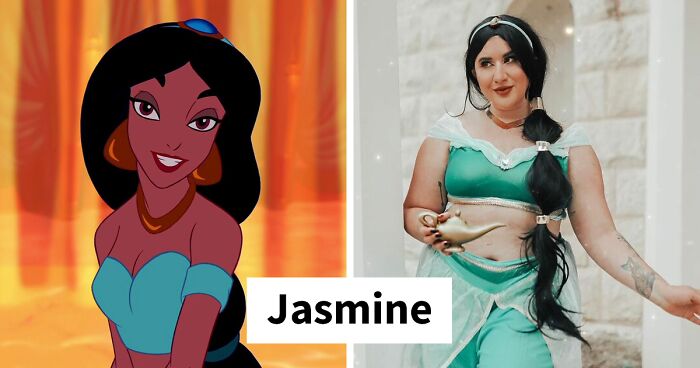
Jasmine
Bonnie Barton portrayed Jasmine in the character’s signature turquoise. Because the available costume was too small, the garment had to be adapted for the photographa behind-the-scenes detail that neatly exposed the retail problem the project was challenging.
-
Mulan
Marie Tran made her Mulan outfit from scratch for less than $40 after finding that many commercial plus-size options were either unavailable or expensive. She kept her pink hair, allowing the transformation to honor Mulan without erasing Marie.
-
Snow White
Monica Kim re-created Snow White’s red, blue, and yellow color story with a polished, graceful pose. The portrait showed how easily an established character can remain recognizable when represented by a different body type.
-
Sleeping Beauty
Heather Traska modeled a pink Aurora gown made by Polis. For someone who had once absorbed the message that princesses did not come in her size, wearing a custom royal dress became an act of reclaiming the fantasy.
-
Megara
Alysse Dalessandro Santiago chose Megara for her independence, strength, sarcasm, and legendary ponytail. The casting emphasized personality as much as appearance, which feels appropriate for a character who would roll her eyes at shallow beauty rules.
-
Belle
Polis herself became Belle in a yellow dress she sewed. Belle was an apt choice for the project’s creator: imaginative, determined, and unwilling to accept the limitations imposed by her surroundings.
-
Merida
Sarah Anne portrayed Merida with flowing curls and a medieval-inspired green dress. The character’s rebellious spirit fit a campaign asking the fashion and entertainment industries to stop following an outdated script.
-
Kida
Adriana portrayed Kida from Atlantis: The Lost Empire. Her inclusion brought attention to a less frequently featured Disney heroine while broadening the project’s racial and cultural range.
-
Rapunzel
The Rapunzel portrait used the heroine’s purple palette and signature frying pan. It was a cheerful reminder that a good accessory can complete an outfit, especially when the accessory can also discourage unwanted tower visitors.
-
Cinderella
Rosey Blair used a printed blue sundress, styled hair, and a black choker to suggest Cinderella without wearing a conventional ball gown. Her DisneyBound approach demonstrated how personal fashion can communicate a character more effectively than an uncomfortable costume.
-
Tinker Bell
Anna O’Brien, widely known as Glitter and Lazers, transformed into Tinker Bell in bright green. Her version retained the fairy’s playful confidence while replacing the idea that tiny wings must come with an equally tiny waist.
Why Plus-Size Representation in Media Matters
Body representation is not merely a question of making a gallery look more varied. Entertainment helps audiences learn which people are allowed to be admired, desired, heroic, funny, powerful, or central to a story. When larger characters appear only as jokes, villains, sidekicks, or cautionary tales, viewers receive a message even if nobody says it aloud.
Children Notice Who Gets to Be the Hero
Research on media and body image has repeatedly associated exposure to narrow appearance ideals with body dissatisfaction and pressure to change one’s shape. Young viewers do not passively consume every message, but repeated patterns can influence what they regard as normal, valuable, or beautiful.
A child who never sees a heroic character with her body type may conclude that she can enjoy the story but cannot fully belong inside it. One participant, an opera singer and vocal teacher, described hearing a young student assume she could play Ursula but not Ariel because she did not “look like a princess.” That moment illustrates how fictional casting conventions can become real-world expectations.
Positive Portrayals Can Challenge Weight Stigma
Weight stigma often frames people in larger bodies as lazy, undisciplined, unattractive, unintelligent, or personally responsible for every assumption others make about their health. Reviews of media portrayals have found that these stereotypes remain common across entertainment, advertising, news, and social platforms.
Positive, non-stereotypical images can interrupt those associations. A plus-size woman portrayed as adventurous Moana, independent Megara, scholarly Belle, or courageous Mulan is not reduced to a storyline about weight. She simply gets to occupy the center of the frame.
Representation Must Be Intersectional
Size inclusivity becomes more meaningful when it recognizes that people also experience media through race, ethnicity, disability, age, gender identity, sexuality, and cultural background. A campaign that features only one fashionable hourglass version of a larger body may widen the door slightly while leaving many people on the porch.
The Plus-Size Princess Project addressed this challenge by including women from varied backgrounds and by casting characters beyond the traditional princess lineup. It was not a complete map of human diversity, nor did it claim to be. Its strength was showing how much more interesting the picture became once multiple identities were invited into it.
The Costume Problem Revealed a Bigger Industry Problem
The difficulty of sourcing costumes became one of the project’s most revealing stories. Some women found that garments marketed as plus-size did not accommodate their measurements. One participant withdrew after becoming frustrated by a costume that would not fit, and another creator ultimately stepped in with an Ariel-inspired athleisure look.
These were not isolated wardrobe mishaps. They reflected a broader mismatch between consumers and the clothing available to them. Size ranges often stop just where a large portion of the market begins, while extended-size products may cost more, offer fewer styles, or exist only online.
That shortage affects more than shopping convenience. Clothing is a tool for identity, work, celebration, performance, and participation. If a child can buy five Cinderella costumes but her plus-size mother cannot find one adult option for a family event, the industry has quietly decided who gets to join the fantasy.
The project’s handmade and altered outfits were creative victories, but customers should not need advanced sewing skills, foam construction, and the strategic camera angle of a seasoned cinematographer simply to dress as a familiar character.
Body Positivity, Body Neutrality, and the Right to Be Seen
Body positivity is often summarized as loving how one looks, but that definition can create another demanding standard. Nobody feels radiant every morning, including people who appear to have been professionally lit by woodland fairies.
Body neutrality offers a complementary approach. It reduces the importance placed on appearance and emphasizes what a body enables a person to experience. Under this framework, someone does not need to declare every feature beautiful before wearing a costume, appearing in photographs, or occupying public space.
The project worked because it allowed both ideas to coexist. Some portraits were joyful celebrations of plus-size beauty. Others carried a quieter message: these women did not need to justify their bodies before playing characters they loved.
What Meaningful Representation Should Look Like Next
Fan projects can open conversations, but lasting change requires the entertainment, fashion, and retail industries to move beyond occasional campaigns. Larger characters should appear in leading roles without every plot revolving around weight loss, insecurity, bullying, or transformation.
Studios can hire writers, designers, performers, animators, and consultants with varied lived experiences. Fashion brands can create extended sizes during the original design process instead of enlarging a straight-size pattern as an afterthought. Costume companies can test garments on multiple body shapes and offer the same quality across their ranges.
Audiences also have power. Supporting inclusive productions, following creators from different backgrounds, questioning stereotypical portrayals, and teaching children basic media literacy can make a narrow beauty standard feel less inevitable. The goal is not to replace thin princesses. It is to build a kingdom with more than one body type.
Experiences Inspired by the Plus-Size Princess Project
One of the most relatable experiences surrounding this project begins in the costume aisle. Imagine arriving with a clear plan: find a purple Rapunzel dress, add flowers to your hair, carry a frying pan, and spend the evening avoiding mysterious men who climb buildings without permission. Then every available costume stops several sizes below yours.
The experience can feel disproportionately painful because it is not only about fabric. It can revive years of being told that certain clothes, characters, relationships, careers, or public spaces are intended for someone else. A costume rack becomes a gatekeeper, which is a remarkable amount of authority to hand to polyester.
Creating an alternative look can therefore become deeply satisfying. A participant might start with a blue dress already hanging in her closet, add Cinderella’s choker, style her hair, and suddenly recognize the character in the mirror. The outfit is not a lesser substitute for a packaged costume. It is more personal, more comfortable, and often more imaginative.
The Experience of Being Photographed Without Hiding
Many larger people learn subtle techniques for becoming visually smaller: standing behind friends, turning sideways, cropping full-body pictures, or volunteering to hold the camera. A themed photo shoot reverses that habit. The participant stands in the center, wears a bold color, takes up space, and performs confidence before she necessarily feels it.
That performance can become genuine. The camera records more than a costume; it captures the experience of being intentionally visible. Instead of waiting to lose weight before creating memories, the participant has proof that joy happened in her present body.
This does not mean every person leaves a photo shoot cured of insecurity. Body confidence is rarely a fairy-tale transformation completed before midnight. Someone can love the final image and still struggle the following week. The meaningful change is recognizing that uncertainty does not cancel the right to participate.
The Experience of Seeing Yourself in a Familiar Story
For a viewer, the emotional response may arrive unexpectedly. A plus-size adult who grew up loving Belle might see Polis in the yellow gown and realize she had always imagined the character as thinner than herself. The portrait offers a new mental picture: Belle’s intelligence, curiosity, and courage were never dependent on the circumference of her waist.
Parents can experience the images differently. They may see an opportunity to discuss why fictional women often share similar proportions, how costumes are manufactured, or why criticizing another person’s size is harmful. These conversations help children evaluate media rather than simply absorb it.
The portraits may also produce discomfort, and that reaction can be informative. If someone immediately thinks a larger woman does not “look right” as a princess, it is worth asking where that rule originated. The character is already fictional. Ariel is a mermaid, Tinker Bell is a fairy, and Cinderella’s transportation is a vegetable. Body diversity is not the least realistic element in the room.
The Experience of Creating Community
Collaborative projects also replace isolation with recognition. Participants exchange costume advice, recommend size-inclusive brands, lend accessories, and discover creators whose work they had not previously encountered. Viewers gain a network of fashion and body-neutrality voices instead of a single inspirational image that disappears down the feed.
That community may be the project’s most durable achievement. A photograph can challenge a stereotype for a moment, but relationships help people sustain a different way of seeing themselves. When many women reinterpret iconic characters together, no individual must carry the entire burden of representation.
The lasting experience is not pretending that everybody lives happily ever after. It is realizing that fantasy, beauty, creativity, and visibility were never scarce resources. The castle has room. The wardrobe department simply needs to catch up.

