
Body Care
Ms. Spine – We Created A World Of The Spine By Personifying It, In Order To Show The Individual Beauty Of Each Of Us (15 Pics)
Aug
Note: This article is written as original cultural commentary based on publicly available information about the “Ms. Spine” photo series, contemporary body-focused art, photography practice, spine anatomy, posture, scoliosis awareness, and body-image research from reputable U.S. art, medical, and psychology sources. It is not medical advice.
When the Spine Stops Being Background and Becomes the Main Character
Most of us think about the spine only when it complains. It sends a rude little email from the lower back after we sit like a shrimp for six hours, or it cracks like a tiny haunted staircase when we stand up too fast. But in the photographic project Ms. Spine, the spine is not treated as a mechanical nuisance, a medical chart, or a silent support beam. It becomes a character. Better yet, it becomes a world.
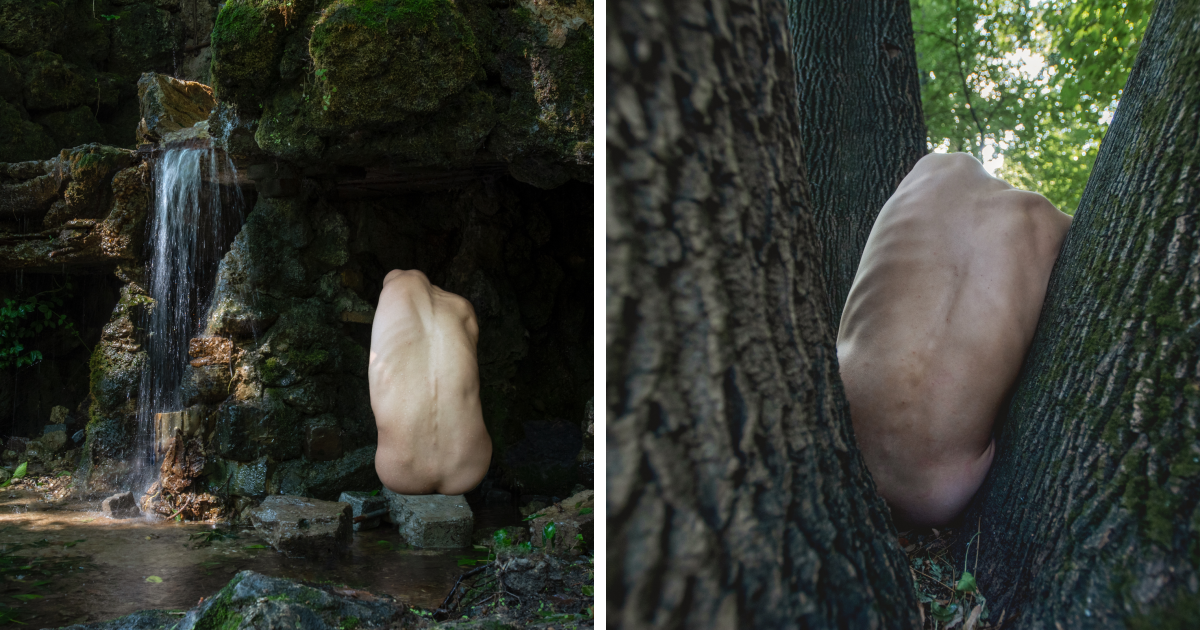
The series was created by photographer Luiza Marinas with Simona as the model, a dancer living with a severe deformity of the spine. Instead of hiding asymmetry, the photographs invite viewers to look directly at itwithout pity, without clinical coldness, and without the usual internet habit of turning every body into a before-and-after project. The result is strange, sculptural, intimate, and occasionally uncomfortable in the best possible way. Good art does not always enter politely. Sometimes it kicks the door open wearing a leotard and says, “Look again.”
At its heart, Ms. Spine asks a deceptively simple question: What if the spine had feelings? What if it could pose, hesitate, stretch, withdraw, dance, rest, or speak? By personifying the spine, the project moves away from the idea of the body as something that must be corrected before it can be beautiful. Instead, it suggests that individual beauty often begins exactly where symmetry ends.
The Spine as Structure, Story, and Sculpture
Scientifically speaking, the spine is a marvel of design. The human spinal column is made of vertebrae, disks, joints, ligaments, muscles, and nerves that together support the head, protect the spinal cord, hold the torso upright, and allow movement. It is both a tower and a spring. It carries weight, absorbs shock, and bends enough to let us dance, reach, twist, bow, and dramatically look out of rainy windows when life becomes cinematic.
That dual naturestrong yet flexibleis exactly why the spine is such a powerful artistic subject. It is not just an anatomical feature; it is a visual line. In drawing, dance, photography, and sculpture, the line of the back often tells the emotional truth before the face does. A curved back can suggest fatigue, tenderness, grief, concentration, resistance, or grace. A lifted chest can suggest confidence, breath, or release. A turned shoulder can say, “I’m leaving,” “I’m listening,” or “I know where the snacks are hidden.”
Ms. Spine uses this expressive potential with unusual focus. The model’s body becomes a living sculpture, but not in the stiff museum-statue way. The poses feel suspended, as if movement has been paused just long enough for the viewer to understand its emotional grammar. Each image seems to say that the body is not a fixed object. It is an event. It remembers. It adapts. It negotiates with gravity every single day.
Why Personifying the Spine Works So Well
Personification is an old storytelling trick, but here it feels surprisingly fresh. We personify storms, cities, cars, pets, and even laptops when they freeze at the exact moment we forgot to save a file. So why not the spine? The spine already behaves like a character in our lives. It has moods. It has demands. It can be generous in the morning and dramatic by bedtime. It can carry us through ordinary errands and extraordinary performances.
In Ms. Spine, personification helps the viewer move beyond diagnosis. A spinal deformity can be medically significant, painful, limiting, or complex, but it is never only a diagnosis. It is lived through a person’s gestures, clothes, habits, confidence, exhaustion, humor, and creativity. By imagining the spine as a figure with its own feelings, the project opens a poetic space where the body is neither reduced to suffering nor forced into fake positivity.
That balance matters. Too often, public conversations about visible difference fall into two boring buckets: tragedy or inspiration. Either the person is treated as someone to feel sorry for, or they are turned into a motivational poster with better lighting. Ms. Spine refuses both. It lets Simona appear as a performer, collaborator, and individualnot a symbol flattened for easy consumption.
Simona’s Body as Movement, Not Limitation
The fact that Simona is a dancer changes the entire meaning of the series. Dance is not just decoration here; it is a language. A dancer understands how much can be said through a small shift of weight, a locked elbow, a dropped shoulder, or a held breath. When the body is shaped differently, the movement vocabulary changes. But different does not mean lesser. It means the choreography has its own accent.
That is one of the most compelling ideas behind Ms. Spine: the body’s asymmetry is not treated as a flaw to be hidden from the camera. It becomes the camera’s reason for being there. The photographs explore how deformity can create unexpected visual possibilitiesangles, tensions, silhouettes, and sculptural lines that a more conventionally symmetrical body might not produce in the same way.
This does not romanticize pain. Pain is real. Spinal conditions can affect mobility, breathing, posture, fatigue, self-image, and daily routines. But the series makes room for a more complicated truth: a body can be difficult and beautiful at the same time. It can be a source of frustration and artistry. It can hurt and still dance. Human beings are annoyingly, wonderfully non-binary like that.
Photography That Does More Than “Capture”
People often say photography “captures” a moment, but Ms. Spine feels more like it releases one. The images do not merely document Simona’s body; they build a visual world around it. That difference is important. Documentary photography can show what is there. Conceptual portrait photography can ask what it means. This project leans into the second approach.
The framing, poses, and body fragmentation invite viewers to study form without forgetting personhood. Body fragmentation can be risky in art because it may turn a person into parts. Here, however, fragmentation works like visual punctuation. A shoulder, back, curve, hip, or arm becomes a sentence fragment that still belongs to a larger story. The viewer is asked to complete meaning carefully, not greedily.
This is where the photographer-model collaboration becomes essential. A project like this cannot work if the camera simply takes from the subject. It needs trust. It needs conversation. It needs a shared willingness to explore vulnerability without turning vulnerability into spectacle. The strongest images in body-centered art often come from that negotiated space between seeing and being seen.
The Beauty of Asymmetry
Modern visual culture is obsessed with symmetry. Faces are filtered, bodies are edited, skin is polished, and posture is corrected until everyone begins to look like they were assembled by the same suspiciously enthusiastic robot. Yet nature is full of asymmetry. Trees bend. Shells spiral. Mountains lean. Rivers refuse straight lines with admirable stubbornness. Even the human body, despite all our mirror-checking, is not perfectly symmetrical.
Ms. Spine argues that asymmetry is not the enemy of beauty. It may be one of beauty’s secret engines. A curved line draws the eye. An unexpected angle creates movement. A body that does not match the standard template can reveal new shapes, new emotions, and new ways of understanding grace.
This idea connects with broader conversations in contemporary art, where artists have long used the body to explore identity, gender, vulnerability, disability, power, and memory. Museums and photography institutions often describe the body as a site where personal experience and cultural pressure meet. Ms. Spine fits into that tradition while remaining intimate and specific. It does not try to speak for every body. It starts with one body and lets the viewer understand something larger from there.
Body Positivity, Body Neutrality, and the Right to Be Seen
The internet loves the phrase “love your body,” which is a lovely idea until you are having a day when your body feels less like a temple and more like a rental apartment with plumbing issues. That is why the conversation around body image has grown beyond body positivity alone. Body positivity emphasizes acceptance and appreciation of all body types. Body neutrality, meanwhile, focuses less on appearance and more on what the body allows a person to experience, feel, and do.
Ms. Spine seems to live somewhere between the two. It celebrates the visual uniqueness of Simona’s body, but it also honors function, movement, endurance, and expression. The body is not presented as beautiful only because it looks interesting to others. It is beautiful because it belongs to a person who inhabits it, moves through it, and collaborates through it.
That distinction is crucial. Real body acceptance is not about demanding that every person feel gorgeous at all times. That would be exhausting, and frankly, nobody has the calendar space. It is about allowing bodies to exist without constant correction. It is about seeing difference without immediately asking how it should be fixed. It is about replacing the narrow question “Is this body perfect?” with the richer question “What story does this body carry?”
The Viewer’s Discomfort Is Part of the Work
Some viewers may find Ms. Spine unsettling. That does not mean the project has failed. In fact, discomfort can be a sign that the work is touching something real. Many people are trained to look away from bodies that do not match familiar ideals. Others stare, but without tenderness. A project like this disrupts both habits.
The images ask viewers to slow down. They make it difficult to consume the body quickly, like another pretty picture in an endless scroll. They also challenge the viewer’s assumptions about beauty, ability, and elegance. If the first reaction is confusion, the second might be curiosity. If the second is curiosity, the third might be empathy. And if empathy arrives, congratulationsthe artwork has successfully hacked the emotional operating system.
There is also a subtle humor in the project’s boldness. Naming the series Ms. Spine gives the spine personality, almost like a glamorous, complicated, slightly mysterious guest at a party. She has opinions. She has history. She may not sit in the chair the way you expect, but she absolutely owns the room.
What Artists and Photographers Can Learn From “Ms. Spine”
For photographers, the project offers a valuable lesson: the most meaningful portraits are not always the ones that flatter in a conventional way. Sometimes the best portrait reveals a relationshipbetween body and space, subject and camera, pain and performance, stillness and motion.
Lighting, composition, and pose matter, of course. But concept matters more. A technically perfect image can still feel empty if it has no emotional pulse. Ms. Spine works because the concept is clear: personify the spine to explore individual beauty. Every visual decision can then serve that idea. The body is not randomly posed; it is staged as a form of speech.
For models and performers, the series is a reminder that the body’s uniqueness can be a creative resource. This does not mean every person must publicly display their difference. Privacy is valid. Modesty is valid. Not wanting to turn your medical history into content is very valid. But for those who choose visibility, art can transform the terms of being seen. It can move the body from object to author.
Why This Project Matters Now
We live in an era when images are everywhere, but looking has become shallow. Social media trains people to judge in half a second: like, skip, zoom, compare, repeat. In that environment, a series like Ms. Spine feels almost rebellious. It does not chase easy prettiness. It does not flatten the body into a marketable ideal. It asks for attention, and not the lazy kind.
The project also arrives in a culture increasingly aware of disability representation, medical visibility, and the emotional weight of body image. People want stories that do not erase difficulty, but they also want stories that do not define people only by difficulty. Ms. Spine offers exactly that middle ground. It is neither sentimental nor cold. It is poetic, a bit strange, and deeply human.
Most importantly, it expands the meaning of beauty. Beauty is not only smoothness, symmetry, youth, or polish. Beauty can be resilience without cliché, vulnerability without helplessness, and difference without apology. Beauty can be a spine that curves, a dancer who adapts, and a photographer who understands that the camera can be a bridge instead of a spotlight.
Experiences Related to “Ms. Spine”: Learning to Look With More Care
One of the most powerful experiences connected to a project like Ms. Spine is the realization that many of us have been taught to look at bodies incorrectly. We scan for errors. We compare proportions. We notice what is “off” before we notice what is alive. This habit is not entirely our fault; advertising, entertainment, fashion, and social media have been handing out invisible measuring tapes for decades. But once you notice the habit, you can begin to change it.
Viewing Ms. Spine can feel like entering a quiet room after being trapped in a noisy mall. At first, the images may feel unfamiliar. The poses are not designed to sell clothing, fitness plans, or the fantasy of effortless perfection. They ask for a slower kind of attention. You begin by seeing the curve of the back, then the gesture, then the tension, then the courage of stillness. After a while, the body is no longer a “case” or a “condition.” It becomes a landscape.
For anyone who has lived with back pain, scoliosis, posture issues, injury, or a body that attracts unwanted comments, the series may feel especially personal. Many people know what it is like to adjust clothing to hide a curve, avoid certain angles in photos, or laugh off discomfort because explaining it feels tiring. There is a strange loneliness in having a body that other people misunderstand. Art cannot solve that loneliness completely, but it can name it. Sometimes being named is the first relief.
For photographers, working on a subject like this requires humility. The camera has power, and power must behave itself. A respectful session would begin with conversation: What does the model want to express? Which poses feel strong? Which angles feel too exposing? What story belongs to the subject, and what story is the photographer trying to impose? The best images often come when the photographer stops hunting for a “wow” shot and starts listening for the quieter truth.
For viewers, the experience can become an exercise in empathy. Instead of asking, “Why does this body look like that?” we might ask, “What has this body carried?” Instead of reacting with shock, we might practice curiosity. Instead of treating difference as a visual interruption, we might see it as evidence that human beauty has more dialects than we were taught.
There is also a personal lesson about our own spines, literal and metaphorical. The spine is associated with standing tall, having courage, and holding oneself together. Yet Ms. Spine suggests that strength does not always look straight. Sometimes strength bends. Sometimes it twists. Sometimes it rests. Sometimes it asks for help. A curved spine can still hold a powerful life. A different body can still create unforgettable art. And a photograph, when made with care, can remind us that the human form was never meant to be a factory-standard product.
That may be the lasting experience of Ms. Spine: it changes the viewer’s posture from judgment to attention. And honestly, that is a pretty good adjustmentno chiropractor appointment required.
Conclusion: A Spine, A Story, A New Definition of Beauty
Ms. Spine is more than a photo series about spinal deformity. It is a visual argument for looking deeper. Through the collaboration between Luiza Marinas and Simona, the spine becomes a character, the body becomes sculpture, and asymmetry becomes a source of meaning rather than something to hide.
The project matters because it refuses simple labels. It is not only about pain, not only about beauty, not only about dance, and not only about anatomy. It is about the complicated place where all of those things meet. It reminds us that every body has architecture, memory, and personality. Some bodies whisper their stories. Others bend them into the air.
In a world that keeps trying to make everyone look the same, Ms. Spine offers a braver idea: individuality is not a defect in the design. It is the design.
SEO Tags

