
Beauty Unlocked
Robotic Ants Function Just Like Real Ones
Aug
Ants may be tiny, but they run some of the most impressive operations on Earth. They build, dig, forage, rescue, defend, transport, communicate, and reorganize without a boss ant shouting through a microscopic megaphone. That is exactly why roboticists keep staring at ant colonies like they are the world’s smallest engineering department.
In recent years, researchers have created robotic ants and ant-inspired robot swarms that behave surprisingly like real ants. They do not need a central commander. They do not require a perfect map. They do not always know what every other robot is doing. Instead, they rely on simple rules, local signals, physical interaction, and teamwork. Somehow, from all that simplicity, complex group behavior appears. Science calls this emergence. The rest of us might call it “tiny chaos with a plan.”
The phrase “robotic ants function just like real ones” does not mean metal insects are marching into your picnic basket and judging your sandwich choices. It means engineers are learning how to build machines that copy the most useful parts of ant behavior: decentralized decision-making, swarm intelligence, collective transport, adaptive digging, obstacle handling, and flexible cooperation. These abilities could shape the future of search and rescue, construction, agriculture, environmental cleanup, medicine, and space exploration.
What Are Robotic Ants?
Robotic ants are small robots designed to act alone but become far more powerful as a group. One robot might be simple, limited, and not especially glamorous. Put dozens, hundreds, or even thousands together, and suddenly the group can move objects, form patterns, explore spaces, build structures, or solve problems that no single unit could handle.
In robotics, this area is usually called swarm robotics. The inspiration comes from social insects such as ants, termites, and bees. These insects achieve large-scale results through many small actions. An ant does not need to understand the whole colony’s master plan. It only needs to react to nearby ants, chemical trails, physical contact, food, obstacles, and environmental changes.
That is the magic engineers want. Instead of designing one expensive, complicated robot that must do everything perfectly, researchers can design many simple robots that cooperate. If one fails, the group keeps going. If the environment changes, the swarm adapts. If the task is too big, more robots can join the effort. It is the robotic equivalent of a group project where everyone actually does their part. Miracles do happen.
Why Ants Are a Perfect Model for Swarm Robots
Ants are not individually brilliant in the way humans define intelligence. They do not hold meetings, create spreadsheets, or argue about font choices. Yet ant colonies display astonishing collective intelligence. They find food, build nests, create living bridges, regulate traffic, allocate labor, and recover from disruptions.
For roboticists, ants offer three major lessons. First, intelligence does not always need to live in one big brain. It can be spread across many small agents. Second, communication does not have to be complex. Real ants use pheromones, touch, vibration, and local cues. Robot swarms can use light, sensors, magnetic fields, radio signals, force feedback, or even physical contact. Third, the environment itself can become part of the control system. A tunnel, wall, pile of material, or object being carried can guide the group’s next move.
Simple Rules Can Create Complex Results
The most important idea behind robotic ants is that simple individual rules can produce complex group behavior. A robot may follow instructions such as “move toward a signal,” “avoid crowding,” “drop material here,” or “follow the force direction of the object.” These rules sound almost too basic. But when many robots follow them at once, patterns emerge.
This is how real ants work. A single ant leaving a chemical trail is not building a grand transportation network. But thousands of ants responding to trails can create efficient routes between nest and food. Likewise, one robotic ant may not understand the final structure being built, but a swarm can collectively create or remove material by reacting to local conditions.
Harvard’s RAnts: Robotic Ants That Build and Excavate
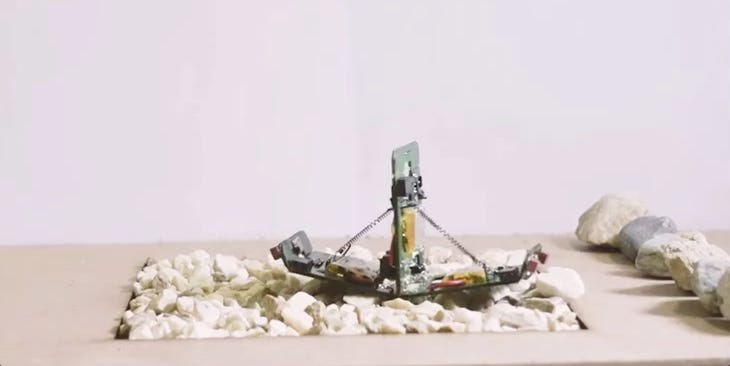
One of the most exciting recent examples comes from Harvard researchers, who developed simple ant-like robots called RAnts. These robots were designed to explore how decentralized swarms can build, excavate, and dismantle structures without central control. Instead of depending on a single commander robot, the RAnts respond to environmental cues and minimal physical rules.
The remarkable part is not that the robots move. Lots of robots move. Your vacuum cleaner moves, usually directly into the one chair leg you forgot existed. The remarkable part is that these robots can collectively organize their work. By adjusting only a small number of behavioral parameters, such as how strongly the robots cooperate and how quickly they deposit material, the same swarm can shift between building and taking structures apart.
This mirrors real ant colonies. Ants do not receive architectural drawings for a nest. They interact with soil, tunnels, pheromones, humidity, crowding, and one another. Over time, those local interactions create organized structures. Robotic ants copy the principle: let the group respond to the world directly instead of forcing every robot to follow a top-down script.
How Real Ants Dig, Escape, and Avoid Traffic Jams
Ant-inspired robotics is not just about building cute mechanical bugs. Researchers study real ants first, because ant colonies have already solved many problems that engineers still wrestle with. For example, studies of black carpenter ants show how groups can cooperate to excavate out of confined spaces. At first, ants may wander and interact locally. Then, as signals and activity concentrate, excavation becomes more organized.
This matters because digging is surprisingly difficult for robots. Soil shifts. Particles jam. Robots collide. Too many workers in a tight space can make the job slower rather than faster. Ants are better at this than machines because they are flexible, responsive, and excellent at not turning a tunnel into rush-hour traffic with legs.
Research comparing ants and robots has shown that more workers do not always mean more work gets done. In confined spaces, a swarm can clog itself if every robot charges forward at once. Real ants often avoid this through uneven work distribution: some dig, some reverse, some wait, and some move out of the way. In human terms, a few ants are working hard, a few are supervising, and a few are apparently on a coffee break. But the colony benefits because the system keeps flowing.
Robotic Ants Communicate Without Talking
Real ants are famous for pheromones, chemical signals that can mark trails, warn the colony, or guide nest behavior. Robotic ants may use digital or physical versions of the same concept. Some systems use light fields, sensor readings, local wireless messages, contact forces, or environmental markers. The goal is not to make robots “chatty.” The goal is to let each robot receive just enough local information to make a useful decision.
In swarm robotics, this is a big advantage. Centralized communication can become a bottleneck. If every robot must constantly report to one computer, the system becomes fragile. If that central controller fails, the swarm may freeze like a group text where nobody knows who is picking the restaurant. Decentralized robotic ants avoid that problem by making decisions locally.
Virtual Pheromones and Environmental Signals
One common idea in ant-inspired robotics is the virtual pheromone. Instead of leaving chemicals on the ground, robots can leave digital markers or react to light patterns, gradients, or sensor data. A robot might mark a useful area, avoid an overcrowded space, or recruit other robots toward a task. This creates a feedback loop: the more useful a path or worksite becomes, the more attention it receives.
That feedback loop can be powerful, but it must be balanced. Too much attraction and every robot piles into the same spot. Too little attraction and the swarm wanders around like it forgot why it came into the room. Good swarm design depends on tuning cooperation, exploration, and avoidance.
Collective Transport: How Tiny Robots Move Big Things
One of the clearest ways robotic ants resemble real ants is collective transport. Anyone who has watched ants carry a crumb knows the scene: a group pushes, pulls, adjusts, gets confused for a moment, then somehow moves the prize home. Engineers love this behavior because many small robots could move loads that would overwhelm one machine.
In some ant-inspired robot systems, robots do not need full communication to transport objects. They can use force feedback from the object itself. If one robot pulls in a direction, the object shifts slightly, and the other robots detect the force or motion. The object becomes a shared communication channel. In other words, the heavy thing everyone is trying to move becomes the meeting room.
Research on systems such as Force-ANTS has explored how groups of robots can align force and amplify pulling power even when follower robots do not know the full destination. This idea closely resembles ant teams, where individuals may respond to the motion, vibration, or tension of a shared load instead of receiving explicit instructions.
Microrobot Swarms: Ant-Like Strength at a Tiny Scale
Robotic ants are not limited to visible tabletop machines. Scientists are also building microrobot swarms that operate at extremely small scales. Some magnetic microrobots can self-assemble under rotating magnetic fields, form rafts, climb obstacles, and move objects many times heavier than a single robot. The ant comparison is obvious: individually, they are weak; collectively, they become surprisingly capable.
This could matter in places where large machines cannot go. Tiny robotic swarms may one day help with delicate medical procedures, targeted delivery, environmental sensing, or work in narrow industrial spaces. These applications are still developing, and researchers are careful to note that real-world autonomy remains a challenge. But the direction is clear: future machines may not always be big, loud, and dramatic. Some may be tiny, cooperative, and extremely good at teamwork.
From Kilobots to Robotic Ant Colonies
Another famous milestone in swarm robotics is Harvard’s Kilobot system. Kilobots are small, simple robots designed to test collective algorithms at large scale. In one major demonstration, more than a thousand Kilobots worked together to form shapes. Each robot followed basic rules, communicated locally, and contributed to a larger pattern.
Kilobots are not ants in the biological sense, but they capture the same principle: a swarm can become more than the sum of its parts. A single Kilobot is modest. A thousand Kilobots become a programmable collective. This research helped show that large groups of simple robots could be controlled as a swarm without requiring each robot to be highly intelligent on its own.
That lesson continues to influence robotic ant research today. Engineers are learning that the future of robotics may not be one perfect humanoid machine doing everything. It may be many specialized, inexpensive robots that cooperate like a colony.
Robotic Ants and Navigation: Learning From Random Walks
Ants are also excellent navigators. Some ants use chemical trails. Desert ants use celestial cues, step counting, and visual information to return home after wandering in harsh environments. Other ant studies show that random exploration can still produce useful information. For example, ants can estimate local density by bumping into other ants during random movement.
This has direct value for robot swarms. A robot in a swarm may not know the whole map. It may only know what it senses nearby. But with enough local encounters, a swarm can estimate density, coverage, or crowding. This helps robots decide whether to spread out, gather, dig, search, or avoid traffic jams.
That is why ant behavior matters beyond biology. It can inspire better algorithms for robot teams, sensor networks, communication systems, and autonomous exploration. Sometimes the smartest route is not a perfect route. It is a robust route that works even when the map is incomplete.
Where Robotic Ants Could Be Used
The potential applications of robotic ants are wide-ranging. In search and rescue, small swarms could enter unstable buildings, collapsed tunnels, or disaster zones where larger robots cannot safely operate. If one robot fails, others could continue searching.
In construction, robotic swarms could help move materials, inspect sites, assemble modular structures, or work in hazardous environments. Instead of one giant machine carrying everything, many smaller robots could coordinate around tasks.
In environmental remediation, swarms could map polluted areas, collect samples, monitor soil, or track changes over time. In agriculture, small robot teams could inspect crops, detect pests, or manage fields with less disruption than heavy machinery.
In space exploration, robotic ant swarms could be especially useful. The Moon and Mars present harsh conditions, communication delays, and high risk. A swarm that can dig, transport, build, and adapt with minimal supervision could help prepare landing pads, shield habitats, or explore terrain. Sending a single expensive robot is risky. Sending a swarm creates redundancy. It is harder for a mission to fail when the team is designed to lose a few members and keep marching.
The Big Challenges: Why We Do Not Have Robot Ant Cities Yet
Robotic ants are promising, but they are not ready to replace construction crews, medical teams, or actual ants. Real ants still outperform robots in flexibility, energy efficiency, durability, and adaptability. An ant can squeeze through tight spaces, climb rough surfaces, recover from collisions, and operate on a tiny biological power budget. Robots often need batteries, sensors, controlled environments, and careful calibration.
Scaling is another challenge. A swarm that works in a lab may struggle outdoors, where dust, rain, uneven ground, lighting changes, and unpredictable obstacles appear. Communication can fail. Sensors can drift. Robots can get stuck. In large swarms, small errors can multiply quickly.
There are also safety and ethical questions. If swarms become common, engineers must make sure they can be monitored, stopped, repaired, and used responsibly. A helpful swarm should not become an uncontrolled swarm. Nobody wants a thousand tiny robots deciding the garage belongs to them now.
Real Ants Still Have the Crown
Perhaps the most humbling lesson is that nature remains ahead. Real ants are soft, flexible, self-repairing at the colony level, and incredibly efficient. Robotic ants imitate selected behaviors, but they do not fully match the biological original. That is not failure. It is the point of bio-inspired engineering: copy what is useful, learn what is possible, and gradually build better systems.
Why Robotic Ants Matter for the Future of AI
When people think about artificial intelligence, they often imagine one big brain: a supercomputer, a chatbot, or a robot with glowing eyes and suspiciously dramatic background music. Robotic ants suggest a different model. Intelligence can be collective, physical, distributed, and practical.
A robotic ant swarm does not need every unit to understand the entire mission. Each robot only needs to make good local decisions. The group behavior becomes intelligent because the rules, interactions, and environment work together. This is important for the future of autonomous systems because the real world is messy. Centralized control is not always possible. Perfect information is rare. Conditions change.
Swarm intelligence offers a way to build machines that are robust rather than perfect. They can adapt, recover, and continue functioning even when individual members fail. That is exactly how ant colonies survive. The colony does not depend on one heroic ant. It depends on many ordinary ants doing small things well.
Experience Section: What Robotic Ants Teach Us When We Watch Them Work
The most interesting experience related to robotic ants is not simply watching them move. At first, a swarm can look almost silly. Tiny machines crawl, bump, pause, reverse, and wander. If you expect a polished robot ballet, you may feel underwhelmed. Then the pattern begins to appear. A few robots cluster near a task. Others drift away. Some return. A path becomes busier. A pile changes shape. A load starts inching across the floor. Suddenly, the mess has meaning.
That moment is the hook. It changes how you think about intelligence. We often expect intelligence to look neat, fast, and confident. Robotic ants show that useful intelligence can look messy from close range and organized from far away. The individual behavior may be clumsy, but the group can still succeed. It is a useful reminder for technology, nature, and honestly, school group projects everywhere.
Imagine standing in a lab while researchers test a small swarm. One robot gets stuck against a block. Another bumps it. A third approaches from a different angle. No single robot seems impressive. There is no dramatic “aha” moment. But slowly, the object rotates. The swarm corrects itself. The robots do not need to be elegant. They need to be persistent, responsive, and coordinated enough to keep the task moving.
The experience is also a lesson in patience. Humans love direct control. We want to point at a machine and say, “Do exactly this.” Swarm robotics asks us to think differently. Instead of controlling every action, engineers design rules and conditions that allow good behavior to emerge. It is more like gardening than driving. You shape the environment, tune the system, and let many small actions accumulate.
There is also a funny emotional shift. At first, you may root for one robot, especially the one that looks like it is trying very hard and achieving absolutely nothing. Then you realize the individual is not the story. The swarm is the story. The “confused” robot may still contribute by blocking a path, nudging a neighbor, or changing local traffic. In a colony, even imperfect motion can become useful information.
For students, hobbyists, and science fans, robotic ants make robotics feel more approachable. They show that advanced technology does not always begin with a giant humanoid machine. It can begin with simple parts, small rules, and careful observation of nature. The ant colony becomes a classroom. The robot swarm becomes a living diagram of cooperation.
The biggest takeaway from experiencing robotic ants is this: complexity does not always require complexity at the starting point. Sometimes, the smartest systems are built from simple agents that know how to interact. That idea may influence the next generation of robots, AI systems, smart materials, and autonomous machines. And it all begins with ants, the tiny engineers that have been quietly running the planet while humans were still trying to assemble furniture without losing the tiny wrench.
Conclusion: Tiny Robots, Big Lessons
Robotic ants function like real ones because they borrow the colony’s best tricks: local communication, simple rules, collective transport, distributed problem-solving, and adaptation without a central boss. The result is a new way to think about robotics. Instead of building one machine that must be brilliant at everything, engineers can build many small machines that become useful together.
The field is still developing, and real ants remain far better at being ants than robots are. But the progress is impressive. From RAnts that build and excavate, to Kilobots that form shapes, to magnetic microrobots that carry loads far beyond their individual scale, the message is clear: the future of robotics may be smaller, smarter as a group, and a lot more ant-like than we expected.
So the next time you see ants moving a crumb across the sidewalk, give them a little respect. They are not just stealing lunch. They are demonstrating principles that may help design the next generation of autonomous machines. Also, they found the crumb before you did, so technically, they are winning.
Note
This article is written for general web publication and summarizes real robotics research in a reader-friendly style. It avoids source-link clutter inside the article body while keeping the content grounded in documented work on robotic ants, swarm robotics, ant-inspired algorithms, collective excavation, and decentralized robot cooperation.

