
Makeup
Watch South Korea’s First Homemade Tank Strut Its Stuff
Jul
At first glance, South Korea’s K1 tank looks like it showed up to a military parade after borrowing a few style notes from the American M1 Abrams. That impression is not entirely wrong. But it also misses the bigger story: the K1, often called the “88 Tank,” was the machine that helped South Korea move from operating imported armor to building a modern armored-vehicle industry of its own.
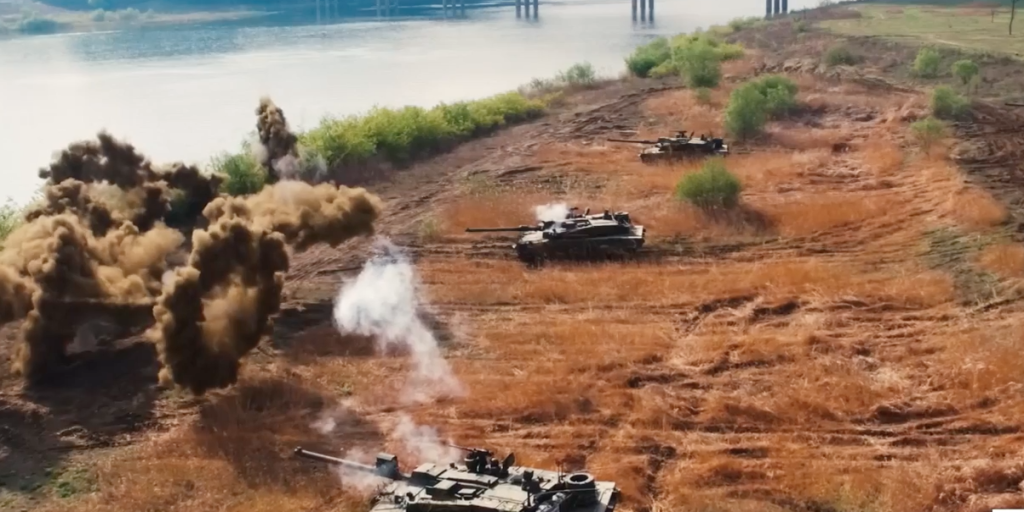
Watching a K1 roll across rough ground is a little like watching a 50-ton engineering thesis decide it has places to be. Its suspension rises and settles over uneven terrain, its compact hull stays surprisingly low, and its broad tracks make the whole vehicle look less like a museum relic than a machine still determined to clock in for work.
The K1 was not born in a vacuum, nor was it a purely homegrown design from the first bolt onward. It was a Korean-led production and integration effort developed with major U.S. technical assistance, especially from Chrysler Defense and later General Dynamics Land Systems. Still, it represented something historic: South Korea’s first domestically produced modern main battle tank and a major step toward the country’s later defense-industry success.
The K1 “88 Tank”: South Korea’s First Big Leap
The K1 is often described as South Korea’s first homemade tank, but the most accurate phrase is South Korea’s first domestically produced modern main battle tank. That distinction matters. The tank was developed through cooperation between South Korean industry and American defense specialists, with Hyundai Precision Industry taking on a central manufacturing role.
Its roots stretch back to the late Cold War, when South Korea wanted more than upgraded older tanks. The country had relied heavily on U.S.-supplied armor after the Korean War, including M47 and M48 Patton tanks. Those vehicles were important in their day, but by the 1970s, “important in their day” was not exactly a comforting phrase when newer Soviet-designed tanks were appearing north of the Demilitarized Zone.
The K1 program was designed to close that capability gap while building domestic industrial know-how. Instead of simply buying a finished foreign tank, South Korea aimed to learn how to manufacture, assemble, test, maintain, and improve armored vehicles at home. That made the K1 more than a tank. It was an industrial classroom with tracks.
The vehicle entered service in the late 1980s and became closely associated with the name “88 Tank,” a nickname tied to the era of the 1988 Seoul Olympics. While the Olympic Games celebrated South Korea’s rise as a global economic and cultural force, the K1 quietly represented another kind of national confidence: the ability to produce sophisticated defense equipment instead of relying entirely on overseas suppliers.
Why South Korea Needed a Tank of Its Own
To understand the K1, it helps to remember the geography and security concerns of the Korean Peninsula. South Korea’s terrain is not one endless flat desert where a tank can charge toward the horizon like it is auditioning for an action movie. The country has mountains, narrow valleys, muddy lowlands, rivers, dense infrastructure, and roads that make vehicle size and mobility especially important.
During the 1970s, South Korea faced a difficult strategic reality. North Korea had a large armored force and access to Soviet-designed equipment. Meanwhile, South Korea’s existing tank fleet was built largely around older American designs. The Republic of Korea Army needed something more modern, more mobile, and better suited to local terrain.
Buying a large number of newer foreign tanks was one option. Building a domestic tank program was another. The second choice was harder, slower, and probably came with enough meetings to make any engineer develop a permanent eyebrow twitch. But it offered long-term advantages.
A local tank program could create skilled jobs, improve precision manufacturing, support military maintenance, and give South Korea more control over upgrades. It could also create a foundation for later projects involving armored recovery vehicles, bridge-launching vehicles, artillery systems, electronics, and eventually entirely new tank designs.
The K1 emerged from this strategic shift. South Korea wanted a tank that could operate effectively in its own environment rather than a vehicle designed only for someone else’s battlefield assumptions. That meant a lower profile, strong mobility, a powerful engine, advanced fire-control equipment for the era, and a suspension arrangement capable of dealing with uneven ground.
How the K1 Was Built: Korean Industry Meets U.S. Expertise
The K1 is often called a Korean cousin of the M1 Abrams, and visually, the family resemblance is hard to ignore. Both tanks have a low, angular silhouette and a modern Western main battle tank layout. However, the K1 was not simply an Abrams with different paint and a new name tag.
South Korea’s K1 development program involved Chrysler Defense, which later became part of General Dynamics Land Systems, along with Hyundai Precision Industry and South Korean defense institutions. The early design was influenced by the M1 Abrams program, but it was adjusted for Korean operational requirements.
Not a Copy, Not a Clone, Not a Tank in Disguise
The K1 had to fit South Korea’s terrain, infrastructure, and military needs. It was smaller and lighter than many Abrams variants, helping it operate in areas where roads, bridges, and maneuver space could place practical limits on heavy vehicles. It also used a hybrid suspension system combining hydropneumatic elements with torsion bars, giving it an ability to adapt to uneven ground.
The result was a tank that borrowed ideas from an American design philosophy while becoming its own machine. Think of it less as copying a recipe and more as taking a famous barbecue sauce, changing the ingredients, adjusting it for local taste, and then building an entire restaurant industry around the kitchen.
Early K1 tanks carried a 105 mm main gun, a caliber common among Western tanks of the period. The vehicle also incorporated a fire-control system, thermal viewing capability for the gunner, laser rangefinding equipment, composite armor protection, and a 1,200-horsepower diesel engine. Those features placed it firmly in the category of modern armored vehicles for its time.
More importantly, the K1 program helped South Korean engineers gain experience in the less glamorous but absolutely essential parts of tank production: metallurgy, quality control, machining, systems integration, testing, supply chains, maintenance planning, and long-term modernization. Tanks are not built from horsepower alone. They are built from factories, documentation, trained workers, spare parts, and a truly heroic number of inspections.
What Makes the K1 Look So Different in Motion?
When footage shows a K1 moving across a course, the first thing many viewers notice is its stance. The tank appears compact, balanced, and lower to the ground than some other Western main battle tanks. That is not an accident.
A Low Profile for a Demanding Landscape
The K1 was designed for the Korean Peninsula’s mix of hills, valleys, and built-up areas. A lower profile can make a vehicle less exposed and easier to position behind terrain. Its relatively compact dimensions also reflect the practical challenge of moving heavy armor through a country where mountains and urban development do not politely step aside.
Suspension With a Job to Do
One of the K1’s most interesting features is its suspension arrangement. The vehicle combines hydropneumatic suspension components with torsion bars, giving it a distinctive ability to settle and adjust as it crosses uneven surfaces. Watching the hull shift over bumps can make the tank look almost graceful, which is a strange adjective for something weighing roughly as much as a large house.
This mobility mattered because the K1 was built for more than parade-ground appearances. The vehicle needed to move through rough terrain, negotiate slopes, and maintain stability while traveling over surfaces that would make a normal car immediately begin drafting a resignation letter.
Power Without the Abrams Turbine
Unlike the American M1 Abrams, which became famous for its gas-turbine engine, the K1 used a diesel powerplant. The 1,200-horsepower diesel engine gave the tank strong mobility while fitting South Korea’s logistical and maintenance preferences. The choice also reflected the fact that the K1 was shaped by Korean requirements, even though its development involved American technology and expertise.
The K1 Family Tree: From K1 to K1A2
The baseline K1 was never meant to remain frozen in time. As sensors, communications, ammunition, and battlefield networking evolved, South Korea continued upgrading the platform. This is one reason the K1 remains historically important: it became a long-running family of vehicles rather than a one-time experiment.
K1: The Original 88 Tank
The original K1 entered service in the late 1980s with its 105 mm main gun, diesel engine, composite armor package, and advanced-for-its-era fire-control system. It gave the Republic of Korea Army a much more capable domestic platform than the older tanks that had formed the backbone of its armored force.
K1A1: More Firepower and Better Electronics
The K1A1 emerged as a major evolution of the original design. It received a 120 mm smoothbore main gun, improved sights, updated ballistic computers, and more capable electronics. Rather than abandon the K1 concept, South Korea used the platform as a foundation for a stronger and more modern vehicle.
This upgrade path also showed why domestic manufacturing mattered. A country that can produce, support, and understand a vehicle has more room to improve it over time. The K1A1 was not just a newer tank; it was evidence that South Korean engineers had gained the confidence to take on more of the design responsibility themselves.
K1E1 and K1A2: Keeping an Old Workhorse Relevant
Later modernization efforts created the K1E1 and K1A2 configurations. These upgrades focused on areas such as communications, battlefield management, navigation, friend-or-foe identification, crew awareness, and improved digital systems. In other words, the tank received the military equivalent of a very serious technology refresh.
The K1A2, in particular, reflected the shift toward networked operations. Modern armored vehicles are not simply isolated machines with armor and engines. They are part of broader systems involving reconnaissance, command networks, logistics, infantry, artillery, drones, and air support. The K1A2 was designed to remain useful in that more connected environment.
Why the K1 Still Matters in the K2 Black Panther Era
South Korea’s K2 Black Panther is now the country’s headline-grabbing main battle tank. It is newer, more advanced, and regularly attracts international attention because of its high-tech features and export success. But the K2 did not appear by magic, nor did it emerge from a factory floor covered in inspirational posters.
The K1 helped create the industrial experience that made the K2 possible. It taught South Korea how to integrate complex systems, manage armored-vehicle production, build supply chains, conduct long-term upgrades, and turn a defense project into a durable manufacturing capability.
The path from K1 to K2 also tells a broader story about South Korea’s transformation. The country moved from dependence on imported military hardware toward becoming a significant exporter of defense systems. That journey includes tanks, artillery, aircraft components, naval systems, electronics, and military vehicles.
There is also a useful lesson here for anyone interested in technology and manufacturing: first-generation domestic products do not need to be perfect to be important. They need to create the skills, infrastructure, and confidence required for the next generation. The K1 was that first major step.
What You Are Really Seeing When the K1 Struts Its Stuff
Watching the K1 maneuver is entertaining because it is an impressive machine. It is loud, heavy, purposeful, and somehow capable of looking both awkward and elegant at once. But the real story is not just the movement of the vehicle itself.
What viewers are seeing is the result of decades of engineering, policy decisions, industrial investment, foreign cooperation, and national ambition. The K1’s tracks represent more than mobility. They represent South Korea’s decision to learn how to make one of the most complex land vehicles in the world.
The tank may have started with American influence, but it became a Korean milestone. It helped transform a country known primarily for importing military equipment into one capable of designing, manufacturing, upgrading, and exporting advanced defense platforms.
That is why the K1 remains worth watching. It is not just a machine from the 1980s rumbling through a training field. It is a moving chapter in South Korea’s industrial history.
The Experience of Watching the K1 in Motion
Watching South Korea’s K1 tank move is one of those experiences that changes depending on what you know before you press play. At first, it can look like a straightforward military demonstration: a large armored vehicle rolls forward, turns sharply, climbs uneven ground, and reminds everyone nearby that physics has a flexible relationship with objects that weigh more than 50 tons.
But after learning the K1’s history, the experience becomes much more interesting. You are no longer watching only a tank. You are watching a country’s industrial confidence take physical form.
The K1 does not glide like a sports car, and honestly, it would be suspicious if it did. Its movement has weight. The tracks bite into the ground, the suspension reacts to bumps, and the hull leans as it crosses uneven terrain. Every shift of the vehicle makes its mass obvious. It looks powerful not because it moves quickly in a flashy way, but because it moves with the steady certainty of something that has no intention of asking permission from a muddy hill.
There is also a surprising amount of design personality in the K1. Its low silhouette gives it a compact appearance compared with some larger Western tanks. Its turret and hull have an unmistakably Abrams-inspired shape, but the overall vehicle feels more tailored, almost as if the design team took an American idea and trimmed it for South Korea’s roads, bridges, mountains, and valleys.
For people interested in engineering, the best part is noticing the details that are easy to overlook. The K1 represents a huge amount of unseen work. Before the first tank could roll, engineers had to solve problems involving engines, tracks, armor integration, electronics, manufacturing precision, heat, vibration, maintenance, testing, and reliability. A video may show a tank crossing a field in a few seconds, but that moment sits on top of years of factory work and technical problem-solving.
For history fans, the K1 offers another kind of fascination. It arrived during a period when South Korea was rapidly becoming a global industrial power. The country was building automobiles, ships, electronics, infrastructure, and export industries at remarkable speed. The K1 fits into that larger story. It was a symbol of a nation deciding that it did not want to remain only a buyer of sophisticated technology.
There is a temptation to view tanks only as machines of force, but the K1 is also a reminder that advanced technology often grows through partnerships, experimentation, and gradual learning. South Korea did not leap instantly from imported Patton tanks to the cutting-edge K2 Black Panther. It built experience step by step, program by program, upgrade by upgrade.
That makes the K1 more compelling than a simple “look how big this thing is” video subject. It is a bridge between eras. It connects South Korea’s reliance on foreign military equipment after the Korean War with its later role as a major defense manufacturer. When it rolls across rough ground, it is carrying a lot more than armor, fuel, and steel. It is carrying an entire industrial story.
And yes, it still looks cool doing it.
Conclusion
South Korea’s K1 “88 Tank” was a turning point for the country’s armored forces and defense industry. It was developed with major American technical involvement, yet it gave South Korean manufacturers and engineers the experience needed to build, support, and modernize complex armored vehicles at home.
Its successor, the K2 Black Panther, may get more headlines today, but the K1 deserves credit as the machine that helped start the journey. When you watch it strut across a training ground, you are watching more than a Cold War-era tank. You are watching the first big step in South Korea’s rise as a modern defense manufacturing power.
Note: “Homemade” is used here in the popular sense. The K1 was South Korea’s first domestically produced modern main battle tank, but its early development relied substantially on U.S. design assistance, foreign components, and joint technical work.

