
Hair Care
I’m A Nurse And I Use Syringes To Paint In My Free Time
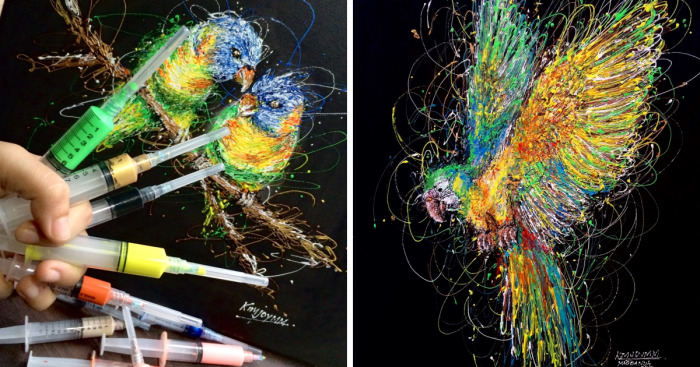
Jun
Most people hear the word “syringe” and think of flu shots, IV meds, lab labels, and that tiny moment when everyone in the room becomes extremely interested in the ceiling tiles. I hear “syringe” and, after a long nursing shift, sometimes think: Could this make a better paintbrush than the paintbrush?
That is how my odd little side quest began: I’m a nurse, and I use syringes to paint in my free time. Not used medical syringes, obviously. Let’s calm down before the infection-control team kicks down the door. I use clean, unused, needle-free art syringes or oral syringes filled with acrylic paint to create lines, dots, petals, textures, and dramatic splashes of color. It is part science, part art, part stress relief, and part “I bought too much paint again, but this is self-care, so legally it does not count.”
Syringe painting may sound strange, but it makes perfect sense if you spend your working life around precision, pressure, patience, and tiny measurements. Nursing teaches you how to steady your hand when things are hectic. Painting teaches you how to loosen it again. Somewhere between those two worlds, I found a hobby that helps me breathe.
How Nursing Led Me to Syringe Painting
Nursing is often described as both an art and a science, and that phrase is not just decorative wall art in a hospital hallway. It is true. Every shift asks for clinical judgment, technical skill, communication, empathy, and the ability to function after drinking coffee that has been reheated three times. Nurses measure, assess, document, comfort, improvise, and adapt. We work with tools, but the real work is human.
That combination followed me home. After difficult shifts, I wanted a creative hobby that did not require perfection. I did not want another checklist. I did not want a hobby that made me feel like I needed a certificate, a five-year plan, and a suspiciously expensive storage cart. I wanted color. I wanted quiet. I wanted to make something that did not beep.
One evening, while cleaning up art supplies, I noticed how easily paint could be controlled with a syringe. The barrel held color neatly. The plunger created pressure. The tip allowed me to place paint exactly where I wanted it. Suddenly, a familiar medical-looking tool became something completely different. Instead of delivering medication, it delivered marigold yellow, ultramarine blue, cherry red, and the occasional blob that looked like a confused jellyfish.
What Is Syringe Painting?
Syringe painting is a creative technique that uses a syringe-like tool to apply paint to canvas, paper, wood panels, or mixed-media surfaces. Artists may use it for fine lines, raised dots, controlled drips, abstract pours, flower petals, lettering, or textured patterns. It is especially useful with acrylic paint because acrylics are versatile, quick-drying, and easy to thin with appropriate mediums.
The technique can look delicate or bold depending on pressure and paint consistency. Push gently, and the paint forms a thin, careful line. Push firmly, and it creates a thick ribbon or energetic splatter. Hold the syringe close to the canvas, and you get control. Lift it higher, and gravity joins the art committee without asking permission.
Why a Syringe Instead of a Brush?
A brush spreads paint. A syringe places it. That difference changes everything. With a syringe, I can build raised textures, create clean dots, draw vines and stems, fill tiny spaces, or make paint flow in a way that feels almost sculptural. It gives me a sense of control while still leaving room for surprise.
There is also something satisfying about reimagining a tool. In the hospital, a syringe is practical and serious. In the studio, it becomes playful. It reminds me that objects are not limited to one identity, and neither are people. A nurse can chart vital signs, educate patients, comfort families, and then go home and make a neon pink flower with a plastic syringe. Range is important.
The Supplies I Use for Syringe Art
You do not need a fancy studio to try syringe painting. My first setup was a table, a canvas, a few acrylic paints, and a level of optimism usually seen in people assembling furniture without reading the instructions.
Basic Materials
For beginner syringe painting, I usually recommend clean, unused plastic syringes without needles, acrylic paints, small cups for mixing, water or acrylic medium, canvas or heavy paper, gloves, paper towels, and a covered workspace. A palette knife or toothpick can help correct small mistakes, though some “mistakes” end up becoming the best part of the piece.
The most important material is patience. Paint consistency takes practice. If the paint is too thick, it clogs. If it is too thin, it runs like it has somewhere urgent to be. The sweet spot is usually smooth enough to push through the syringe but thick enough to hold shape on the surface.
A Safety Note From the Nurse Side of My Brain
Syringe painting should be done with clean art tools only. Do not use medical syringes that have been used for patient care, personal medication, or any biological material. Do not use needles for casual art projects. If you use any sharp tool in a professional or medical context, follow proper sharps disposal rules. In my art space, I use needle-free syringes, label them clearly for art only, and keep them far away from anything clinical. Creativity is wonderful; accidental needlestick injuries are not a charming plot twist.
How I Create a Syringe Painting
Every piece starts with a mood. Sometimes I want to paint flowers because after a hospital shift, I want something soft and alive. Sometimes I paint abstract waves because my brain feels like twelve browser tabs are open and one of them is playing music. Sometimes I paint tiny dots and lines simply because repetition helps me settle down.
Step 1: Planning the Design
I usually sketch a loose outline first. For florals, I mark the center of the flower, the direction of petals, and the movement of stems. For abstract work, I decide on a color palette and general flow. I do not over-plan because the paint always has its own opinions.
Step 2: Mixing the Paint
Paint mixing is where nursing habits sneak in. I pay attention to ratios, texture, and consistency. A small change in thickness can completely change the result. A thicker mix creates raised lines and bead-like dots. A thinner mix creates smooth trails and organic drips. I test every color on scrap paper before touching the final canvas because I enjoy surprises in art, not disasters in the first five seconds.
Step 3: Loading the Syringe
Loading paint into the syringe is weirdly satisfying. I pull the plunger back slowly, tap out air pockets, and wipe the tip. The process feels familiar, but the purpose is totally different. No pressure, no patient waiting, no medication calculationjust color waiting to become something.
Step 4: Applying Paint With Pressure
This is the fun part. I press the plunger slowly for fine details and more firmly for bold texture. I use the tip almost like a pen, hovering just above the canvas. For flowers, I drag paint outward to form petals. For abstract pieces, I layer colors and let them overlap. For dots, I press, lift, press, lift until the surface starts to look like a tiny landscape of paint pearls.
Step 5: Letting the Painting Rest
Acrylic paint dries quickly, but thick syringe-applied areas need more time. I let each piece rest flat so gravity does not redesign it overnight. This is also when I practice the most difficult art skill: not touching it. Nurses are trained to intervene. Artists must sometimes walk away. This is character development.
Why Syringe Painting Helps Me Decompress
Nursing can be rewarding, meaningful, and deeply human. It can also be exhausting. Nurses witness pain, uncertainty, recovery, grief, relief, and everything in between. A creative hobby does not erase hard days, but it gives the mind a place to land.
Making art helps me shift from clinical focus to personal expression. During a shift, every action has consequences. At the canvas, the stakes are lower. If a line goes sideways, nobody calls a rapid response. If a color combination fails, I paint over it. That freedom matters.
Art Gives the Brain a Different Kind of Task
Painting asks for attention, but not the same attention as nursing. Instead of monitoring symptoms, I watch color. Instead of listening for alarms, I listen to the quiet scratch of the table cover and the soft movement of paint. The repetitive motion feels grounding. It gives my hands something useful to do while my mind unloads the day.
Creativity Restores a Sense of Control
Healthcare can be unpredictable. Patients change quickly. Schedules shift. Staffing gets tight. A painting is not completely controllable either, but it gives me choices: this color, this line, this pause, this layer. Those small decisions remind me that I am more than my workday. I am still allowed to play, explore, and make something for no reason except joy.
The Emotional Connection Between Nursing and Art
Both nursing and painting require observation. A nurse notices the change in a patient’s breathing, the hesitation in a family member’s voice, the small signs that do not always appear in a chart. An artist notices shadow, rhythm, texture, and contrast. In both worlds, small details matter.
Both also require compassion. In nursing, compassion is directed toward patients and families. In art, I have learned to turn a little of that compassion toward myself. I do not criticize every imperfect line. I do not demand that every painting become gallery-worthy. Some pieces are simply proof that I sat down, made time, and let my nervous system unclench.
Common Syringe Painting Ideas for Beginners
If you are curious about syringe art, start simple. You do not need to paint a realistic portrait on your first try. In fact, please do not do that to your confidence. Start with dots, lines, leaves, petals, waves, or abstract patterns.
Floral Syringe Paintings
Flowers are perfect for this technique because syringe-applied paint naturally creates raised, petal-like shapes. Try a daisy, sunflower, peony, or orchid-inspired design. Use a small dot for the center, then pull lines outward for petals. Layer lighter colors on top once the base dries.
Abstract Drip Art
For abstract work, load two or three colors and experiment with pressure. Create streams, loops, dots, and overlapping trails. This style is forgiving and expressive. It is also excellent for people who say, “I can’t draw.” Great news: the paint can do half the drama for you.
Textured Lettering
Syringes can create raised lettering if the paint is thick enough. Start with a penciled word such as “breathe,” “hope,” or “charting is not my love language.” Follow the outline slowly, then let it dry flat.
What Syringe Painting Has Taught Me
Syringe painting has taught me that creativity does not always arrive wearing a beret and holding a perfect brush. Sometimes it shows up as a familiar tool used in a surprising way. It has taught me that rest can be active, that hobbies do not need to become side hustles, and that identity is allowed to be layered.
I am a nurse. I am also a person who needs beauty, humor, silence, and color. Painting with syringes lets those parts meet. It turns a symbol of clinical routine into a symbol of imagination. It takes something associated with treatment and transforms it into expression. That feels meaningful to me.
Extra Reflections: My Real-Life Experiences With Syringe Painting
The first time I tried syringe painting, I made a flower that looked less like a flower and more like a tomato experiencing emotional distress. I stared at it for a long time, laughed, and kept going. That moment mattered because it reminded me that I was allowed to be bad at something. In nursing, competence is essential. You do not “wing it” with patient safety. But in art, beginner status is not dangerous. It is freeing.
After especially long shifts, I found myself reaching for the syringes and paint instead of scrolling endlessly on my phone. The ritual became familiar: change clothes, wash up, drink water, cover the table, choose colors, and begin. Some nights I painted for fifteen minutes. Other nights I disappeared into the process for two hours and emerged surprised that the world still existed outside my little paint-covered corner.
One of my favorite pieces came after a week that felt emotionally heavy. I did not want to paint anything realistic, so I filled three syringes with blue, white, and silver acrylic paint. I made slow lines across a black canvas, then added small dots like stars. It looked like rain, or veins, or a night sky depending on how tired I was when I looked at it. That painting still hangs near my desk. It reminds me that difficult weeks can leave behind something other than exhaustion.
Friends sometimes ask whether using syringes makes the art feel too connected to work. For me, it does the opposite. It helps me reclaim the object. At work, tools have strict purposes and serious responsibilities. At home, a clean art syringe becomes playful. It becomes a tiny paint cannon with manners. It lets me shift from “perform correctly” to “explore curiously.” That shift is one of the healthiest boundaries I have learned.
I have also learned that art does not need an audience to be valuable. Some paintings I share. Some I keep. Some are so chaotic they go directly into the “learning experience” pile, which is a polite name for the trash. But even the failed pieces serve a purpose. They give my hands motion, my mind quiet, and my day a softer ending.
Syringe painting has changed how I think about self-care. It is not always bubble baths, vacations, or perfect morning routines. Sometimes self-care is a washable tablecloth, five colors of acrylic paint, and permission to make a mess that does not need to be documented in triplicate. It is having one small place where no one needs anything from me. The canvas does not ask for pain medication, discharge teaching, or a phone charger. It just waits.
The hobby has also made me more observant in unexpected ways. At work, I notice color in hospital life more often: the calm blue of gloves, the pale green of privacy curtains, the bright warning labels, the soft pink of sunrise after a night shift. At home, those colors return in my paintings. Nursing gives me stories I cannot always tell, but art gives me a safe way to process the feelings around them.
Most importantly, syringe painting reminds me that healthcare workers are whole people. We are not only our badges, schedules, and skill checklists. We are gardeners, runners, bakers, musicians, parents, readers, gamers, poets, and yes, occasionally nurses filling syringes with purple paint at midnight because the idea simply will not leave us alone. That wholeness matters. It helps us return to work with a little more room inside.
Conclusion
Using syringes to paint may sound unusual, but for me it is the perfect meeting point between nursing and creativity. It uses precision without pressure, technique without rigidity, and color without apology. It has become a way to decompress, experiment, and reconnect with myself after days spent caring for others.
The best part is that syringe painting does not require perfection. It only requires curiosity, clean tools, safe habits, and a willingness to let paint surprise you. Some people journal. Some people run. Some people bake bread that looks professionally blessed. I paint with syringesand somehow, that strange little hobby helps me feel more human.
Note: This article is an original, publish-ready synthesis based on real information about nursing, creative self-care, art therapy, acrylic painting techniques, and safe needle-free syringe use for art.

