
Skincare
5 Myths You Probably Believe About Famous Landmarks
Jun
Famous landmarks are magnets for cameras, postcards, school reports, and wildly confident “fun facts” that are only half trueor not true at all. Somewhere between souvenir shops and social media captions, the world’s most iconic places have picked up myths the way airport luggage picks up mysterious dents.
Some landmark myths are harmless. They make great dinner-table conversation, especially if everyone has already run out of weather updates. Others, however, flatten real history into a catchy sentence. The Great Wall becomes a space object. The pyramids become a cartoon of forced labor. The Eiffel Tower becomes a permanent masterpiece everyone supposedly adored from day one. Reality is messier, smarter, and much more interesting.
This guide debunks five common myths about famous landmarks using real historical, scientific, and architectural context. Better yet, it will give you sharper travel stories, stronger trivia-night instincts, and fewer opportunities to confidently repeat something your seventh-grade textbook may have exaggerated.
Why Famous Landmark Myths Stick Around
Landmark myths survive because they are easy to remember. “The Great Wall is visible from space” sounds dramatic. “The Great Wall may be difficult to distinguish with the naked eye from low Earth orbit because it is narrow and blends into the surrounding terrain” sounds like it needs a coffee and a nap.
Myths also give landmarks emotional shortcuts. They turn complicated stories into neat legends: heroic builders, accidental miracles, secret rooms, impossible engineering, and symbols that have supposedly always looked exactly as they do now. The problem is that landmarks are not frozen props. They were designed, funded, criticized, repaired, altered, stabilized, and reinterpreted over centuries.
So let’s trade the tourist-brochure version for the better version: the one with science, archaeology, unexpected design flaws, and a few “Wait, seriously?” moments.
Myth 1: The Great Wall of China Is Clearly Visible From Space
The myth
The Great Wall of China is often called the only human-made structure visible from space. It is one of the most repeated landmark myths in the world, right up there with “I packed light” and “this airport sandwich is reasonably priced.”
The reality
The Great Wall is not visible from the Moon with the naked eye, and from low Earth orbit it is difficult or impossible to spot without special conditions or magnification. NASA has explained that the wall is too narrow and too similar in color to its surroundings to stand out easily from orbit. Scientific American has also noted that reports of astronauts seeing human-made landmarks from space are often exaggerated.
The confusion comes from scale. The Great Wall is extraordinarily long, but length is not the same as visibility. A thread can be very long and still disappear on a patterned rug. From orbit, broad features such as cities, airports, bridges, highways, irrigated fields, and brightly reflective surfaces can be easier to identify than a narrow wall snaking across mountains and desert.
Why the truth is more interesting
The real Great Wall is not a single continuous wall built all at once. It is a vast system of fortifications constructed and rebuilt across different dynasties, using materials that varied by region. Some sections are stone and brick; others were made from tamped earth. Many famous tourist sections near Beijing have been restored, while remote stretches are weathered, broken, or nearly absorbed by the landscape.
In other words, the Great Wall does not need to be visible from the Moon to be impressive. It is impressive because generations of people built defensive systems across punishing terrain long before modern construction equipment existed. “Hard to see from space” is not an insult. It is simply optics doing what optics do.
Myth 2: The Eiffel Tower Was Always Meant to Be Permanent
The myth
Today, the Eiffel Tower feels as permanent as Paris itself. It appears on coffee mugs, movie posters, engagement photos, perfume ads, and every travel influencer’s “spontaneous” morning croissant shot. Many people assume it was designed to be the eternal symbol of France.
The reality
The Eiffel Tower was built for the 1889 Exposition Universelle, a world’s fair celebrating the 100th anniversary of the French Revolution. It was originally expected to stand for only about 20 years. Gustave Eiffel’s tower survived largely because it proved useful for scientific experiments and, later, radio transmission.
That is right: Paris almost lost its most famous landmark because it was considered temporary. Even worse for its early reputation, many artists and writers criticized it as ugly, industrial, and out of place. Imagine building one of the most beloved structures on Earth and having the local comment section show up in 19th-century handwriting.
How science saved the tower
Gustave Eiffel understood that beauty alone might not save the structure. So he promoted its practical value. The tower became a site for meteorological studies, aerodynamic experiments, and radio communication. In the early 20th century, wireless telegraphy gave the tower strategic importance, helping justify its continued existence.
This makes the Eiffel Tower more than a romantic backdrop. It is also a story about engineering, public opinion, and usefulness. The landmark survived not just because people eventually loved it, but because it became too valuable to tear down.
Myth 3: The Egyptian Pyramids Were Built by Enslaved People
The myth
For many people, the mental image of pyramid construction includes exhausted enslaved workers dragging stones under whips in the desert sun. It is a dramatic picture, helped along by old movies, ancient Greek accounts, and centuries of repetition.
The reality
Modern archaeology points to a more complex and more human story. Evidence from worker villages, bakeries, cemeteries, tools, food remains, and organization systems suggests that the Giza pyramids were built by a large workforce of skilled laborers, seasonal workers, and support crewsnot by the simple Hollywood image of enslaved masses.
Researchers have found signs that pyramid workers were housed, fed, medically cared for, and organized into crews. National Geographic has described evidence showing that workers had access to bread, beer, beef, and community infrastructure. Harvard Magazine has highlighted archaeologist Mark Lehner’s work on a city of workers near Giza, while PBS NOVA has discussed the labor force and the settlements that supported it.
Why this matters
Debunking the slavery myth does not make pyramid building easy or cozy. Ancient construction was brutally demanding. Moving massive stones, feeding thousands of people, organizing transport, and maintaining labor crews required enormous state power and social coordination. But “not built by enslaved people in the popular sense” does not mean “built during a relaxing team-building retreat with complimentary sandals.”
The more accurate story is also more impressive. The pyramids were not magic, alien engineering, or one big forced-labor cliché. They were the result of planning, logistics, skilled craftsmanship, agricultural cycles, administrative control, and a society capable of mobilizing resources on a staggering scale.
Myth 4: The Statue of Liberty Was Designed to Be Green
The myth
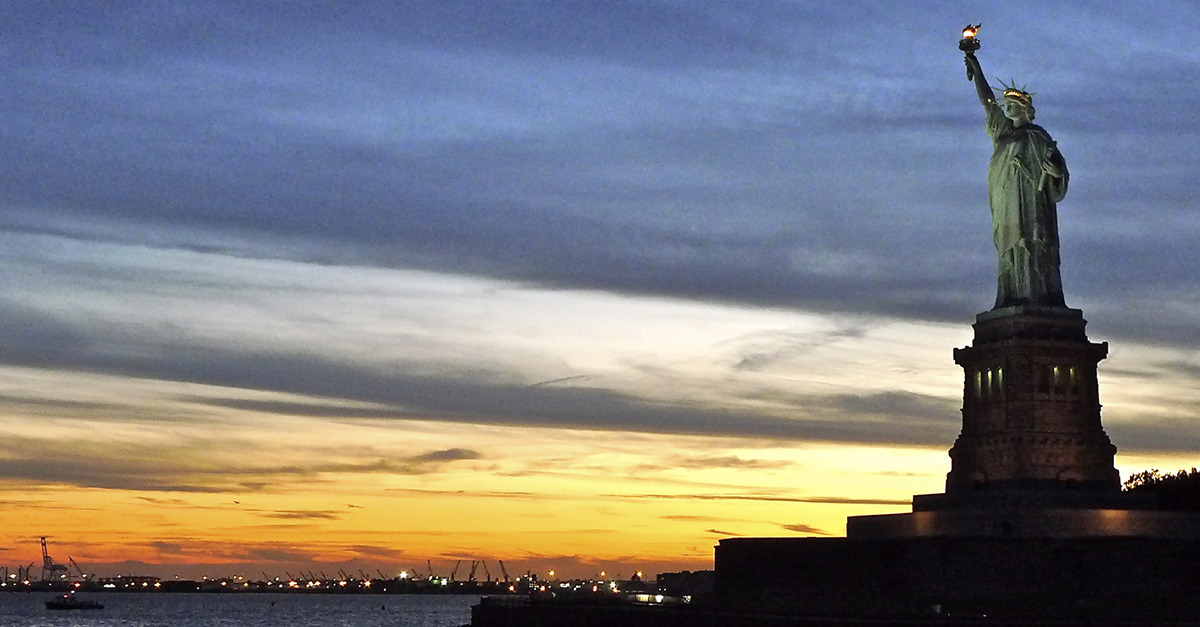
Lady Liberty is so famously green that it is easy to assume she was always meant to look that way. Her sea-green shade feels official, patriotic, and permanentlike the color was chosen by a committee of eagles.
The reality
The Statue of Liberty was originally copper-colored. When it was dedicated in 1886, its exterior copper skin had a reddish-brown metallic appearance. Over time, exposure to air, moisture, salt, and pollution caused the copper to oxidize and form the green patina we see today.
The green coating is not paint. It is a natural chemical layer that helps protect the copper underneath from further corrosion. The National Park Service explains that the statue’s copper developed its familiar green patina through oxidation. The American Chemical Society has also described the color change as a patina that formed over roughly two decades.
The twist: the “aging” became the icon
At one point, officials considered painting the statue. Public opinion and conservation understanding helped preserve the patina instead. That decision mattered. Without the natural green surface, the Statue of Liberty might look more like an enormous penny with excellent posture.
The myth reveals something important about landmarks: their meaning can grow through change. The Statue of Liberty’s color was not part of the original visual plan, yet it became inseparable from her identity. The patina is both chemistry and symbolisma visible sign of endurance, weathering, and protection.
Myth 5: The Leaning Tower of Pisa Was Built to Lean
The myth
The Leaning Tower of Pisa is so famous for leaning that many visitors assume the tilt was intentional. After all, why else would a tower lean so photogenically for centuries? Surely some medieval architect thought, “Let’s make the tourists pretend to hold it up someday.”
The reality
The Leaning Tower of Pisa was not designed to lean. Its tilt began during construction because of an unstable foundation and soft ground. Britannica notes that the lean became noticeable in the late 1170s after the first stories were built, caused by uneven settling in soft soil. Engineering sources also point to shallow foundations and unstable subsoil as the root of the problem.
Construction began in 1173 and stretched across nearly two centuries, interrupted by wars and political conflicts. Ironically, those long pauses may have helped the tower survive by allowing the ground beneath it to settle. Later builders tried to compensate for the tilt by adjusting upper levels, which is why the tower is not only leaning but subtly curved.
Why Pisa’s mistake became a masterpiece
The Tower of Pisa is a reminder that flaws can become identity. Of course, not every construction error turns into a UNESCO-worthy tourist attraction. Most just become expensive emails with the subject line “urgent structural review.” But Pisa’s tilt transformed an architectural problem into a global symbol.
Modern stabilization work has reduced the danger while preserving the lean. Engineers did not simply “fix” the tower by making it straight, because the tilt is now part of its cultural value. The goal became stability without erasing character. That balancebetween safety and authenticityis one of the great challenges of preserving famous landmarks.
What These Landmark Myths Teach Us
These famous landmark myths are not just trivia mistakes. They show how easily we turn complicated history into simple stories. A wall becomes visible from space. A temporary tower becomes eternal. A workforce becomes a stereotype. A chemical reaction becomes a design choice. A foundation failure becomes intentional genius.
The truth is usually less tidy, but it is richer. Real landmarks are shaped by ambition, accidents, politics, science, maintenance, climate, public opinion, and sometimes plain old luck. That is what makes them worth visiting. They are not perfect objects dropped into the world; they are ongoing stories made of stone, metal, labor, argument, and repair.
Travel Experiences: How to Enjoy Famous Landmarks Without Falling for the Myths
One of the best travel experiences you can have at a famous landmark is to arrive curious rather than already convinced. It is tempting to show up with a checklist: take the photo, repeat the famous fact, buy the magnet, move on. But landmarks reward people who slow down. The moment you stop treating them like background scenery, they start acting like time machines with better architecture.
At the Great Wall, for example, the best experience is not proving whether it can be seen from space. It is noticing how the wall follows ridgelines, disappears into hills, changes materials, and feels different depending on which section you visit. A restored section may feel grand and cinematic, while a wilder stretch can feel quiet, broken, and strangely intimate. The myth points upward to space; the real experience asks you to look down at the stones and outward at the terrain.
At the Eiffel Tower, the richest experience comes from remembering that people once disliked it. Stand beneath the iron lattice and imagine Paris without it. Imagine the tower as an argument, not an inevitability. That shift changes the visit. You are no longer just seeing a romantic symbol; you are seeing a structure that had to prove its right to remain. Suddenly, the bolts, beams, elevators, antennas, and observation platforms become part of the story.
At the pyramids, a myth-busting mindset helps visitors move beyond mystery for mystery’s sake. Yes, the pyramids are enormous and astonishing. But the human details are what make them unforgettable: workers’ settlements, food supply systems, stone transport, skilled crews, and generations of research trying to understand how it all came together. The experience becomes less about asking, “How could anyone do this?” and more about asking, “What kind of society could organize this?” That question is far more powerful.
At the Statue of Liberty, knowing the green color was not original makes the visit more vivid. You can picture the statue as copper-brown, bright against the harbor, then slowly transformed by weather and chemistry. The patina becomes a visible record of time. It is not just a color; it is the landmark aging into itself. That makes photos of Lady Liberty feel less like snapshots of a fixed icon and more like portraits of a living symbol.
At Pisa, the best experience is not the classic forced-perspective photothough yes, everyone deserves one ridiculous vacation picture. The deeper experience is understanding the tension between failure and survival. The tower leans because something went wrong, yet centuries of engineering and preservation have kept that wrongness from becoming disaster. Visitors are not just admiring a tilt. They are admiring a long negotiation between gravity, soil, architecture, and human stubbornness.
The smartest travelers collect better stories, not just better selfies. Before visiting any famous landmark, read one myth and one correction. Ask a guide what visitors usually misunderstand. Look for small museum displays, plaques, restoration notes, or construction details. These tiny pieces of context turn a crowded tourist stop into a layered experience. You still get the beautiful view, but you also get the satisfaction of knowing what you are actually looking at.
And perhaps that is the real magic of debunking landmark myths: it does not make the world less wonderful. It makes wonder more accurate. The truth does not shrink these places. It gives them depth, texture, and humanity. Famous landmarks do not need fake facts to be fascinating. They have survived wars, weather, bad reviews, engineering problems, chemical reactions, political changes, and billions of camera clicks. Honestly, that is much more impressive than any myth.
Conclusion
Famous landmarks become famous for good reasons, but the stories we tell about them are not always reliable. The Great Wall is not easily visible from space. The Eiffel Tower was not guaranteed a permanent place in Paris. The pyramids were not built according to the simplistic slave-labor myth. The Statue of Liberty was not designed green. The Leaning Tower of Pisa was not intentionally tilted.
Each correction makes the landmark more fascinating, not less. The real histories reveal science, labor, design, public debate, preservation, and the occasional construction mistake that accidentally becomes world-famous. So the next time someone drops a confident landmark “fact,” smile politely, adjust your imaginary tour-guide hat, and bring the truthwith just enough charm to avoid ruining dinner.

